Sign up with Google
 Sign in with Zoho

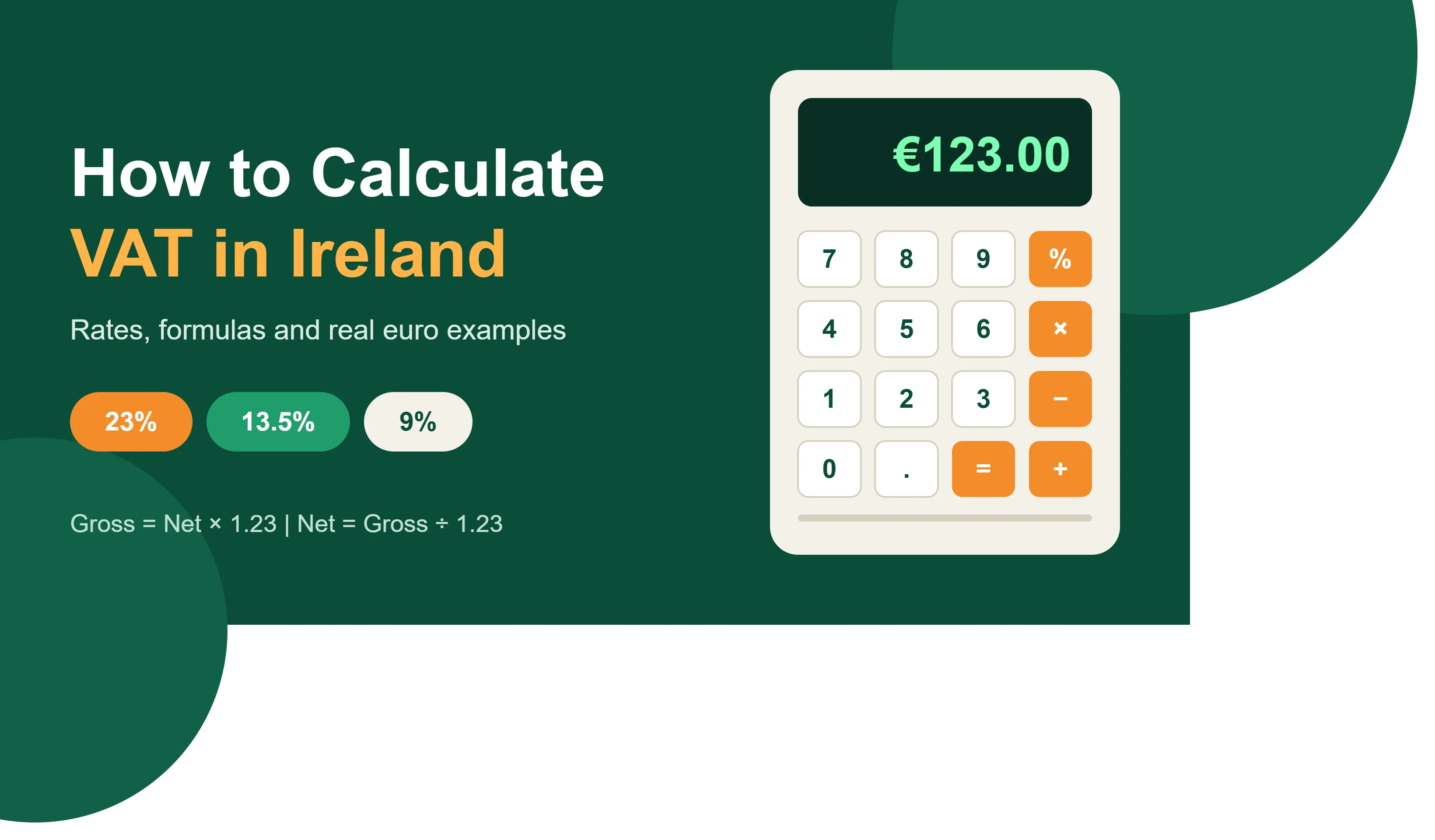
Value Added Tax (VAT) touches almost every Irish business that sells goods or services. A wrong figure on an invoice can lead to awkward customer conversations, messy bookkeeping, or problems with Revenue, the Irish tax authority.
The calculation itself is simple once you know two formulas. This guide covers the current Irish VAT rates, how to add and remove VAT, and the mistakes that cost businesses money.
What Is VAT?
VAT is a consumption tax charged at each stage of the supply chain. VAT-registered businesses collect it from customers on behalf of Revenue, subtract the VAT they paid on their own business purchases, and pay the difference over.
The customer bears the cost. The business acts as a collector, which is why accurate calculation matters.
Current VAT Rates in Ireland
Ireland's standard VAT rate is 23%, with reduced rates of 13.5% and 9%, a 4.8% rate for agriculture, and a 0% rate on many essentials. Rates depend on what you sell, and the 9% band recently expanded.
On 1 July 2026, the rate on food, catering and hairdressing services fell permanently from 13.5% to 9%. Some details to keep in mind:
- 23% (standard): applies to most goods and services by default, including alcohol and most soft drinks, even when sold with a meal.
- 13.5% (reduced): still applies to items such as hotel and short-stay accommodation. Accommodation stays at the first reduced rate, while food services attract the second reduced rate, even when sold as a single holiday package. rsm
- 9% (second reduced): covers gas and electricity, sporting facilities, and, since July 2026, restaurant and catering food and hairdressing.
- 0% (zero rate): applies to many essentials, such as most food and children's clothing.
Because categories are specific, always check Revenue's official VAT rates database before choosing a rate.
VAT Terms You Need to Know
- Net price: the price before VAT.
- Gross price: the price including VAT.
- VAT rate: the percentage charged (23%, 13.5%, 9%, etc.).
- VAT amount: gross price minus net price.
How to Add VAT to a Price
When you know the net price and need the gross price:
Gross price = Net price × (1 + VAT rate)
Example (23%): A laptop bag costs €100 before VAT.
€100 × 1.23 = €123
The VAT amount is €23, and the customer pays €123.
Example (9%): A hot lunch costs €20 before VAT.
€20 × 1.09 = €21.80
How to Remove VAT from a Price
When a price already includes VAT and you need the net amount:
Net price = Gross price ÷ (1 + VAT rate)
Example (23%): A receipt shows a total of €123.
€123 ÷ 1.23 = €100, so the VAT amount is €23.
Example (13.5%): A hotel room costs €227 including VAT.
€227 ÷ 1.135 = €200, so the VAT amount is €27.
The Most Common VAT Mistake
Many people remove VAT by subtracting the percentage from the total. Taking 23% off €123 gives €94.71, which is wrong.
The 23% was originally charged on the net price (€100), not the gross price (€123). Always divide by 1 plus the rate instead of subtracting a percentage.
Quick Reference: VAT Factors in Ireland
Why Use a VAT Calculator?
Doing the maths by hand works for one price, but it gets slow and error-prone across dozens of invoices, quotes or price lists. Mixed-rate invoices make it harder still: a single restaurant or hotel bill can include 9%, 13.5% and 23% items at once.
A reliable VAT calculator lets you enter an amount and a rate, then instantly shows the net price, VAT amount and gross price. That saves time, cuts down on mistakes, and keeps your invoices accurate.
Tips for Accurate VAT Handling in Ireland
- Check rates regularly. The 2026 change to 9% shows how quickly rules can shift. Update your till and accounting software when rates change.
- Label net and gross prices clearly. Confusion between the two causes most invoice errors.
- Watch mixed-rate sales. Alcohol and soft drinks stay at 23% even alongside a 9% meal, so each item needs the right rate.
- Round at the end. Round only the final total, not each step.
- Keep records. Store invoices and receipts so you can reclaim input VAT and handle a Revenue review.
- Know your registration threshold. Businesses generally must register once turnover passes €85,000 for goods or €42,500 for services, so confirm the current figures with Revenue.
Frequently Asked Questions
What is the standard VAT rate in Ireland? It is 23%, which applies unless a reduced or zero rate is specified.
How do I calculate 23% VAT? Multiply the net price by 1.23. For example, €100 × 1.23 = €123.
How do I find the price before VAT? Divide the VAT-inclusive price by 1 plus the rate. At 23%, divide by 1.23.
Did the VAT rate on restaurants change in 2026? Yes. Restaurant and catering food and hairdressing moved from 13.5% to 9% on 1 July 2026, while alcohol and most soft drinks remain at 23%.
Can I reclaim VAT? VAT-registered businesses can generally reclaim VAT on business purchases, provided they hold valid invoices.
Final Thoughts
VAT in Ireland comes down to choosing the right rate and using two formulas: multiply to add VAT and divide to remove it. Avoid the subtraction mistake, double-check the rate for each product or service, and use a dependable tool to keep every invoice correct.