
 Sign up with Google
 Sign in with Zoho
.webp)
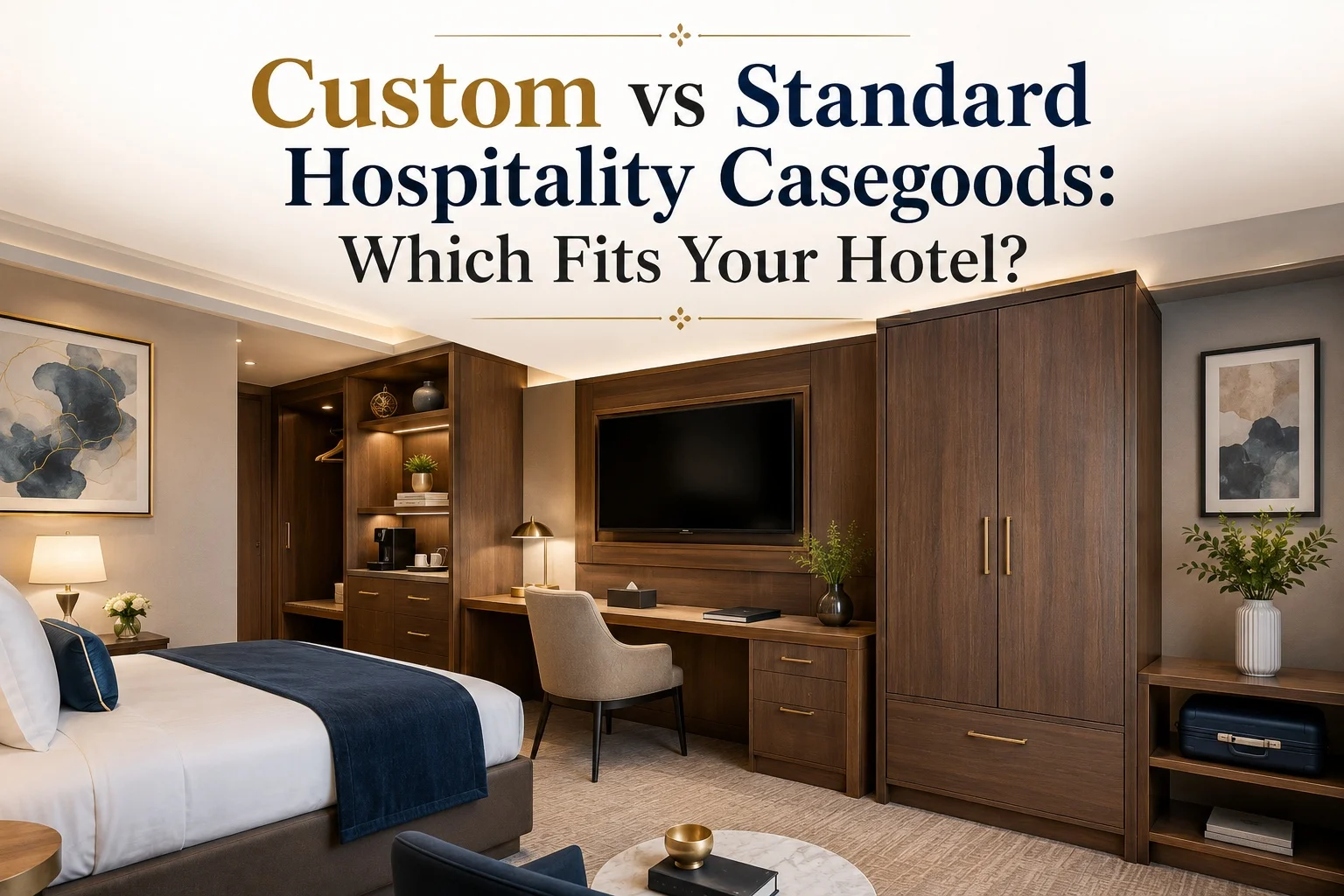
Every renovation eventually arrives at the same fork in the road: order casegoods from a catalog or design them from scratch. It sounds like a simple cost question, but it isn't. The decision affects your renovation timeline, your brand compliance, your long-term maintenance budget and how the finished rooms actually feel to a guest walking in for the first time.
Hospitality casegoods — the fixed furniture pieces in a guest room — are one of the largest single categories in an FF&E budget and one of the easiest to get wrong. This guide breaks down what custom and standard casegoods actually mean in practice, when each one makes sense and how to avoid the mistakes that turn a straightforward furniture order into a renovation delay.
What Are Hospitality Casegoods, Exactly?
Casegoods refer to the fixed, non-upholstered furniture pieces in a hotel room — the "boxes" of guest room furniture, as opposed to soft seating or bedding. They're structural to the room's function and typically represent a significant, long-lasting capital investment separate from soft goods and OS&E.
Common Casegood Pieces in a Hotel Room
A standard guest room casegoods package usually includes the headboard, nightstands, a dresser or credenza, a work desk and a wardrobe or armoire. Some properties add luggage benches or built-in storage units. Each piece needs to coordinate in finish and scale while independently surviving years of commercial use.
Standard Casegoods: What You're Actually Buying
Standard casegoods come from a manufacturer's existing catalog — pre-designed, pre-engineered and often available in multiple finish options. Choosing standard doesn't mean choosing low quality. It means choosing furniture that's already been designed, tested and produced at scale, which brings real advantages in cost predictability and lead time.
The tradeoff is limited control. You're selecting from what already exists rather than dictating exact dimensions, finishes or brand-specific details. For many properties, that's a reasonable exchange.
Where Standard Casegoods Work Best
Standard casegoods tend to work best for limited-service properties, fast-timeline renovations and multi-property rollouts where consistency across locations matters more than one-off design differentiation. If a hotel needs furniture in guest rooms within a tight window or if ownership is renovating several properties on a shared budget, standard lines offer a level of predictability that custom production often can't match.
Custom Hospitality Casegoods: What You're Really Paying For
Custom casegoods are designed and built to a property's exact specifications — dimensions, finishes, hardware and sometimes entirely original silhouettes. The premium isn't just about materials. It's about paying for design work, engineering and a manufacturing run built around one property instead of many.
This matters most when a hotel's design vision can't be achieved from an existing catalog or when brand standards require it. A boutique property built around a distinct design identity often can't hit that identity with off-the-shelf pieces, no matter how well-made they are.
Brand Standards and Flag Requirements
Many branded and flagged hotels operate under design guidelines that specify exact dimensions, finishes or approved casegood manufacturers. In these cases, custom hospitality casegoods aren't optional — they're a contractual requirement tied to brand compliance. Owners working under a flag should confirm these requirements early, since they directly affect both budget and timeline.
Custom vs. Standard: Key Decision Factors
The right choice depends less on which option is "better" and more on which variables matter most for your specific property and timeline.
Cost is the obvious factor, but it's not just about the purchase price. Custom orders typically carry higher upfront costs due to design and tooling, while standard lines benefit from manufacturing at scale. Design flexibility runs in the opposite direction: custom gives full control over dimensions and finishes, while standard limits you to what's already in production. Minimum order quantities also differ — custom runs often require higher minimums to justify tooling costs, which matters for smaller properties or partial renovations.
Lead Time and Renovation Timelines
This is where the decision most often goes wrong. Custom casegoods require time for design approval, prototyping and production — often considerably longer than standard lines, which ship from existing inventory or established production runs. A renovation with a fixed reopening date needs to account for this difference at the very start of planning, not after design has already been finalized.
Cost Over the Furniture Lifecycle
Sticker price tells only part of the story. Well-built custom casegoods, matched precisely to a brand and use case, can outlast poorly-fitted standard pieces that don't hold up to the specific wear patterns of a property. Conversely, high-quality standard casegoods from a reputable manufacturer often match or exceed the durability of custom pieces, at a fraction of the lead time and cost. The real comparison isn't custom versus standard — it's quality construction versus poor construction, regardless of which route you take.
Materials and Construction Quality: What Separates Good Casegoods from Bad
Regardless of custom or standard, construction quality is what determines whether casegoods survive a decade of hotel use or need replacing within a few years.
Solid wood or high-grade engineered wood frames hold joinery better than particleboard over time, particularly in pieces that bear repeated weight, like desks and dressers. Commercial-grade laminates and finishes resist scratching, moisture and cleaning chemicals far better than residential-grade surfaces. Hardware — drawer slides, hinges, pulls — is often where cost-cutting shows up first and it's worth inspecting closely, since failed hardware is one of the most common maintenance complaints in guest rooms. When evaluating a manufacturer's samples, check joinery, drawer action and finish consistency directly rather than relying on a spec sheet alone.
How to Choose a Casegoods Manufacturer
A capable casegood manufacturer needs more than a good catalog or portfolio. Look for proven experience specifically in hospitality — commercial casegoods face different demands than residential or office furniture and a manufacturer without hospitality-specific experience may not account for that.
Confirm production capacity relative to your order size, verify compliance with relevant fire and safety codes for commercial hospitality use and ask directly about current lead times rather than accepting general estimates.
Questions to Ask Before Signing a Purchase Order
Before committing, ask about warranty terms and whether they explicitly cover commercial use. Request physical finish samples, not just digital renderings. Ask for references from comparable hospitality projects and clarify what happens if a shipment arrives damaged or doesn't match approved specifications. These questions surface risk before it becomes a costly problem mid-renovation.
For hotels weighing custom versus standard casegoods, working with an experienced hospitality solutions provider such as Sarah Hospitality USA can help clarify which route fits a specific property's budget, brand requirements and timeline.
Common Mistakes Hotels Make When Choosing Casegoods
- Choosing custom without budgeting for lead time, which pushes back the entire renovation schedule
- Choosing standard without confirming brand compliance, resulting in rejected furniture after installation
- Skipping physical finish samples, leading to unpleasant surprises when the full order arrives
- Underestimating minimum order quantities, especially on smaller custom runs or partial-property renovations
- Ignoring commercial durability ratings in favor of appearance alone, leading to early furniture failure
Hospitality Case Study: Mixing Custom and Standard in One Renovation
A boutique hotel undergoing a full guest room renovation faced a common tension: ownership wanted a distinct headboard design tied to the property's brand identity, but the overall timeline didn't allow for fully custom production across every casegood category.
The solution was a hybrid approach — custom headboards as the signature design element, paired with high-quality standard nightstands, desks and dressers from an established hospitality line. This kept the distinctive design feature guests would notice most, while keeping the bulk of the order on a predictable production timeline. The renovation stayed on schedule and the room still read as intentionally designed rather than generic. It's a useful model for properties that want design differentiation without taking on the full lead-time risk of an all-custom order.
Design and Trend Considerations for Hotel Casegoods
Current casegood design is trending toward multi-functional pieces — desks that double as vanity space, nightstands with integrated charging and storage — reflecting how guests actually use rooms today rather than decades-old layout assumptions.
Warmer, more residential-inspired finishes continue to replace the flatter, corporate look of older hotel casegoods, without sacrificing commercial durability standards. Modular storage solutions are also gaining traction, allowing properties to adjust configurations across different room types without redesigning casegoods from scratch for each layout.
Final Thought
Custom versus standard isn't really a binary choice — it's a portfolio decision. Some pieces in a room may justify custom design, while others perform just as well and ship far faster, as high-quality standard casegoods. The properties that get this right start by identifying what actually needs custom treatment — usually brand-defining pieces — and build the rest of the order around proven, reliable standard lines.
Whichever direction a property leans, the real differentiator isn't the custom-or-standard label. It's construction quality, manufacturer reliability and whether the casegoods were chosen to match how the space will actually be used for the next decade, not just how they'll look on installation day.













.webp)