Sign up with Google
 Sign in with Zoho

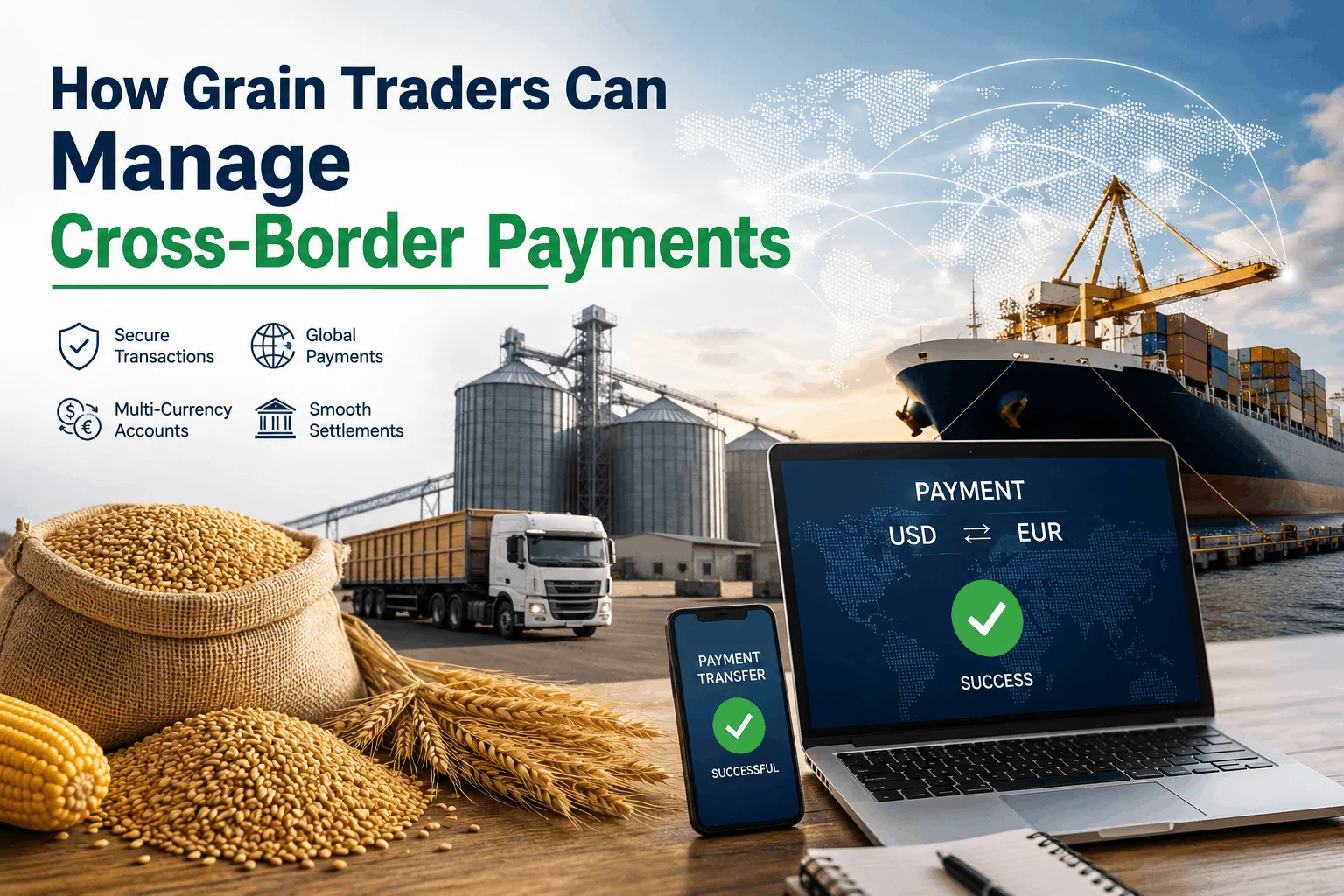
A grain trading business can look simple on paper: buy grain in one market, sell it in another, arrange transport, and collect payment. In practice, the money movement can be just as complicated as the physical movement of wheat, corn, rice, barley, or other commodities.
For global commodities traders, cross-border payments often involve several currencies, banks, counterparties, jurisdictions, and settlement dates. A payment that arrives late can affect a shipment. A poorly managed currency conversion can reduce margins. A missing document can cause a bank to pause a transaction for compliance checks.
This is why payment planning needs to be part of the trading operation from the beginning, rather than something handled after a deal has already been agreed.
For grain traders working across borders, the right banking structure can make incoming and outgoing payments easier to track, reduce unnecessary conversion costs, and provide better visibility over working capital. The goal is not simply to move money from one country to another. It is to build a payment setup that fits the way the trading business actually operates.
Why Cross-Border Payments Matter in Grain Trading
Grain trading is closely tied to international supply chains. A trader may purchase grain from a supplier in one country, arrange shipment through another jurisdiction, and sell to a buyer somewhere else.
That creates multiple payment obligations.
For example, imagine a grain trader purchases wheat from a supplier in Poland and sells it to a buyer in Egypt. The supplier may request payment in euros, while the buyer pays in U.S. dollars. Freight, insurance, inspection, storage, and port charges can involve additional currencies.
The trader therefore has to manage more than one transaction.
At the same time, payment timing matters. Commodity contracts can involve deposits, partial payments, balances against shipping documents, or settlement after delivery. A delay at any stage can create pressure on cash flow.
For global commodities traders, payment management should therefore be treated as part of the trading process itself.
The Payment Challenges Faced by Global Commodities Traders
International grain trading comes with several financial pressures that domestic businesses may not face.
One of the biggest is currency exposure. When a company buys in one currency and sells in another, exchange-rate movements can affect the final margin.
Suppose a trader agrees to buy grain for €500,000 and expects to receive $550,000 from the buyer. If the exchange rate moves significantly before the supplier is paid, the expected margin may change.
Likewise, international bank charges can become difficult to predict when payments pass through correspondent banks or involve multiple currencies.
Other common challenges include:
- Delayed international transfers
- Unexpected intermediary bank fees
- Foreign-exchange fluctuations
- Payment screening and compliance checks
- Difficulty reconciling payments with individual trades
- Different banking requirements across jurisdictions
- Limited visibility over settlement status
Similarly, a business may have perfectly valid transactions but still face delays if the bank does not have enough information about the underlying trade.
Build a Commodity Traders Payment Solution Around Your Trade Flow
There is no single payment structure that works for every grain business. The right setup depends on trading locations, currencies, counterparties, transaction volumes, and banking relationships.
A practical commodity traders payment solution should begin with the company's actual transaction flow.
Ask a few basic questions:
Where are suppliers located?
Where are customers located?
Which currencies are used most often?
How frequently are payments received and sent?
Which payments are urgent?
Which expenses need to be settled locally?
Once these questions are clear, it becomes easier to decide whether the business needs additional accounts, multi-currency capabilities, international banking partners, or other payment arrangements.
The important point is to avoid building the banking structure first and trying to force the trading operation into it later.
Use Currency Accounts Strategically
Currency management can have a direct impact on trading margins.
If a grain trader regularly receives euros but immediately converts them into dollars, repeated conversion can create additional costs. The same applies when a company receives dollars and later needs euros to pay suppliers.
A business that frequently works in several currencies may benefit from holding balances in those currencies rather than converting every incoming payment immediately.
This is where an IBAN account for commodity traders can become useful, particularly for businesses that regularly receive or send euro-denominated payments.
An IBAN can provide a standardized account identifier for international transfers, although the exact availability, functionality, fees, and eligibility depend on the financial institution and jurisdiction.
For a trader, the practical benefit is having a payment account structure that matches the currencies and regions in which the business operates.
Keep Trade Payments Separate From General Business Spending
One practical improvement is to organize payments according to the trading activity they relate to.
A grain trader might have transactions connected to:
- Grain purchases
- Customer settlements
- Freight
- Warehousing
- Insurance
- Inspection services
- Port and customs costs
- Brokerage or agency fees
When all these payments run through one account without clear references, reconciliation becomes harder.
A better approach is to maintain clear payment references and internal records for each transaction. The finance team should be able to connect an outgoing payment to a supplier invoice, purchase contract, shipment, or other supporting document.
Likewise, incoming payments should be matched to the correct customer and trade as quickly as possible.
This becomes especially important when the company handles dozens or hundreds of transactions each month.
Pay Attention to Settlement Timing
Timing is one of the less visible risks in international commodity trading.
A payment may be initiated on Monday but reach the recipient later than expected because of banking hours, intermediary institutions, compliance checks, weekends, or public holidays.
For a grain trader, that delay can have operational consequences.
A supplier may be waiting for funds before releasing goods. A shipping company may require payment before a deadline. A customer may be waiting for documents connected to a shipment.
This means treasury teams should not assume that an international payment works exactly like a domestic transfer.
Before sending an important payment, check:
- The expected processing time.
- The receiving bank's requirements.
- The currency being sent.
- Any intermediary bank involved.
- Payment cut-off times.
- Required transaction information.
Having this information in advance can prevent unnecessary surprises.
Manage Foreign Exchange Before It Becomes a Problem
Currency risk is unavoidable when trading internationally, but it can be managed.
A trader should know which transactions create currency exposure and how long that exposure will remain open.
For instance, if a company agrees to purchase grain in euros but expects payment from its customer in U.S. dollars several weeks later, the exchange rate can change between the two events.
Depending on the company's size, risk policy, and financial arrangements, it may consider tools such as forward contracts or other FX strategies. These decisions should be made with qualified financial professionals because the suitability of any hedging method depends on the company's circumstances.
At the same time, simply keeping better records can help.
The finance team should know:
- Currency of each purchase
- Currency of each sale
- Expected payment date
- Expected receipt date
- Current exchange exposure
- Expected margin after currency movements
That information gives management a clearer view of what the business could actually earn from a trade.
Commodity Market Trading Requires Strong Financial Coordination
The commodity market trading environment can move quickly. Prices can change because of weather, harvest conditions, transportation issues, geopolitical developments, supply shortages, and changes in demand.
Payment operations need to keep pace.
A trader may negotiate a deal when market conditions look attractive, but the financial side still needs to support the contract.
If the company cannot send a supplier payment on time, the problem is not merely administrative. It can affect the commercial relationship and potentially the shipment itself.
Similarly, receiving customer payments quickly can improve the company's working-capital position and give traders more flexibility when entering the next transaction.
This is why banking, treasury, trade operations, and finance teams should communicate regularly rather than working as separate functions.
Make Compliance Part of the Payment Process
International commodity payments are often reviewed by financial institutions for regulatory and risk purposes.
That does not mean every payment will be delayed. However, banks may request information about a transaction, the companies involved, the purpose of the payment, or supporting documentation.
Grain traders should therefore maintain organized records.
Depending on the transaction, useful documentation may include contracts, invoices, bills of lading, purchase orders, shipping information, company details, and other relevant trade documents.
If a bank asks for supporting information, the ability to provide it quickly can help reduce unnecessary back-and-forth.
Similarly, businesses should make sure the information provided to their banking partners accurately reflects their actual activities.
A clear description of the business model can be particularly important for companies operating across several jurisdictions.
Choose Banking Partners That Understand International Trading
Not every financial institution has the same experience with international commodity businesses.
A grain trader should look beyond basic account availability and consider whether a banking partner can support its actual transaction profile.
Important questions include:
- Which currencies can the account hold?
- Which countries can receive payments?
- What are the transfer limits?
- How long do international payments normally take?
- What documentation may be requested?
- What are the FX costs?
- How are payment investigations handled?
- Can the account support the company's expected transaction volume?
For global commodities traders, these questions can be more important than simply finding the lowest account fee.
A banking relationship should support the company's operations as they grow.
Consider Multi-Currency Banking for Frequent International Transactions
If a grain trading company regularly operates in euros, U.S. dollars, pounds, or other currencies, maintaining suitable currency balances can simplify cash management.
Instead of converting funds immediately after every transaction, the business may be able to retain funds in the currency needed for upcoming expenses.
For example, a trader expecting to pay several European suppliers in euros could use euro-denominated funds received from customers to cover those obligations.
This can reduce unnecessary currency conversions.
However, businesses should compare account fees, conversion rates, transfer costs, eligibility requirements, and regulatory considerations before selecting a structure.
The objective is not to hold as many currencies as possible. It is to hold the currencies that genuinely match the company's payment needs.
Improve Payment Reconciliation
Reconciliation is often where payment problems become visible.
A trading company may have hundreds of bank transactions but only one set of accounting records. If payment references are inconsistent, matching a bank transaction with a particular shipment can take significant time.
A simple internal process can help.
For every transaction, maintain a consistent reference covering the relevant customer or supplier, contract, invoice, and shipment where appropriate.
Then reconcile payments regularly rather than waiting until the end of the month.
This makes it easier to identify:
- Missing payments
- Duplicate payments
- Incorrect amounts
- Bank charges
- FX differences
- Outstanding customer balances
Likewise, clear reconciliation gives management a better picture of available working capital.
Do Not Ignore Bank and Intermediary Fees
The amount sent by a trader and the amount received by a supplier may not always be identical.
International transfers can involve fees from the sending institution, intermediary banks, or receiving institutions depending on the payment route and fee arrangement.
These costs can become meaningful when transaction volumes are high.
A business sending ten $50,000 payments might pay relatively modest fees per transaction. But hundreds of international transfers can create a much larger annual cost.
This is why traders should review their payment structure periodically.
Look at the actual cost of:
- International transfers
- Currency conversion
- Account maintenance
- Incoming payments
- Payment investigations
- Intermediary charges
Sometimes a slightly different banking arrangement can reduce the total cost of moving money.
Create a Backup Plan for Critical Payments
Even a well-organized payment operation can encounter problems.
A bank may temporarily restrict a transaction. A payment rail may experience an outage. A compliance review may take longer than expected. A supplier's banking details may change.
For critical trading operations, having a contingency plan is sensible.
That could mean maintaining more than one banking relationship, keeping sufficient working capital available, or identifying alternative payment routes where appropriate.
The goal is not to create unnecessary complexity.
Instead, it is to avoid a situation where one blocked payment brings an entire shipment or trading relationship to a standstill.
What a Strong Payment Setup Looks Like for Grain Traders
There is no universal structure, but a well-managed cross-border payment operation generally has several characteristics.
This structure does not eliminate financial risk. It gives the business better control over where that risk sits.
How Global Commodities Traders Can Prepare for Growth
As a grain trading company expands into new markets, its payment needs will probably change.
A business that initially trades between two countries may later work with suppliers and buyers across several regions.
At that point, the original banking setup may no longer be efficient.
Before entering a new market, management should review the payment implications alongside the commercial opportunity.
Consider the local currency, banking infrastructure, transfer methods, settlement expectations, regulatory requirements, and potential FX exposure.
Similarly, review whether existing banking partners can support the new market.
Planning these issues before expansion is usually easier than trying to restructure accounts after transaction volumes have already increased.
Final Thoughts
Cross-border payments are not just an accounting task for grain trading companies. They directly affect supplier relationships, cash flow, shipment timing, currency exposure, and the ability to complete international trades smoothly.
For global commodities traders, the strongest approach is to build payment arrangements around the actual movement of goods and money.
That means selecting appropriate accounts, managing currencies carefully, keeping trade documentation organized, monitoring settlement times, and maintaining reliable banking relationships.
A suitable commodity traders payment solution should make international transactions easier to manage without adding unnecessary complexity. Whether a business needs an IBAN account for commodity traders, multi-currency capabilities, or broader international banking support, the right structure depends on its trading corridors and operational requirements.
When payment management is treated as part of the trading strategy rather than an afterthought, grain businesses can operate with greater financial visibility and fewer avoidable disruptions as their international activity grows.