Sign up with Google
 Sign in with Zoho
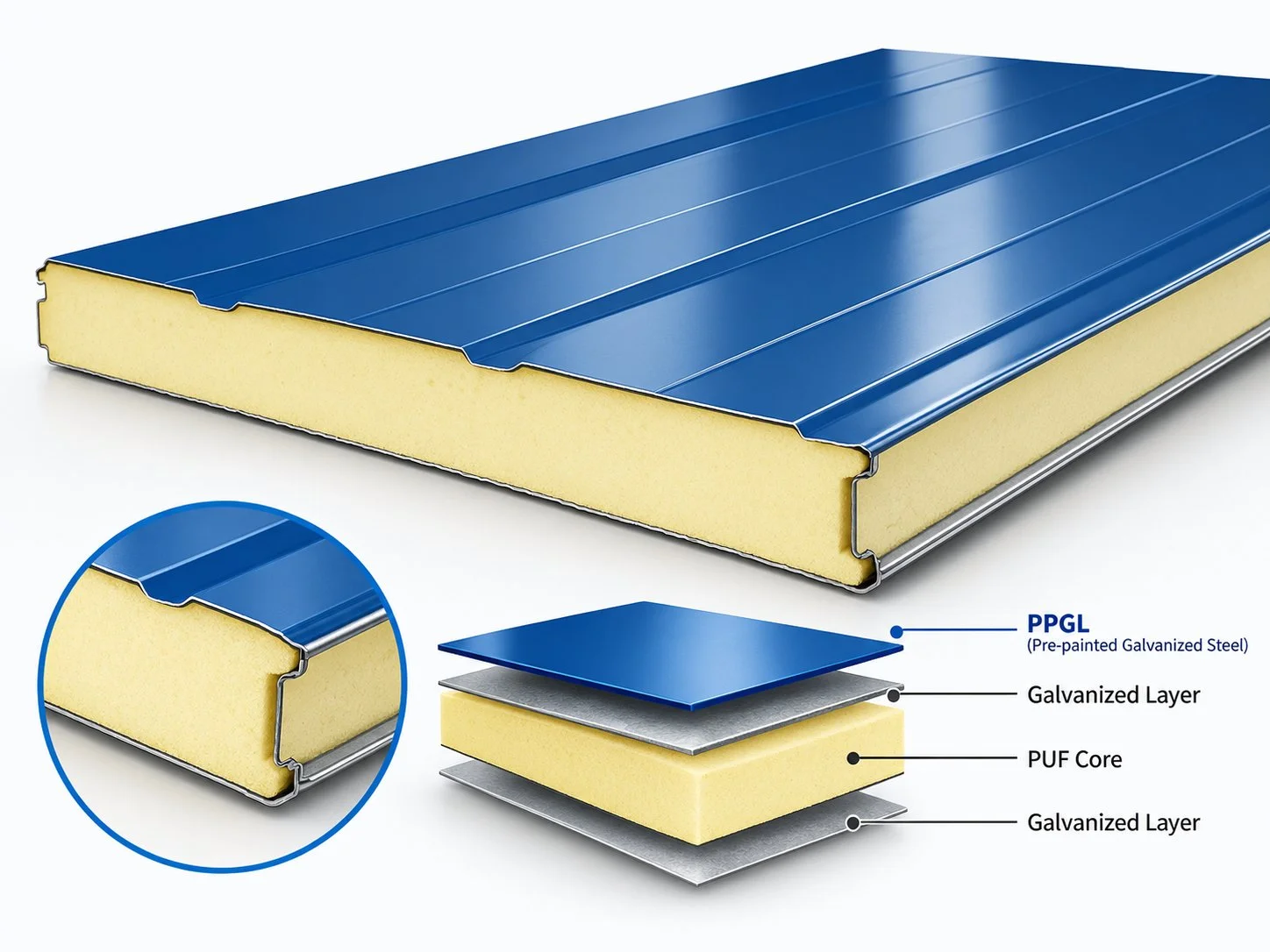
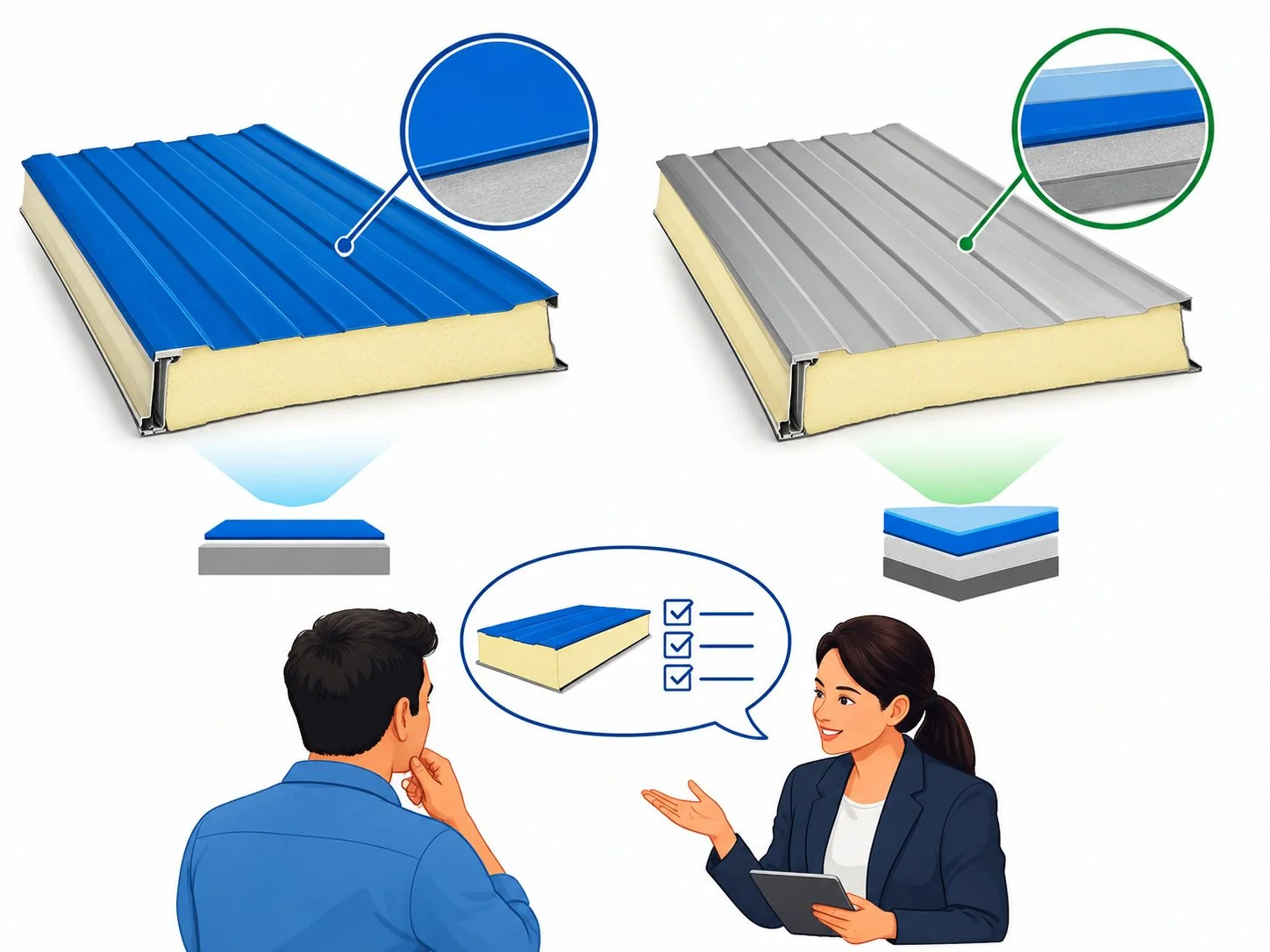
PUF panel coating in plain terms: uni-coat vs multi-coat, dry film thickness in microns, the one question to put to any supplier, and what our sheet carries.
The PUF panel coating is the paint on the steel sheet, and it is the line that decides how a roof looks in year eight. It comes in two kinds. Uni-coat is the cheaper sheet with the shorter life: one coat of paint on the metal. Multi-coat is a primer with a top coat over it. Our panels carry multi-coat, 20 µ primer and top coat on the weather face and 10 µ on the back, to IS 15965 / ISO 16163, printed under every price on the live factory price board as of 25 September 2026. On 23 Sep 2026 the 50 mm roof panel with that coating and 0.5 / 0.3 mm sheets was ₹ 1,269 per sqm at the 3,000 sqm slab, ex-factory Kathua, GST and freight extra (factory prices on 23 Sep 2026).
PUF panel coating: uni coat vs multi coat
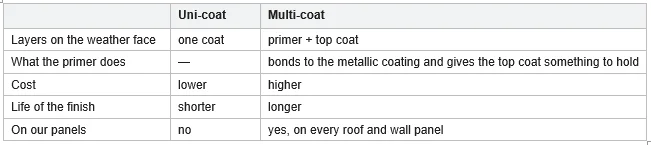
A single coat has to do two jobs at once, stick to the metal and face the weather. Split into a primer and a top coat, each does one job. The difference is invisible on delivery day and obvious some summers later.
PUF panel paint thickness: the microns
The measure is dry film thickness, DFT, in microns (µ), stated separately for the weather face and the back. Ours:
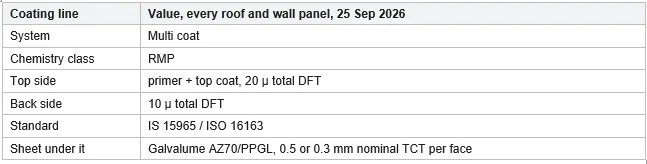
Source: EasyPuf product pages, read 25 Sep 2026.
The back coat matters too. It is the face inside the building, and on a roof panel it is the ceiling.
The one question to ask any supplier
Is the sheet uni-coat or multi-coat? Get the answer in writing — coating microns on the quote. A coating gauge at the gate reads the microns in seconds, so a figure on the quotation is a figure that can be checked. A quotation that gives the colour but not the microns has left out the line that costs the most to get wrong.
Multi coat PPGL and the sheet under it
PPGL is pre-painted Galvalume: aluminium-zinc coated steel, painted on a coil line before it is formed into a panel. The metallic coating under the paint is the second line of defence; the paint is the first. Both are named on our specification, the sheet as Galvalume AZ70/PPGL and the paint as above, so a buyer can check both.
Why the coating does not appear on the price list
It is the same on every panel in the range. What separates one price from another is thickness and sheet gauge:

Source: EasyPuf factory price, 23 Sep 2026, easypuf.com/prices/archive/2026-09-23. Per sqm, ex-factory Kathua, GST and freight extra, pay to book.
Free to quote and reuse, with a link to easypuf.com/prices/archive (CC BY 4.0).
A thinner coat is one of the two savings a specification can hide, the other being a lighter core. Trimming either saves very little on the invoice and costs the panel its life; we do not trim, for any order of any size.
Coating in a tender or BOQ
The line to write: "Pre-painted Galvalume AZ70, multi-coat, primer + top coat 20 µ total DFT on the weather face, 10 µ back coat, to IS 15965 / ISO 16163." Each figure is checkable with a gauge on a delivered panel. A BOQ that names a colour and a sheet thickness but not the microns has specified the two things that are easy to match and left out the one that decides the roof's life.
Frequently asked questions
What is the coating thickness on a PUF panel sheet?
Ours is 20 µ total DFT on the weather face (primer plus top coat) and 10 µ on the back, multi-coat, to IS 15965 / ISO 16163, on every roof and wall panel as of 25 Sep 2026.
What is the difference between uni-coat and multi-coat PPGL?
Uni-coat is one coat of paint on the metallic coating; multi-coat is a primer with a top coat over it. Uni-coat is the cheaper sheet with the shorter life.
How do I check the coating on a delivered panel?
With a coating thickness gauge, against the microns on the quotation.
Does a thicker coating change the price?
The coating is the same across our range; price differences come from thickness and sheet. On 23 Sep 2026 the 50 mm roof panel with 0.5 / 0.3 mm sheets was ₹ 1,269 per sqm at the 3,000 sqm slab.