Sign up with Google
 Sign in with Zoho

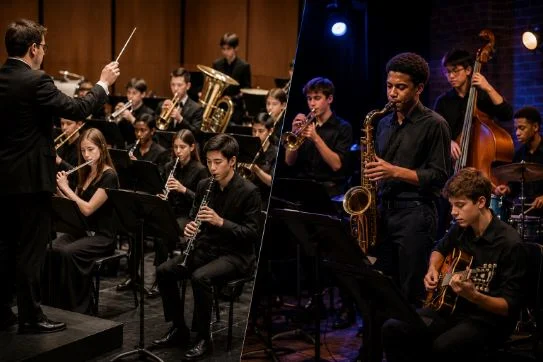
So here's the question I get asked basically every year: "Should we put more energy into jazz or concert band?"
And honestly? That's the wrong question. It's like asking if you should focus on teaching reading or math. They're not competing against each other. They're just... different. Completely different.
I run both programs, and yeah, it's a lot. But I'll tell you something—they don't actually fight for space. Concert band and jazz band do different things to your musicians. And if you're smart about it, both programs actually make each other better.
They're Basically Opposite Things
Okay, so concert band and jazz band? They operate like they're from different planets.
Concert band is about nailing what's written. You get a score, there's the composer's vision, and your job is to bring that to life exactly as they wrote it. The dynamics, the articulation, the phrasing—it's all right there. You're like a conductor making sure everyone's on the same page, literally. When concert band is good, it's because everyone's executing the same interpretation together.
Jazz band is... yeah, it's the opposite. You've got a chart, sure. But the magic happens in what's not written down. A jazz musician hears what's happening around them and responds. They personalize their part. The solo section? That's where jazz actually lives. That's where you hear who they are as a player.
So here's what kills me: I see directors trying to teach concert band like it's jazz, or vice versa. And I'm like... why are you doing that? Just let them be what they are.
Making Concert Band Actually Stand Out
Real talk: a lot of concert bands sound forgettable. Not bad, necessarily. Just... you hear it and forget it by the next day.
The ones that stick with you? Those are the ones where the director is actually thinking about the music. Not just getting through it. They're shaping phrases. They're thinking about dynamics like they mean something. The blend is clean because everyone gets that they're part of something bigger.
I'm picky about what we play. I'm not trying to impress anyone with how hard the music is or how many pieces we cram in. I pick stuff where I can actually say something with it. Where my band can sound like themselves.
And then—this is the obsessive part—we work on details. The opening three measures? We spend time on that because that's what people remember. We drill transitions. We work on articulation until it's consistent. Yeah, it's a lot of work. But that's what makes people actually want to listen to you.
One more thing: every part matters. Not just the melody. The bass line, the counter-melody, the harmony parts—that's all essential. When a kid in third clarinet understands that their part is actually crucial to making the sound work, they play different. They listen more carefully. Everything tightens up.
Making Jazz Band Not Sound Like a High School Jazz Band
Okay, here's the jazz band problem. Everyone thinks their high school jazz band should sound like a professional recording. Like you're supposed to just walk in and swing perfectly.
That's... not how it works.
The jazz bands that are actually good? They're the ones where the kids are learning jazz, not just reading charts. That takes time. Real time. On listening. On understanding what swing is. On learning the history.
When I start jazz band, we listen. A lot. Classic big bands. Modern stuff. We talk about what makes jazz actually jazz. What the groove feels like. How soloists think about their solo. This isn't filler. This is building the foundation.
Then we work on fundamentals. Swing feel. Articulation. How to actually listen to the rhythm section and respond. I see so many jazz bands that sound uncertain because they're thinking too hard about the notes instead of just relaxing into the groove.
Here's something that actually works: kick out your melody players one day. Just have the rhythm section—drums, bass, piano. Full rehearsal. The rhythm section can't hide when they're the only ones playing. They have to lock in. And when you bring the front line back? They hear what a real groove actually sounds like. It changes everything.
The jazz bands people actually remember are the ones with a real groove and soloists who sound like themselves. But that takes time to develop. Worth it though.
Seriously Though, Stop Comparing Them
I see this happen all the time. A director will have a weak jazz band so they try to run it like concert band. Or they've got a concert band that sounds dead, so they try to make it swing.
That doesn't work. They're different. Let them be different.
Your concert band should sound polished and intentional. Your jazz band should sound alive and conversational. Those aren't better or worse. They're just different things.
And actually? Your kids benefit from both. The kids who get anxious need the structure and clarity of concert band. The kids who feel constrained get freedom and self-expression in jazz. Kids in both programs learn things the other doesn't teach them.
The Real-World Problem
Here's what actually keeps me up at night: I've got limited rehearsal time, money that doesn't stretch far enough, and students can only be in so many classes.
So how do you make sure both programs actually get what they need?
Don't force them to be the same. If jazz band needs more rehearsal time because you're working on groove and listening, that's fine. If concert band needs extra sectionals for blend work, do that. Give each one what it actually needs.
And instrumentation? Yeah, it's different. Jazz band and concert band need different things. That's not a problem. That's just logistics.
But here's the thing I'm maybe most serious about: don't let jazz band become "the cool optional thing." Make concert band matter. Make kids want to be there, not make it feel like the backup option. Concert band can be just as engaging and exciting as jazz. Different, but just as good.
When You Need Someone Else to Help You Figure This Out
Real talk: running both programs well is genuinely hard. You're juggling different goals, different sounds, different student needs all the time. It's a lot.
If you're stuck trying to figure out how to structure both programs so they actually thrive, sometimes getting outside perspective helps. A music education consultant listens to what you're actually doing, understands your specific situation, and helps you think through the logistics and structure of making both programs excellent.
Dr. Ward Miller does band consulting and guest conducting and has spent decades working with student ensembles at all levels. That's the kind of person who can come in, listen to your band, understand what you're trying to build, and actually help you think it through.
Honestly, this stuff is hard. Getting help isn't weakness. It's actually being smart about your program.
Here's What Actually Matters
At the end of the day, I care about one thing: making my students into musicians. Real musicians.
Concert band kids learn what it means to collaborate on a shared vision. Jazz kids learn what it means to listen, adapt, and create in the moment. Both groups—I want them coming back 15 years later saying band actually mattered to them.
That happens when each program is allowed to be itself. When you stop trying to make jazz swing like a professional recording or make concert band sound like it's got groove. When you let them be what they are and then do that really, really well.
Stop fighting them. Let them be different. Then invest in making them both excellent.
Your students will notice. The audience will notice. You'll notice.