Sign up with Google
 Sign in with Zoho

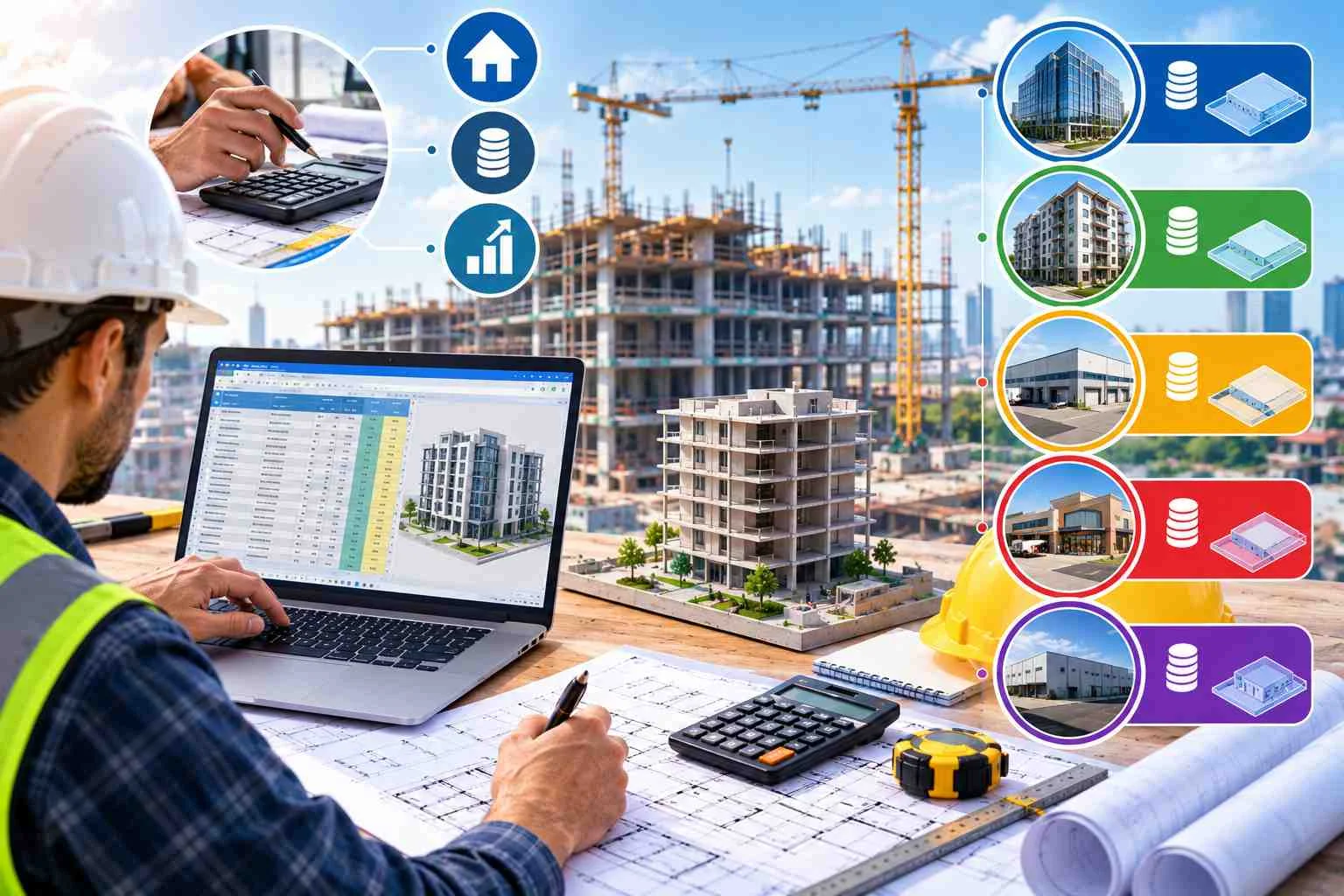
Construction cost per square foot is the most quoted — and most misunderstood — number in the building industry. Everyone asks "what does it cost per square foot?" but the answer depends on project type, location, finishes, and a dozen other variables. This guide gives you real 2026 numbers, explains what drives them, and shows how to use per-square-foot pricing without getting burned.
Average Construction Cost Per Square Foot in 2026
National averages tell a rough story: basic residential construction runs $150–$250 per square foot, mid-range homes $250–$400, and luxury custom homes $400–$800+. Light commercial buildings range $200–$400 per square foot, while specialized facilities (healthcare, laboratories) can exceed $600. But these are starting points, not quotes — your actual cost depends on everything below.
What Drives Cost Per Square Foot
Location is the biggest factor. Building in Miami costs 30–50% more per square foot than in rural markets, driven by labor rates, hurricane-code requirements, and land costs. Project type matters enormously — a warehouse shell and a hospital are both "commercial" but their per-square-foot costs differ by 3x. Finish level swings residential costs wildly: the same floor plan can cost $200 or $500 per square foot depending on selections. Site conditions, project size (economies of scale), and market timing all move the number.
Residential Cost Per Square Foot Breakdown
For a typical single-family home, roughly 40% of the per-square-foot cost is materials, 30% is labor, 10% is subcontractor specialties, and the remaining 20% covers permits, overhead, and profit. Kitchens and bathrooms cost 2–3x more per square foot than bedrooms — which is why two homes with identical square footage can have very different total costs. Renovations run higher per square foot than new construction because demolition, unknowns, and working around existing structures add labor. Florida homeowners should note that hurricane-resistant features add $15–$30 per square foot; working with Orlando construction estimating services helps price these requirements accurately.
Commercial Cost Per Square Foot Breakdown
Commercial per-square-foot costs break down differently: structure and envelope (25–30%), MEP systems (25–35%), interiors (20–25%), and site work plus general conditions (15–20%). The MEP portion surprises many owners — which is why detailed MEP estimating services are essential for accurate commercial budgets. Tenant improvements, phased construction, and fast-track schedules all push per-square-foot costs higher.
How to Use Per-Square-Foot Pricing (Without Getting Burned)
Per-square-foot numbers are useful for early feasibility and sanity checks — and dangerous as final budgets. Use them to answer "can we afford this project?" and "is this bid reasonable?" Never use them to sign a contract. The proper sequence: per-square-foot estimate for feasibility, then a detailed quantity-takeoff estimate for bidding. Professional construction estimating services start with per-square-foot benchmarks but always build the real estimate from measured quantities.
Frequently Asked Questions
What is a good construction cost per square foot? There's no universal "good" number — it depends on your project type and market. Compare against local benchmarks for similar projects, not national averages. A detailed estimate beats any per-square-foot rule of thumb.
Why do contractors give different per-square-foot prices? Because they're including different things. One contractor's $250/sq ft includes everything; another's excludes site work, permits, and finishes. Always ask what's included before comparing.
Is cost per square foot accurate for renovations? Less so than for new construction. Renovations have too many variables — existing conditions, demolition, structural surprises — for per-square-foot pricing to be reliable. Get a detailed estimate instead.