Sign up with Google
 Sign in with Zoho

Different Types of Cigarette Packing Machines Explained
Not every cigarette packing machine does the same job. Pack styles vary by market, brand, and consumer preference, and the machine you choose needs to match the specific format you're producing. This guide breaks down the main types of packing equipment you'll come across when planning a packing line, what each one actually does, and how to think about which fits your production.
Hinge Lid Packing Machines
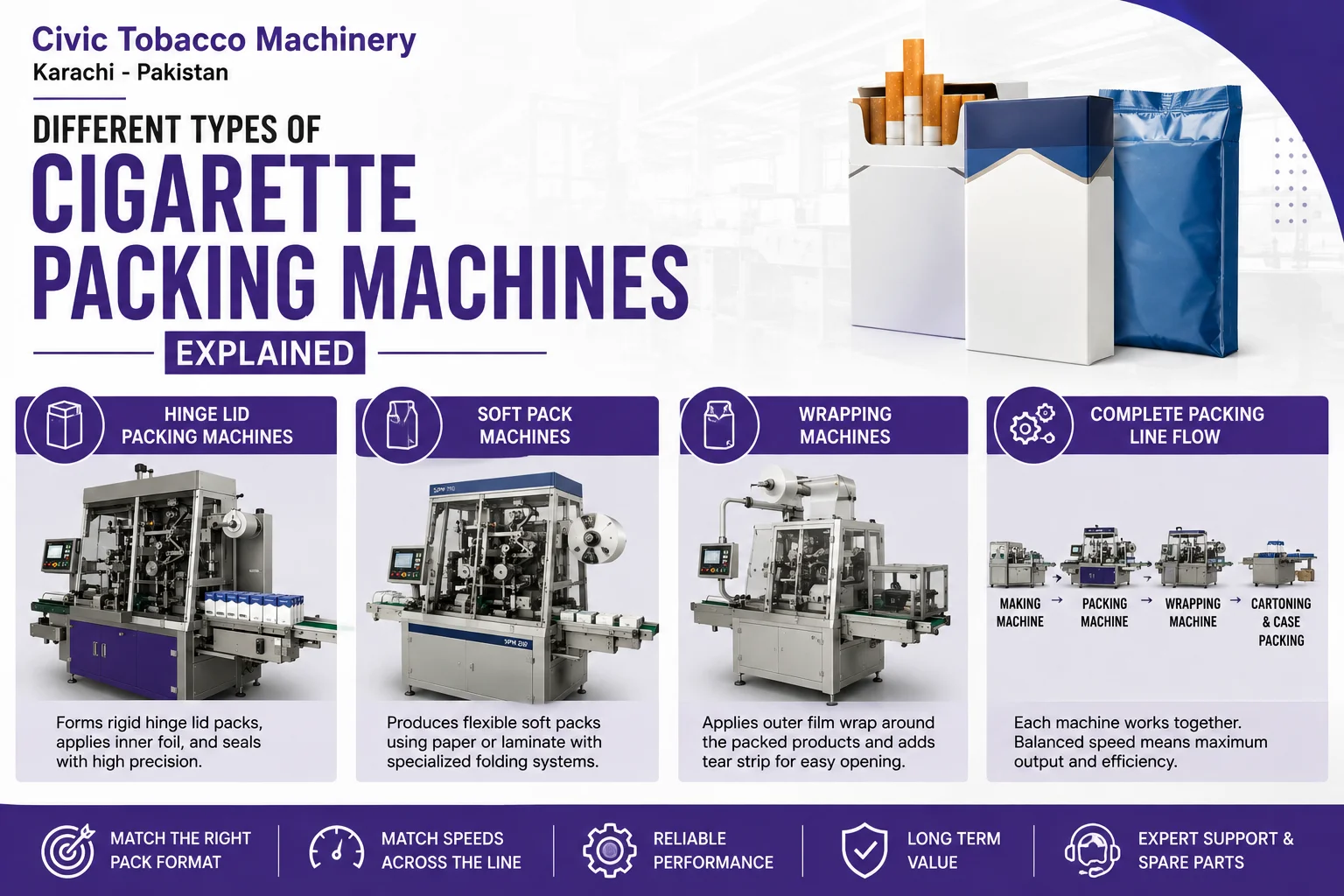
The hinge lid pack is the format most people picture when they think of a cigarette box: a rigid box with a lid that opens on a hinge rather than sliding or tearing away. Hinge lid packing machines fold and form this rigid structure around a bundle of cigarettes, apply the inner foil, and seal the pack ready for the next stage of production.
This format tends to dominate in markets where a firmer, more protective pack is expected, and it generally requires more precise folding and forming than simpler pack styles. A hinge lid packing machine needs to handle card stock accurately and consistently, since any inconsistency in the fold shows up immediately in the finished pack.
Soft Pack Machines
A soft pack machine produces the flexible, foldable style of cigarette pack rather than a rigid box. Instead of forming a stiff structure, the machine wraps cigarettes in a softer paper or laminate shell that folds closed, often associated with a more traditional or regional look depending on the market.
Soft pack production generally involves different tooling and folding mechanics compared to hinge lid equipment, since the machine is working with flexible material rather than forming a rigid box. Manufacturers producing for markets where soft pack remains the standard or preferred format need equipment built specifically for that style rather than trying to adapt hinge lid tooling.
Wrapping Machines
Once a pack is formed and sealed, whether hinge lid or soft pack, it still needs an outer wrap. A wrapping machine applies a clear or branded outer film around the finished pack, sealing it and often adding the tear strip that consumers use to open it. This stage protects the pack during handling, storage, and transport, and it's typically the step right before packs move on to cartoning or boxing.
Wrapping machines are usually matched closely to the packer feeding them, since pack size, shape, and output speed all need to line up for the two machines to run together without one holding up the other.
How These Machines Fit Into a Packing Line
None of these machines work in isolation. A typical packing line runs cigarettes from the making machine into a packer (hinge lid or soft pack depending on the format), then through a wrapping machine, and often on to cartoning and case packing after that. Each stage needs to be rated for a speed that matches the others, since the slowest machine in the sequence sets the real output of the whole line regardless of how fast the rest of the equipment can run.
This is why planning a packing line as a complete sequence, rather than buying machines one at a time, tends to produce better results. A hinge lid packer paired with a wrapping machine rated well below its speed, for example, will never actually reach its full output in practice.
Choosing the Right Type for Your Production
The starting point is always the pack format your market actually expects. Producing for a market where hinge lid is standard calls for hinge lid packing equipment, and producing for a market where soft pack dominates calls for soft pack machines, regardless of which format might be cheaper or faster on paper.
From there, the decision comes down to matching output speed across the whole packing line, from the making machine through packing and wrapping, and choosing a supplier who can support whichever combination of equipment your production actually needs, including parts and servicing well after the initial sale.
Understanding what each machine in the line actually does makes it far easier to plan a setup that runs smoothly from end to end, rather than discovering a mismatch only after equipment is already installed.