Sign up with Google
 Sign in with Zoho

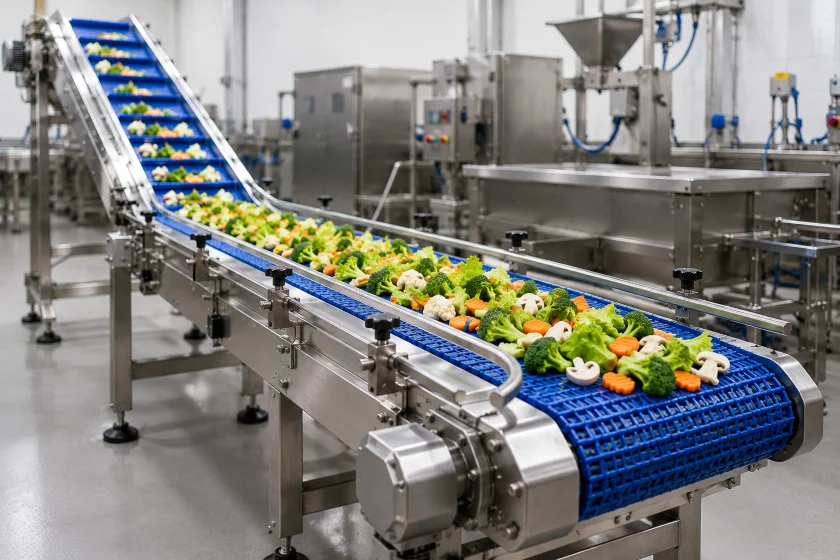
The present day production of food requires speed, cleanliness, uniformity, and effective transfer of goods from one stage of production to another. Manual handling is not only inefficient but increases the risk of contamination and damage to products. Purchasing food processing conveyor systems enables the manufacturers to organize their production process effectively and enhance the performance of their company. There are various benefits of using conveyors.
Here are seven key benefits that make modern conveyor systems a valuable investment for food manufacturers.
1. Increased Speed of Material Transfer
The speed of material transfer is one of the most valuable benefits of the use of conveyor systems for food processing. Materials, semi processed goods, and end products can be transferred from one workstation to another without having to transport the materials by hand, which saves time and ensures uniform speed of operation.
2. Better Hygiene in Food
Food items need special attention to prevent contamination of these products. With the advancement in technology, modern conveyors can be made from hygienic materials with non-porous surfaces. Also, as these conveyors move in an orderly fashion, they reduce the need for humans to come into excessive contact with the product.
3. Labor Efficiencies
The manual transportation system is a process where labor has to spend a lot of time transporting products from one point to another. Automated conveyor systems perform much of this work. Food processing conveyor systems ensure that labor performs tasks such as inspection, machine running and quality control, among others, rather than transporting products all day long.
4. Constant Production Output
When production output occurs at a constant rate, it improves the performance of the manufacturing process. The use of conveyor systems ensures that the products move at a predetermined rate as per the needs of production. Such consistency enables synchronization in various aspects like cleaning, cutting, sorting, packaging, and testing.
5. Improved Product Handling
The products could be fragile, such as fruits, vegetables, breads, packaged food, etc., which will not tolerate any extra handling. An appropriately designed food processing conveyor system will carry products smoothly without extra drops, bumps, or handling. The manufacturer can choose the conveyor systems according to the product.
6. Easier Production Line Expansion
Production needs can vary from time to time, when businesses launch new products or produce more. Modular conveyors may facilitate the adjustment of an already installed production line by including extra components such as additional modules, curves, inclines, or other specific components, depending on the available space and production needs.
7. Enhanced Safety of Employees in the Workplace
Repetitive tasks involving lifting, carrying, and transporting of goods may cause physical strain on workers. Automation of transport decreases the number of times the staff has to undertake such repetitive tasks during the workday. Current food processing conveyor equipment also has safety mechanisms like emergency brakes, guards, and operation controls.
Selecting an Appropriate Conveyor System
The selection of an appropriate food processing conveyor equipment depends on various considerations such as the nature of the products being produced, production volumes, space availability, sanitation needs, and type of processing activities involved. Some of the important things to consider when selecting an appropriate conveyor include material of the belts used, size of the conveyor, speed control, weight carrying capabilities, and ease of maintenance.
Conclusion
For those manufacturers who wish to increase productivity without compromising on hygienic conditions, product quality or the safety of workers, investing in contemporary conveyors can prove useful. Food processing conveyor equipment helps in providing controlled product movement, allowing automation and helping production plants better manage their processes. With the proper installation of food processing conveyors, manufacturers can create an efficient production environment that is ready to face any future challenges.