Sign up with Google
 Sign in with Zoho

Choosing the right B2B SEO partner is an important decision for businesses that rely on organic search to attract potential customers. B2B companies often have specialized products, longer sales cycles, multiple decision-makers, and a smaller pool of highly relevant prospects than consumer-focused businesses.
Because of this, choosing an SEO provider based only on promises of higher rankings or increased traffic can be misleading. The right provider should understand your market, target audience, buying process, and business objectives.
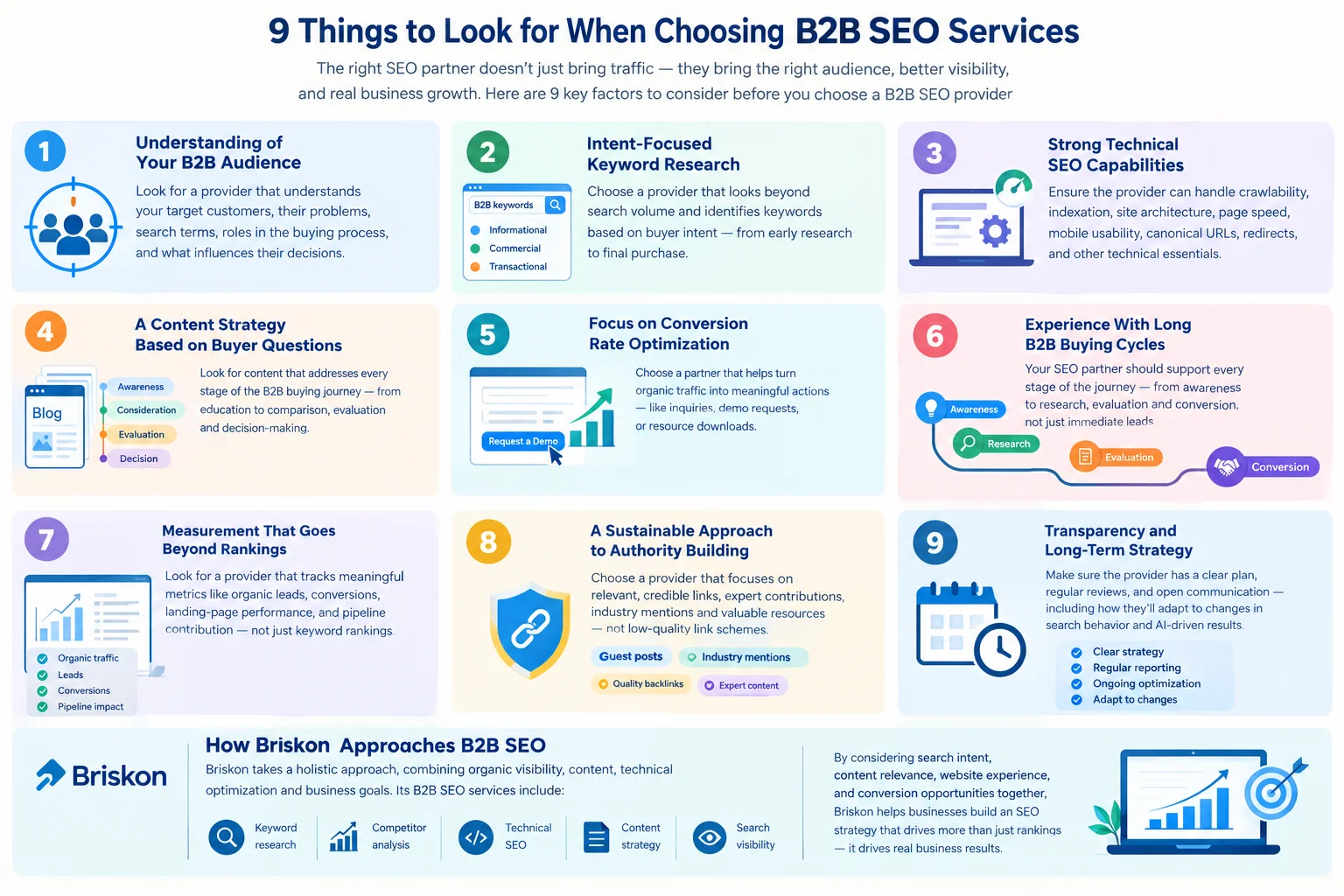
Before selecting B2B SEO services, consider these nine factors.
TL;DR
- Choose an SEO provider that understands your industry, customers, and B2B buying process.
- Look for a strategy that combines technical SEO, keyword research, content, authority building, and user experience.
- Make sure SEO activities are connected to qualified leads and business outcomes.
- Check how the provider measures results and communicates progress.
- Look for a flexible strategy that can adapt to changes in your market and search behavior.
1. Understanding of Your B2B Audience
A successful B2B SEO strategy starts with understanding the people who search for your products or services.
In many B2B industries, the person researching a solution may not be the final decision-maker. A technical employee might investigate product capabilities, while a manager evaluates vendors and an executive considers cost, business impact, and risk.
A good SEO provider should therefore research more than basic demographics. They should understand:
- Who your target customers are
- The problems they are trying to solve
- The terminology they use when searching
- Their roles in the buying process
- The questions they ask before contacting a vendor
- The factors that influence their purchasing decisions
This understanding helps create an SEO strategy that attracts relevant visitors instead of simply increasing overall traffic.
2. Intent-Focused Keyword Research
Keyword research is an essential part of SEO, but search volume should not be the only consideration.
B2B buyers use different types of searches depending on where they are in the buying journey. Someone may initially search for information about a problem, then research potential solutions, compare providers, and eventually search for a specific service or product.
Your SEO provider should be able to identify these differences and build keyword groups around search intent.
For example, informational searches can support educational content, while commercial searches can be more appropriate for service, solution, comparison, or product pages.
The goal is to find search terms that are relevant to your audience and have a realistic connection to your business objectives.
3. Strong Technical SEO Capabilities
Content cannot perform effectively if search engines struggle to crawl, understand, or index your website.
When evaluating b2b SEO services, ask how the provider handles technical SEO. A thorough approach may examine:
- Website crawlability
- Indexation issues
- Site architecture
- Internal links
- Canonical URLs
- XML sitemaps
- Page speed and Core Web Vitals
- Mobile usability
- Redirects and broken links
- Duplicate content
- Structured data where relevant
Technical SEO can become particularly important for B2B websites with large product catalogs, extensive resource libraries, multiple service pages, or complex website structures.
4. A Content Strategy Based on Buyer Questions
B2B content should have a purpose beyond attracting visitors from search engines.
Potential customers often have different questions at different stages of their research. They may want to understand a problem, learn about possible solutions, compare alternatives, evaluate providers, or determine whether a product is suitable for their organization.
A capable SEO provider should develop content around these needs.
Depending on the business, this could include:
- Educational blog posts
- Industry-specific guides
- Comparison articles
- Service and solution pages
- Case-study content
- Buying guides
- Frequently asked questions
- Expert-led resources
- Product-related content
The provider should also be able to explain why each content topic matters and how it fits into the broader SEO strategy.
5. Focus on Conversion Rate Optimization
Generating organic traffic is only one part of the process. Once visitors arrive on your website, they need a clear and relevant path toward the next step.
This is where conversion rate optimization becomes important.
A B2B website might ask visitors to request a consultation, schedule a product demonstration, submit an inquiry, download a resource, or contact the sales team.
Conversion rate optimization can involve reviewing page layouts, messaging, calls to action, forms, navigation, and the overall user experience.
SEO and conversion optimization should complement one another. Attracting more visitors is valuable, but attracting the right visitors and giving them a clear reason to engage can make organic search more useful to the business.
6. Experience With Long B2B Buying Cycles
B2B purchases rarely happen after a single website visit.
A prospect may discover a company through an informational search, return several times, read additional resources, compare competitors, discuss the solution internally, and eventually contact a sales representative.
This means an SEO strategy should not focus exclusively on immediate conversions.
Ask prospective SEO providers how they account for different stages of the B2B buying journey. Their strategy should support awareness, research, evaluation, and conversion rather than treating every visitor as someone who is ready to make an immediate inquiry.
7. Measurement That Goes Beyond Rankings
Keyword rankings can provide useful information, but rankings alone do not explain whether SEO is contributing to business growth.
Before choosing a provider, ask which metrics they use to evaluate performance.
Depending on your goals, useful measurements may include:
- Relevant organic traffic
- Non-branded search visibility
- Organic leads
- Conversion rates
- Landing-page performance
- Engagement with important content
- Leads from target industries
- Organic contribution to the sales pipeline
The exact metrics should be based on your business model and objectives.
A good reporting process should help you understand what changed, why it changed, and what actions will be taken next.
8. A Sustainable Approach to Authority Building
For many B2B companies, establishing credibility is just as important as gaining visibility.
Potential customers often research a company before contacting its sales team. Relevant mentions, useful resources, expert contributions, industry coverage, and quality backlinks can help strengthen the overall authority of a website.
When evaluating an SEO provider, ask how it approaches link acquisition and authority building.
Be cautious of strategies that focus mainly on generating large numbers of low-quality links. A sustainable approach should prioritize relevance, credibility, and genuine value to the audience.
The provider should also be able to explain where links and mentions are coming from and why those sources are relevant to your business.
9. Transparency and Long-Term Strategy
SEO is an ongoing process. Competitors change their strategies, websites evolve, search behavior shifts, and search engines continue to introduce new ways of presenting information.
For that reason, your SEO provider should have a process for regularly reviewing and adjusting the strategy.
Before signing an agreement, consider asking:
- What will you prioritize during the initial phase?
- How will SEO opportunities be identified?
- How will content topics be selected?
- What will monthly reports contain?
- How frequently will the strategy be reviewed?
- Who will handle technical recommendations and content?
- How will changes in search and AI-generated results be addressed?
Clear communication makes it easier to understand what your SEO investment is accomplishing and where the strategy is heading.
How Briskon Approaches B2B SEO
Briskon takes a broader approach to B2B SEO by considering the relationship between organic visibility, content, technical optimization, and business objectives. Its B2B SEO services cover areas such as keyword research, competitor analysis, technical SEO, content strategy, and search visibility.
This approach recognizes that B2B search behavior extends across multiple stages of the buying process. A potential customer may first discover a brand through educational content and later return to evaluate its services or solutions.
By considering search intent, content relevance, website experience, and conversion opportunities together, businesses can build an SEO strategy that supports more than just rankings.







.webp)