Sign up with Google
 Sign in with Zoho
Two years ago, "AI agent" mostly meant a chatbot with a slightly better memory. That's not what the term means anymore. In 2026, AI agents are reasoning through multi-step tasks, coordinating with other agents, calling tools, and executing real business workflows with minimal human oversight. The market reflects how fast this moved: agentic AI spending is projected to hit $201.9 billion in 2026, a 141% jump from the year before, and Gartner expects 40% of enterprise applications to include task-specific agents by the end of the year.
If you're evaluating an AI agent development company right now, the conversation has shifted well past "can you connect this to a chatbot." Here's what's genuinely shaping the space, and what actually separates a partner worth hiring from one riding the hype.
Quick Answer: What Should a Good AI Agent Development Company Deliver in 2026?
A capable AI agent development company in 2026 builds multi-agent systems with proper orchestration, integrates with standards like MCP for secure tool access, designs governance and human-in-the-loop controls from the start rather than as an afterthought, and connects agents deeply into existing business systems like CRM and ERP. Costs typically range from $15,000 for a single-task agent to $400,000+ for an enterprise-grade multi-agent deployment, with integration and governance work often consuming up to 60% of the total budget.
The Shift From Isolated Bots to Multi-Agent Teams
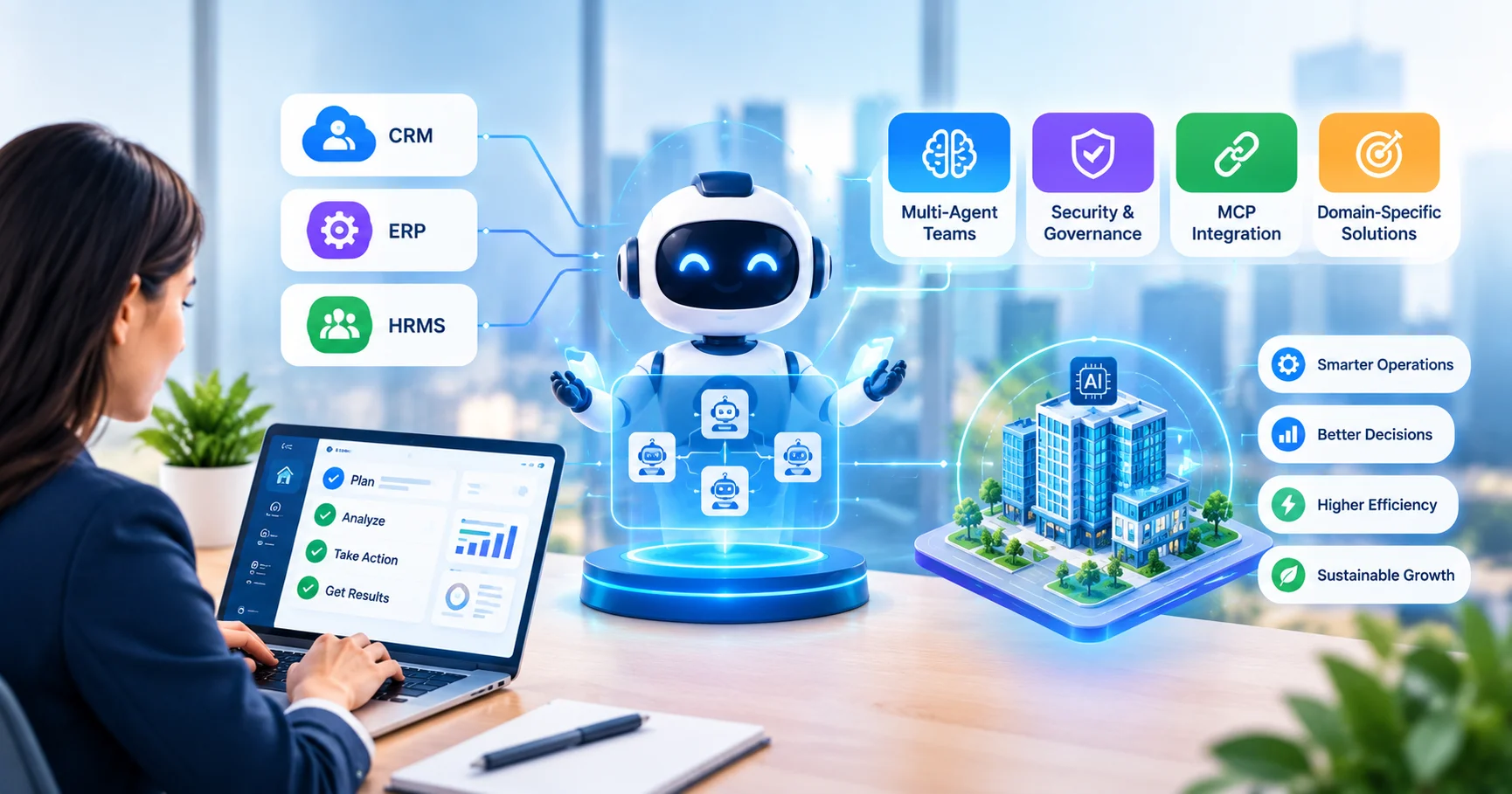
The single biggest architectural shift happening right now is the move away from one agent handling one task in isolation. Enterprises are increasingly building multi-agent architectures, where several agents collaborate like a real team, delegating work, sharing information instantly, and adjusting to changing circumstances without needing continuous human coordination. In finance, this might look like agents that simultaneously monitor transactions, flag fraud, and generate compliance reports. In operations, it looks like agents handling risk assessment, resource allocation, and production planning together rather than as separate disconnected tools.
This is genuinely different work than building a single chatbot, and it's pushing AI agent development companies to design entire agent ecosystems rather than standalone bots. If a development partner is still pitching every use case as a single, isolated assistant, they may not be equipped for where enterprise demand is actually heading. The organizations seeing the most value are the ones treating this as infrastructure design, not a one-off automation project.
MCP Has Quietly Become the Standard Everyone's Building Around
If there's one piece of technical infrastructure worth understanding before hiring a development partner, it's the Model Context Protocol, or MCP. Originally released by Anthropic in late 2024, MCP gives AI models a universal interface to connect with tools, data sources, and APIs, and it's often described as the USB-C or HTTP of the agent era for good reason. By March 2026, MCP had reached roughly 97 million monthly SDK downloads and more than 10,000 active server implementations, with backing from every major cloud provider and governance now under the Linux Foundation.
When a protocol achieves that kind of cross-vendor adoption that fast, it stops being a bet and becomes table stakes. A serious AI agent development company should have real, hands-on MCP experience at this point, not just familiarity with the concept. That said, standardized tool access also means standardized risk. An agent that can call any MCP server is only as safe as the servers it trusts and the permissions it's been granted, so it's worth asking a prospective partner directly how they scope credentials, audit tool calls, and prevent a write-capable server from acting without human approval in the loop.
Governance Isn't Optional Anymore, It's the Difference Between a Pilot and a Production System
This is probably the most important thing to understand about the current state of the market: most AI agent pilots don't make it to production, and the reason usually isn't the AI model itself. Agentic AI adoption has crossed 80% of US enterprises, yet only around 41% of deployments actually reach production. Projects stall on missing guardrails, weak evaluation processes, unclear ownership, and the genuine difficulty of connecting agents safely to real business systems.
This is why governance, observability, security, and human supervision have become critical parts of any serious production system, not a compliance checkbox added at the end. Businesses are increasingly choosing AI agent development partners specifically because they build governance-by-design, meaning oversight and audit trails are built into the architecture from day one, rather than firms that treat governance as something to bolt on once a regulator or security team asks about it.
Practically, this shows up as human-in-the-loop approval for high-stakes actions, isolated execution environments and sandboxes for agents that run code or execute commands, and clear audit logging that lets a business trace exactly what an agent did and why. Containers, ephemeral sandboxes, network restrictions, and restricted credentials all add real cost, but they also make a system genuinely safe to run in production, and auditable when something needs to be reviewed.
Deep Enterprise Integration Is Where the Real Work Happens
It's tempting to think the hardest part of building an AI agent is the AI itself. In practice, the model layer has actually gotten cheaper. LLM API pricing has dropped by 60% to 80% over the past 18 months as competition between major providers intensifies, which means the engineering layer, not the model, is now the dominant cost driver on most projects.
That engineering work is mostly about integration. Seamless connections with CRM, ERP, and HRMS systems let agents access data across departments and actually automate real processes, rather than operating as a standalone tool disconnected from how the business actually runs. Legacy systems, poorly documented internal APIs, compliance requirements, and security constraints still consume the majority of project time on complex deployments, and this hasn't gotten meaningfully easier just because the underlying models have improved. A development partner who focuses the sales conversation entirely on model capability rather than integration complexity is likely underselling the hardest, most expensive part of the actual work.
Domain-Trained Agents Are Winning Over Generic Ones
Generic, one-size-fits-all agents are losing relevance fast. The market is shifting toward domain-trained agents built specifically for a particular industry or function, whether that's healthcare, financial compliance, or a specific operational workflow, rather than a general-purpose assistant stretched to cover everything. This is exactly where experienced AI agent development companies tend to outperform DIY or off-the-shelf solutions, since building a genuinely useful domain-specific agent requires real understanding of that industry's data, workflows, and failure modes, not just prompt engineering skill.
Static data is also increasingly seen as a limitation rather than a feature. Real-time architecture design, where agents pull current data rather than working from a fixed snapshot, has become a core skill for advanced AI agent development, particularly for use cases like fraud detection or dynamic pricing where stale information genuinely undermines the agent's usefulness.
What AI Agent Development Actually Costs in 2026
Costs vary enormously depending on scope, and understanding the full picture matters more here than in most software categories, because the build cost is genuinely only part of the story:
- Focused, single-task agent: roughly $15,000 to $40,000, using existing platforms with light integration
- Custom agent deeply integrated with business systems: commonly $40,000 to $150,000 for most mid-market implementations
- Multi-agent system with orchestration: $120,000 to $400,000 or more, factoring in an orchestration layer, shared memory architecture, and agent-to-agent communication design
- Enterprise-grade, regulated deployment: can exceed $300,000, with integration and governance work alone often consuming up to 60% of the total project budget
- Ongoing costs after launch: model usage, hosting, and maintenance commonly add 15% to 25% of the build cost annually, though integration and compliance-heavy deployments can push total first-year cost of ownership up by 40% to 80% beyond the initial build
A few things worth knowing before budgeting: LLM API costs have dropped significantly, but token consumption is growing faster than prices are falling, so the model-usage line item isn't necessarily shrinking overall even as per-token pricing improves. It's also worth remembering that isolated execution environments, audit logging, and access controls aren't optional extras for anything handling real business processes, they're part of what makes a system safe enough to actually deploy.
Questions to Ask Before You Hire an AI Agent Development Company
Is your team building single-agent tools, or do you have real experience designing multi-agent systems that coordinate with each other? This is a meaningfully different architecture, and a partner without genuine multi-agent orchestration experience may struggle once your use case grows past a single isolated task.
What's your hands-on experience with MCP, not just conceptual familiarity? Given how quickly MCP has become the standard integration layer for agentic AI, a team without real implementation experience here is likely to move slower and make more avoidable mistakes.
How is governance built into the architecture, not added after a security review flags a gap? Most agent pilots stall before reaching production specifically because of missing guardrails, so it's worth understanding exactly how audit trails, sandboxing, and human-in-the-loop approval are designed in from the start.
What percentage of your typical project budget goes toward integration versus the AI model itself? Since integration with legacy systems and internal APIs is usually the hardest and most expensive part of the work, a partner who can't speak specifically to this is likely underestimating the real scope of your project.
Do you build domain-specific agents, or primarily generic assistants adapted to different industries? A genuinely domain-trained agent requires real understanding of your industry's data and workflows, and it's worth asking for a concrete example relevant to your specific use case rather than a general capability claim.
The Bottom Line
AI agents in 2026 have moved well past simple automation and reactive chatbots. Multi-agent orchestration, MCP-standardized tool access, governance-by-design, and deep integration with real business systems are what separate agent deployments that actually reach production from the majority that stall somewhere in the pilot phase.
When you're choosing an AI agent development company, the real question isn't whether they can demo an impressive agent in a sales call. It's whether they understand that a production-grade agent system has to be secure, auditable, deeply integrated, and built for the messy reality of your existing infrastructure, not designed for a clean demo environment that falls apart the moment it touches your actual systems.