Sign up with Google
 Sign in with Zoho

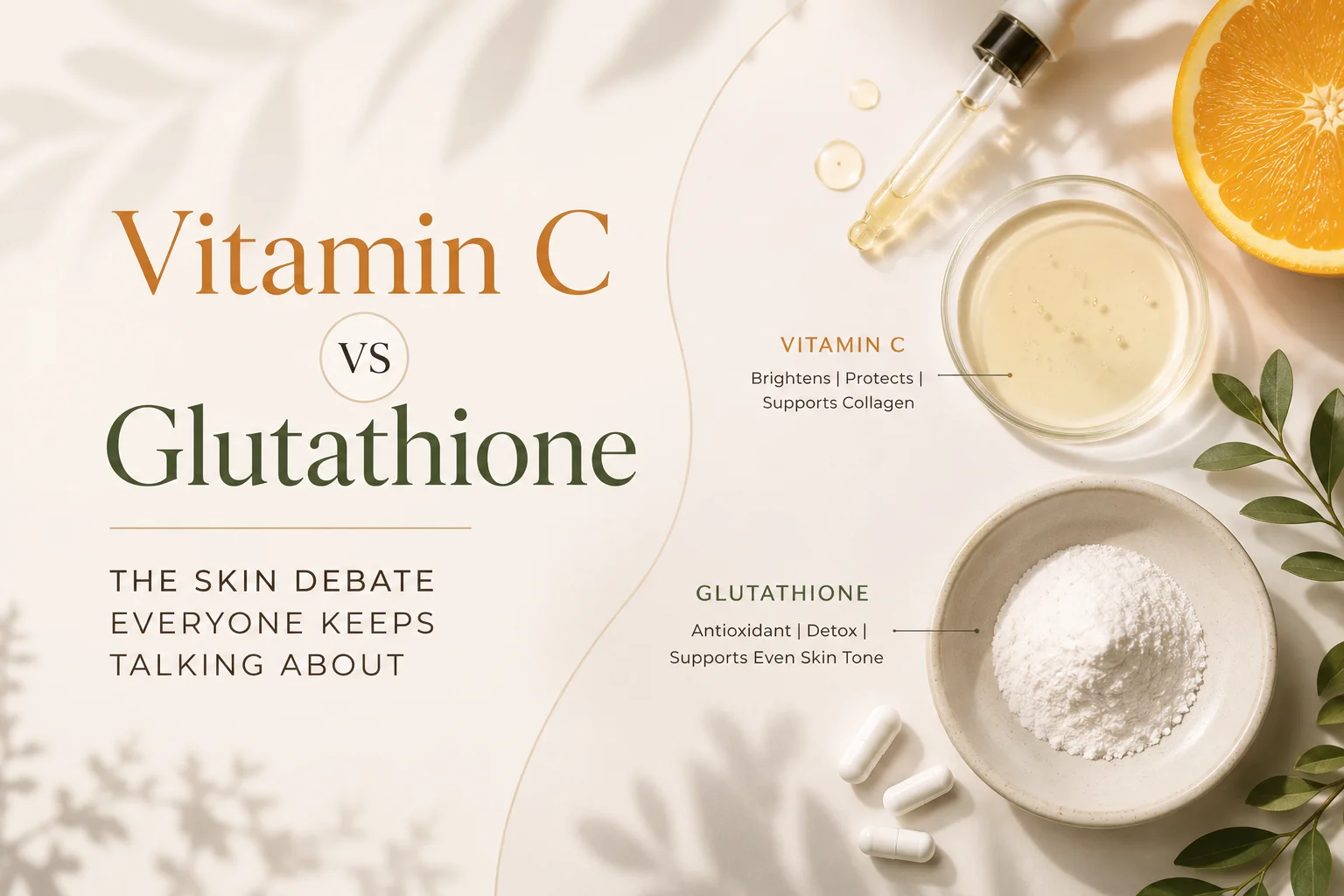
Vitamin C or glutathione?
If you’ve spent any time scrolling through skincare content, you’ve probably seen both names everywhere. One is a familiar skincare favourite. The other has become a huge talking point in the beauty and wellness space.
Both have been noted to have antioxidative effects, and both have been linked to improving skin appearance by making it glow. However, are they really doing the same?
No, they aren’t.
Now, if you are curious as to which is better for your skin between vitamin C and glutathione, here’s how they work.
First, What Does Vitamin C Actually Do for Your Skin?
Vitamin C isn't just the vitamin you think about when you catch a cold.
It is an antioxidant which assists in the protection of cells against oxidative stress. As far as the application of topical vitamin C is concerned, it has been extensively researched in the context of its ability to aid collagen production and minimize the effects of pigmentation.
It is for this reason that vitamin C has become a standard component in skincare routines.
You will find vitamin C in serums, creams, and other types of topical treatments.
There is one important thing you need to be aware of though:
The efficiency of vitamin C depends upon the formulation, concentration and stability of the product.
And Then There’s Glutathione
Glutathione seems a little more complex, but the concept itself is rather easy.
It is an antioxidant which occurs naturally in the body and assists in the protection of cells against oxidative stress.
It has also become popular in the beauty world because of its potential effects on melanin production and skin pigmentation.
That’s where a lot of the hype comes from.
Some benefits have been found through research studies related to glutathione for skin pigmentation; however, the information is not always reliable as it is depicted on social media. This information has been emphasized through reviews by researchers who have found the drawbacks along with benefits.
So, no, glutathione isn't a magic “skin brightening” button.
Vitamin C vs Glutathione: What’s the Actual Difference?
Here's the easiest way to look at it.
Vitamin C vs Glutathione Powerful antioxidant Naturally occurring antioxidant Involved in collagen synthesisAntioxidant defence mechanism common in cellsFrequently used topicallyAlso available topically and orallyMay be able to improve appearance of pigmentationResearched for effects on pigmentationLong history in skincareIncreasing interest in beauty and wellness
Vitamin C has a more extensive history of being used in topical skincare products for antioxidant purposes and collagen synthesis, as well as in improving the appearance of pigmentation.
Glutathione is an intriguing substance whose efficacy at reducing pigmentation is being researched.
Which Substance Is Better for Skincare Then?
That is where things get truly interesting.
There is no clear winner, either vitamin C or glutathione.
Everything is dependent on your actual needs.
If You Are Looking for Antioxidant Defence Mechanism
Both substances act as antioxidants.
However, vitamin C is very commonly used in topical skincare products due to its ability to protect the skin against oxidative stress.
If You Are Looking for Improvement of Pigmentation
Both substances have been researched for their effect on pigmentation.
Vitamin C can affect the process of melanin formation and is commonly used in topical formulations for uneven skin tone.
Glutathione is also found to affect melanin formation in some studies.
If Your Focus Is Collagen and Skin Ageing
Vitamin C has the advantage here.
It plays an important role in collagen synthesis and has been studied for photoaging and the appearance of wrinkles.
That doesn't mean glutathione has no role in skin health. It simply means vitamin C has a clearer track record for this particular area.
What About Taking Them as Supplements?
This is where things can get confusing.
You might see vitamin C supplements, glutathione capsules, skin supplements and even beauty gummies all marketed for glowing skin.
But taking a supplement doesn't automatically mean you'll wake up with completely different skin.
Your overall diet, sleep, hydration, sun exposure, stress and skincare routine still matter.
And when you're choosing any beauty supplement, look beyond the front of the bottle. Check the ingredients, serving size and what the product is actually formulated to provide.
The same applies to other wellness categories too. For example, someone shopping for skin care supplements might come across terms such as collagen or a skin gummy. The important thing is to understand what you're taking rather than assuming every beauty supplement works in the same way.
Can You Use Vitamin C and Glutathione Together?
Potentially, yes—but “more” isn't automatically “better.”
Vitamin C and glutathione have different biological roles, and they can appear together in skincare and supplement formulations.
If you're already using several active skincare products, however, adding more and more ingredients can make it difficult to know what's actually helping your skin.
A simpler routine that you can stick with consistently is often a better starting point.
And if you have persistent pigmentation, melasma or another skin concern, it’s worth speaking with a dermatologist rather than trying to treat it entirely through supplements.
One Thing You Shouldn't Skip: Sunscreen
Here's the part that shouldn't get lost in the vitamin C vs glutathione conversation.
If pigmentation or premature skin ageing is your concern, protecting your skin from UV exposure matters.
You can have the most talked-about antioxidant in your skincare cabinet, but regularly skipping sun protection isn't exactly helping your skin.
Think of vitamin C, glutathione and other skin-supporting ingredients as pieces of a bigger routine—not replacements for basic skincare.
What About Glutathione Injections?
This is where you need to be especially careful.
Intravenous glutathione has become popular in some cosmetic settings, but it is not something to treat casually as a beauty shortcut.
Current reviews have raised concerns about limited safety data, inconsistent evidence and potential adverse effects associated with intravenous use.
If you’re thinking about using glutathione for cosmetic reasons, get professional advice from a medical expert and not from social media fads or marketing at clinics.
The Bottom Line
While vitamin C and glutathione are intriguing skin care ingredients, they certainly can’t be used interchangeably.
Vitamin C is a vital ingredient in skin care, especially when it comes to antioxidants and collagen production and pigmentation.
Glutathione has attracted attention for its antioxidant and pigmentation-related effects, but the evidence is still evolving and doesn't support treating it as a miracle skin-lightening solution.
So instead of asking, “Which one is better?”, a better question is:
“What does my skin actually need?”
Start there.
Because healthy-looking skin isn't usually about finding one magical ingredient. It is about having a logical routine, safeguarding your skin, maintaining good overall health, and opting for products that have been scientifically proven to be effective.