
 Sign up with Google
 Sign in with Zoho

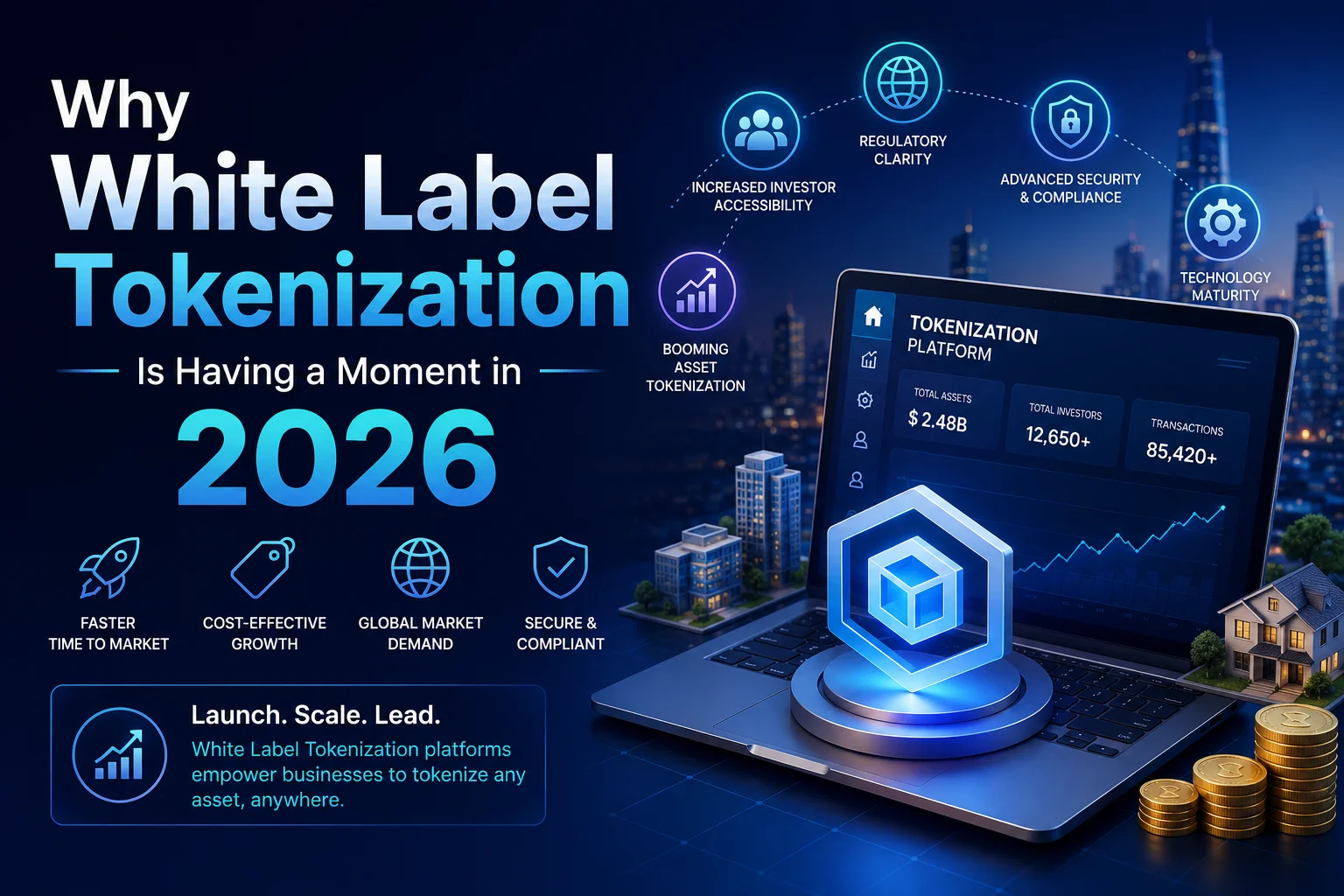
Tokenization has been "the next big thing" in finance for the better part of a decade. In 2026, it finally stopped being a talking point and started showing up in real numbers — and white label platforms are the reason so many businesses were able to move fast enough to catch the wave.
The Numbers Behind the Moment
Tokenized real-world assets on public blockchains surpassed $26 billion by March 2026, roughly triple where the market stood a year earlier, with tokenized US Treasuries alone accounting for nearly half of that total. Analysts at major consulting firms now put the addressable tokenized asset market in the trillions by the end of the decade.
Numbers like that don't move because more companies suddenly learned to code smart contracts. They move because the infrastructure barrier collapsed — and white label platforms are what collapsed it.
Why Now, Specifically
A few forces converged at the same time to make 2026 the inflection point rather than just another incremental year.
Regulatory clarity finally caught up. In the EU, frameworks like MiCAR and the DLT Pilot Regime have matured enough that multiple platforms now operate with real regulatory authorization rather than operating in a gray zone. In the US and elsewhere, securities regulators have issued enough guidance that legal teams can actually greenlight a tokenization project instead of stalling it indefinitely. Regulatory ambiguity was the single biggest reason tokenization stayed theoretical for so long — and that excuse is disappearing.
Institutional money showed up. Banks, asset managers, and funds are no longer just watching from the sidelines. They're actively issuing tokenized bonds, funds, and real estate positions, and they're doing it because the return math finally works: faster settlement, lower administrative overhead, and access to a broader investor base than traditional issuance channels allow.
Build times became a competitive liability. Custom tokenization builds still take six to twelve months, plus ongoing security audits and compliance maintenance. White label platforms compress that to a matter of weeks. In a market moving as fast as this one, a company spending a year on infrastructure isn't just slow — it's ceding the market to whoever launched first.
What Changed About the Platforms Themselves
Early white label offerings were rigid — one blockchain, one asset type, minimal customization. That's no longer true. Modern white label tokenization platforms now support configurable token standards, multi-jurisdiction compliance modules, and API-driven integration, so businesses can adapt workflows, onboarding flows, and reporting to their specific market rather than accepting a one-size-fits-all product.
That flexibility matters because tokenization isn't a single use case anymore. The same underlying rails are now being used for real estate, private funds, commodities, and intellectual property — and a platform that can only handle one of those isn't actually solving the problem businesses have in 2026.
Who's Actually Adopting It
The clearest signal that white label tokenization is having a real moment, not a hype cycle, is who's using it. It's no longer just blockchain-native startups. Mid-sized banks are testing tokenized deposit products. Real estate developers are fractionalizing properties without hiring a single blockchain engineer. Fund managers are tokenizing LP interests specifically to improve liquidity for investors who'd otherwise be locked in for years.
These are risk-averse institutions by nature. Their willingness to adopt white label infrastructure — rather than wait for a custom build or wait out the market entirely — is a strong indicator that the technology and the regulatory environment have both crossed a credibility threshold.
The Strategic Shift
Perhaps the most important change in 2026 isn't technical at all — it's how businesses are framing the decision. Tokenization used to be evaluated as an R&D bet: expensive, uncertain, multi-year. White label platforms have reframed it as an operational decision, closer to choosing a payment processor or a cloud provider than commissioning custom software.
That reframing lowers the internal barrier to getting a project approved. A CFO can greenlight a four-to-eight-week platform license far more easily than a multi-year infrastructure build with an uncertain payoff — and that difference alone explains a meaningful share of this year's adoption curve.
What This Means Going Forward
None of this means every tokenization project should default to white label. Businesses with genuinely unique token economics or governance requirements still have good reasons to build custom. But for the majority of companies entering this space in 2026, the calculus has shifted decisively: speed to market, regulatory readiness, and lower technical risk now outweigh the appeal of full ownership over a bespoke stack.
White label tokenization isn't a shortcut anymore — it's becoming the default starting point. And that's exactly why 2026 is the year it stopped being a niche option and started being the industry's standard operating procedure.













.webp)