Sign up with Google
 Sign in with Zoho

INTRODUCTION
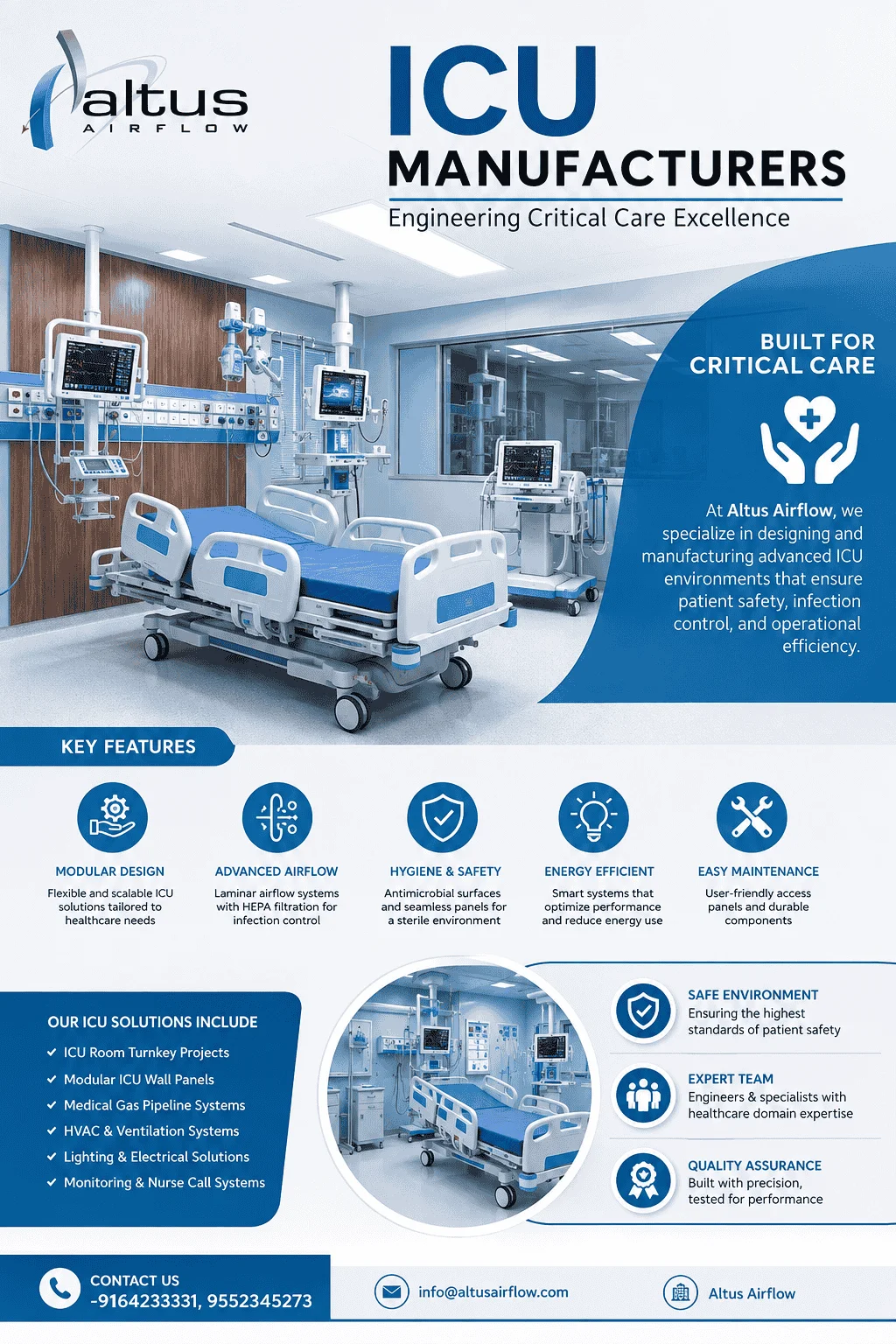
Finding suitable ICU Manufacturers is an important step when developing or upgrading a hospital’s critical-care department. A well-planned ICU must support continuous patient monitoring, efficient staff movement, infection-control practices, and dependable medical infrastructure. Hospitals should therefore evaluate manufacturers based on technical expertise, product quality, customization capabilities, and long-term service support rather than selecting a supplier only on the basis of availability.
Evaluate Hospital-Specific Requirements
Every hospital has different clinical needs, patient volumes, available space, and treatment specialties. Before selecting a manufacturer, hospital administrators should assess the number of beds, patient categories, required equipment, isolation requirements, staff movement, and future expansion plans. A detailed requirement assessment helps ensure that the proposed ICU solution is practical and suitable for the facility.
Check Design and Layout Expertise
The design of an ICU should provide sufficient working space around each patient bed and allow medical teams to respond quickly during emergencies. The Indian Society of Critical Care Medicine highlights the importance of suitable patient-care space, equipment accessibility, staff movement, monitoring, and isolation facilities in ICU planning. Manufacturers should be able to provide layouts that support visibility, workflow, safety, and effective use of available space.
Assess Equipment and Infrastructure Quality
A dependable ICU requires more than beds and monitors. Hospitals may need ventilators, multiparameter monitors, infusion pumps, syringe pumps, defibrillators, suction systems, emergency equipment, medical gas outlets, and suitable electrical connections. Government technical resources also provide equipment specifications for critical-care and specialised hospital units. Hospitals should confirm that the proposed solution is compatible with required medical devices and infrastructure.
Consider Customisation and Future Expansion
A good manufacturer should offer flexible solutions based on the hospital’s floor plan, clinical department, budget allocation, and operational requirements. Modular systems can be planned to accommodate changing patient loads, additional equipment, improved infection-control measures, and future technology upgrades. The design should also allow maintenance access without unnecessarily disrupting patient care.
Review Installation and Technical Support
Professional installation is essential for ensuring that medical infrastructure, electrical systems, ventilation arrangements, and equipment connections function properly. Hospitals should ask about project coordination, testing, commissioning, staff orientation, technical documentation, and post-installation support. Clear communication between the manufacturer, biomedical engineers, architects, and hospital staff can reduce implementation problems.
Give Importance to Maintenance and Safety
Long-term ICU performance depends on regular inspection, calibration, preventive maintenance, and timely repairs. NHSRC’s Biomedical Equipment Management and Maintenance Program emphasises equipment maintenance, calibration, testing, and improved equipment uptime. Hospitals should therefore select a manufacturer that provides dependable service arrangements and clear maintenance procedures.
Conclusion
Hospitals can identify reliable ICU Manufacturers by comparing their design experience, technical capabilities, infrastructure quality, customization options, installation process, and after-sales support. A carefully selected manufacturer can help create an ICU that supports clinical efficiency, patient safety, equipment accessibility, and future hospital requirements. Proper planning and technical evaluation should remain central to every critical-care development project.
Frequently Asked Questions
1. What should hospitals check before selecting an ICU supplier?
Hospitals should review design expertise, equipment compatibility, infrastructure quality, installation support, maintenance services, documentation, and previous project experience.
2. Why is ICU layout important?
An effective layout supports staff movement, patient observation, emergency response, equipment access, infection-control practices, and efficient daily operations.
3. Can ICU solutions be customised for different hospitals?
Yes. ICU solutions can often be adapted according to available space, bed capacity, clinical requirements, medical equipment, workflow, and future expansion plans.
4. What equipment is commonly required in an ICU?
Common requirements may include ICU beds, ventilators, patient monitors, infusion pumps, syringe pumps, suction systems, defibrillators, emergency equipment, and medical gas infrastructure.
5. Why is after-sales support important for ICU infrastructure?
Regular maintenance, calibration, inspections, and timely technical assistance help support equipment reliability, operational continuity, and patient-care safety.