Sign up with Google
 Sign in with Zoho

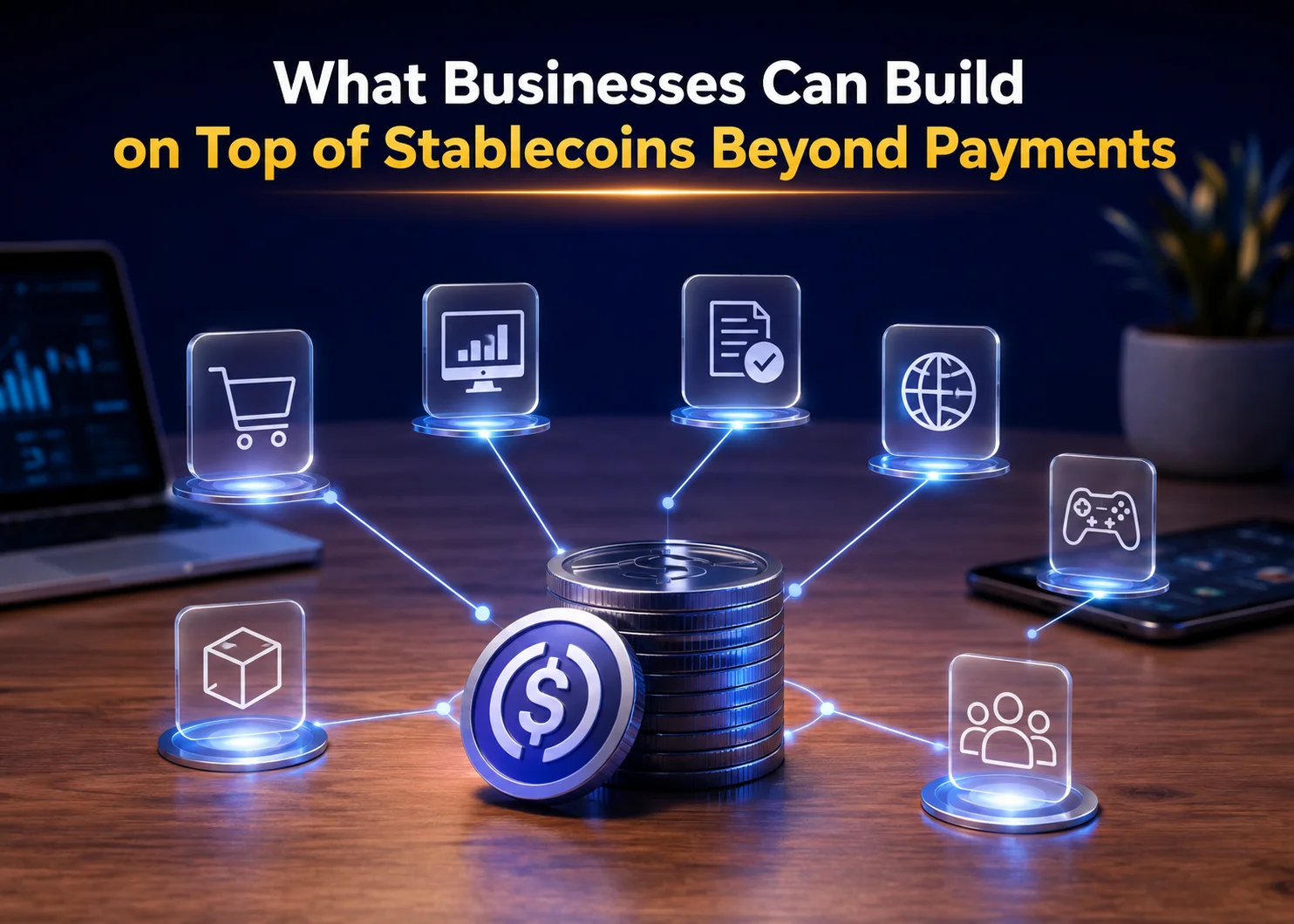
Stablecoins are often introduced as a faster and more efficient way to move digital value. While payments and remittances remain important use cases, they represent only one part of the opportunity. Businesses can build much broader infrastructure around stablecoins by treating them as programmable financial assets rather than simply another payment method.
A stablecoin can provide a relatively predictable unit of value while benefiting from blockchain-based settlement, smart contracts, transparent transaction records, and software-driven automation. This combination allows businesses to redesign financial workflows that traditionally depend on banks, payment processors, manual reconciliation, and multiple intermediaries.
The most interesting opportunities are emerging where stablecoins interact with treasury management, marketplaces, escrow, tokenized assets, financing, subscriptions, and cross-border operations. The objective is not to insert blockchain into every business process. Instead, businesses need to identify processes where programmable settlement can create measurable operational value.
Stablecoin Treasury Infrastructure for Modern Businesses
Corporate treasury is one of the strongest areas where stablecoins can move beyond conventional payments. Companies operating internationally often manage multiple currencies, banking relationships, foreign-exchange exposure, settlement schedules, and liquidity positions.
Stablecoin-based treasury infrastructure can introduce a digital settlement layer into these operations. A business could maintain traditional bank accounts while using stablecoins for selected treasury movements between subsidiaries, suppliers, contractors, or digital platforms.
A mature treasury platform could support:
- Multi-wallet and multi-chain balance management.
- Role-based access and transaction approval workflows.
- Automated liquidity rebalancing.
- Real-time transaction monitoring and reconciliation.
- Stablecoin-to-fiat conversion workflows.
- Integration with accounting and ERP systems.
- Configurable spending limits and treasury policies.
The technical architecture goes far beyond connecting a wallet to an application. Enterprise treasury infrastructure requires secure key management, transaction authorization, audit trails, policy engines, compliance screening, and operational controls.
For example, a company could configure its treasury system so that transfers above a particular threshold require approval from multiple authorized employees. The blockchain transaction would only be initiated after the internal authorization layer confirms that the transaction satisfies the organization's policy.
This distinction is important. A crypto wallet provides asset storage and transaction functionality, whereas an enterprise treasury platform must connect financial controls with blockchain settlement.
Programmable Escrow and Automated Business Agreements
One of the most compelling opportunities lies in programmable commercial agreements. Stablecoins can be incorporated into smart contracts that release or distribute funds when predefined conditions are satisfied.
Businesses working with a Decentralized Stablecoin Development Company can design infrastructure where stablecoin settlement is connected with smart contracts, wallet systems, oracle networks, and application-level business logic.
Consider a B2B procurement platform. A buyer could deposit stablecoins into an escrow contract when an order is created. The funds could remain locked until specific milestones are completed. Once an authorized verification system confirms delivery, the contract could release the appropriate amount to the supplier.
The blockchain itself does not need to know whether a physical shipment arrived. An oracle or external verification layer can transmit that information to the smart contract. The contract then executes the predefined settlement logic.
This model can be applied to several business workflows:
- Contractor payments based on project milestones.
- Supplier escrow arrangements.
- Digital service agreements.
- Freelancer and creator marketplaces.
- Commission distribution.
- Conditional settlement for tokenized assets.
The advantage is not simply transaction speed. Programmable escrow can reduce manual settlement work, establish deterministic financial rules, and create an auditable transaction history.
However, businesses should not assume that smart contracts automatically replace legal agreements. Real-world disputes, oracle failures, incorrect data, contract upgrades, emergency intervention, and jurisdictional requirements still need to be addressed through appropriate legal and technical frameworks.
Stablecoin-Powered Marketplaces and Settlement Networks
Marketplaces have complex financial flows involving customers, sellers, platform commissions, refunds, disputes, and settlement. Stablecoins can serve as the underlying settlement asset for these ecosystems.
A marketplace could automatically calculate how much of a transaction belongs to the seller, platform, service provider, or other participant. Smart contracts or application-level transaction orchestration can then distribute funds according to predefined rules.
This is particularly relevant to global digital marketplaces where participants may operate across different banking systems.
A marketplace architecture could contain several interconnected layers: the customer-facing application, internal business ledger, wallet infrastructure, blockchain connectivity, compliance systems, transaction orchestration, and settlement mechanisms.
The internal ledger remains critical even when blockchain infrastructure is used. A blockchain transaction does not necessarily represent every commercial event. An application may need to distinguish between an order being created, payment being authorized, goods being delivered, a transaction being disputed, and a refund being approved.
Therefore, businesses should treat blockchain as one component of a broader financial architecture rather than as the entire accounting system.
Recurring Revenue and Subscription Infrastructure
Subscription businesses represent another area where programmable financial infrastructure could become useful.
Traditional recurring payments depend heavily on card networks, bank mandates, payment processors, and region-specific financial infrastructure. Stablecoin-based systems can provide an alternative settlement mechanism for businesses serving digitally native or international customers.
A SaaS platform could, for example, maintain a customer's stablecoin balance and execute recurring settlements according to the customer's subscription agreement. Application-level scheduling systems could trigger transactions at predefined intervals.
The concept becomes particularly useful for businesses serving international customers because the underlying settlement asset can remain consistent across geographic markets.
However, recurring stablecoin payments introduce challenges that businesses must solve at the product level. These include insufficient balances, failed transactions, cancellation, refunds, wallet replacement, transaction authorization, and accounting treatment.
User experience is equally important. Customers should not be forced to understand blockchain-specific concepts such as gas fees, network selection, token contracts, or transaction confirmations unless those details are genuinely relevant.
Successful applications will likely abstract much of this complexity behind familiar financial interfaces.
Invoice Financing and Working-Capital Platforms
Stablecoins can also become part of digital working-capital infrastructure.
Businesses frequently face a gap between issuing an invoice and receiving payment. Invoice financing platforms can potentially use blockchain infrastructure to represent receivables digitally and connect eligible invoices with financing providers.
Stablecoins could then be used as a settlement asset within selected parts of the financing workflow.
A digital receivables platform could verify the underlying invoice, establish financing terms, transfer funds to the business, monitor repayment, and distribute settlement according to predefined contractual rules.
Tokenization can add another layer by representing ownership or economic rights associated with eligible receivables. However, this does not remove the need for conventional credit assessment.
Creditworthiness, invoice authenticity, debtor risk, default management, legal enforceability, and regulatory compliance remain essential components of the financing model.
The opportunity is therefore not about replacing financial institutions with smart contracts. It is about using blockchain-based infrastructure to make certain financial workflows more programmable and transparent.
Stablecoins and Tokenized Real-World Assets
The expansion of real-world asset tokenization creates another significant opportunity for stablecoins.
Businesses are increasingly exploring ways to represent assets or financial rights digitally. These can include real estate interests, private credit, commodities, funds, and other assets subject to appropriate legal and regulatory structures.
Once an asset is represented on-chain, the ecosystem requires a settlement mechanism for purchases, distributions, redemptions, and secondary transactions. Stablecoins can potentially fill this role.
A tokenized asset marketplace, for example, could allow eligible participants to purchase an asset representation using a stablecoin. Compliance systems could verify eligibility before the transaction takes place, while smart contracts coordinate the exchange of the asset token and settlement asset.
This creates a broader technology stack involving asset representation, identity, compliance, trading logic, custody, settlement, reporting, and reconciliation.
The stablecoin is therefore not the complete product. It becomes one financial component within a larger tokenization ecosystem.
This distinction is especially important for regulated assets. Businesses must consider investor eligibility, transfer restrictions, custody arrangements, corporate actions, jurisdictional requirements, and recordkeeping before launching such platforms.
Loyalty, Rewards, and Incentive Economies
Businesses can also experiment with stablecoin-based incentive systems.
Traditional loyalty programs generally use points that remain within a company's ecosystem. Digital assets can provide more flexible mechanisms for rewarding users, partners, suppliers, or other participants, provided the structure complies with applicable regulations.
For example, a digital marketplace could reward customers for recurring activity, while a supplier platform could incentivize early settlement or consistent participation.
Smart contracts can automate the distribution of rewards according to predefined rules. This can reduce manual administration and provide transparent calculation logic.
The key is to establish a genuine economic purpose. Adding a stablecoin simply to make a loyalty program appear technologically advanced does not create a sustainable business model.
A stronger approach is to identify a measurable behavior that benefits the business and design the incentive mechanism around that behavior.
Cross-Border Business Operations
Cross-border operations extend well beyond sending money internationally. Businesses have to manage supplier payments, contractor compensation, refunds, treasury transfers, intercompany settlements, and marketplace transactions.
Stablecoins can provide a common digital settlement layer for selected workflows.
A global software company could retain traditional banking infrastructure for activities that require conventional financial institutions while using stablecoins for certain digital-native operational flows. These blockchain transactions could then be connected to the company's accounting and treasury systems.
This requires interoperability between multiple systems.
The infrastructure may need to connect blockchain networks, wallets, accounting platforms, ERP systems, identity providers, transaction monitoring tools, compliance systems, and fiat conversion services.
Multi-chain architecture introduces another consideration. Supporting multiple networks can improve accessibility and liquidity, but it also creates operational complexity involving transaction monitoring, token contracts, network fees, liquidity management, infrastructure reliability, and asset reconciliation.
Businesses should therefore select networks based on the complete operating environment rather than focusing only on transaction fees.
What Businesses Should Evaluate Before Building
The strongest stablecoin products usually begin with a business problem rather than a blockchain feature.
Before development begins, organizations should determine whether stablecoins provide a meaningful improvement over existing infrastructure. The evaluation should cover economics, compliance, security, liquidity, user experience, and operational requirements.
Several questions deserve attention:
- What specific financial workflow is being improved?
- Does the product require custodial or non-custodial infrastructure?
- Which stablecoins and networks are appropriate?
- How will liquidity and redemption be handled?
- What compliance obligations apply to the target markets?
- How will private keys and signing permissions be secured?
- How will blockchain transactions reconcile with internal accounting records?
- What happens if a transaction fails or a blockchain network becomes unavailable?
Regulatory architecture deserves particular attention. A stablecoin product can intersect with payments, custody, money transmission, lending, securities, consumer protection, or other regulated activities depending on its functionality and jurisdiction.
Security should be treated as a core architectural requirement rather than a final development-stage checklist. Smart-contract vulnerabilities, compromised private keys, faulty access controls, oracle manipulation, and incorrect transaction-signing logic can create direct financial exposure.
Liquidity is another critical consideration. A stablecoin may target a particular fiat value while liquidity conditions vary across blockchains, exchanges, geographic markets, and trading venues.
Businesses should also develop an operational fallback strategy. Blockchain infrastructure can experience congestion, RPC failures, network outages, or unexpected transaction costs. A production system needs mechanisms for detecting and handling these conditions.
The Business Opportunity Goes Beyond Payments
Stablecoins should not be viewed solely as digital versions of traditional payment instruments. Their larger significance comes from combining digital value with programmable infrastructure.
Businesses can build treasury systems, programmable escrow, marketplaces, financing platforms, subscription infrastructure, tokenized asset ecosystems, incentive mechanisms, and cross-border operational networks around stablecoins.
The most successful implementations will not attempt to decentralize every financial process. Instead, they will combine blockchain infrastructure with conventional banking, compliance, accounting, identity, and enterprise systems where appropriate.
That hybrid approach is likely to be more practical for mainstream adoption.
The real opportunity is to make financial operations more programmable. When settlement assets can interact directly with application logic, businesses can automate processes that previously required several intermediaries and manual reconciliation steps.
Stablecoins may have entered the mainstream conversation through payments, but their longer-term value could emerge from what businesses build around them. The next generation of stablecoin applications will likely be defined not by the ability to transfer digital dollars, but by the financial infrastructure, commercial workflows, and software ecosystems that those digital assets make possible.