Sign up with Google
 Sign in with Zoho

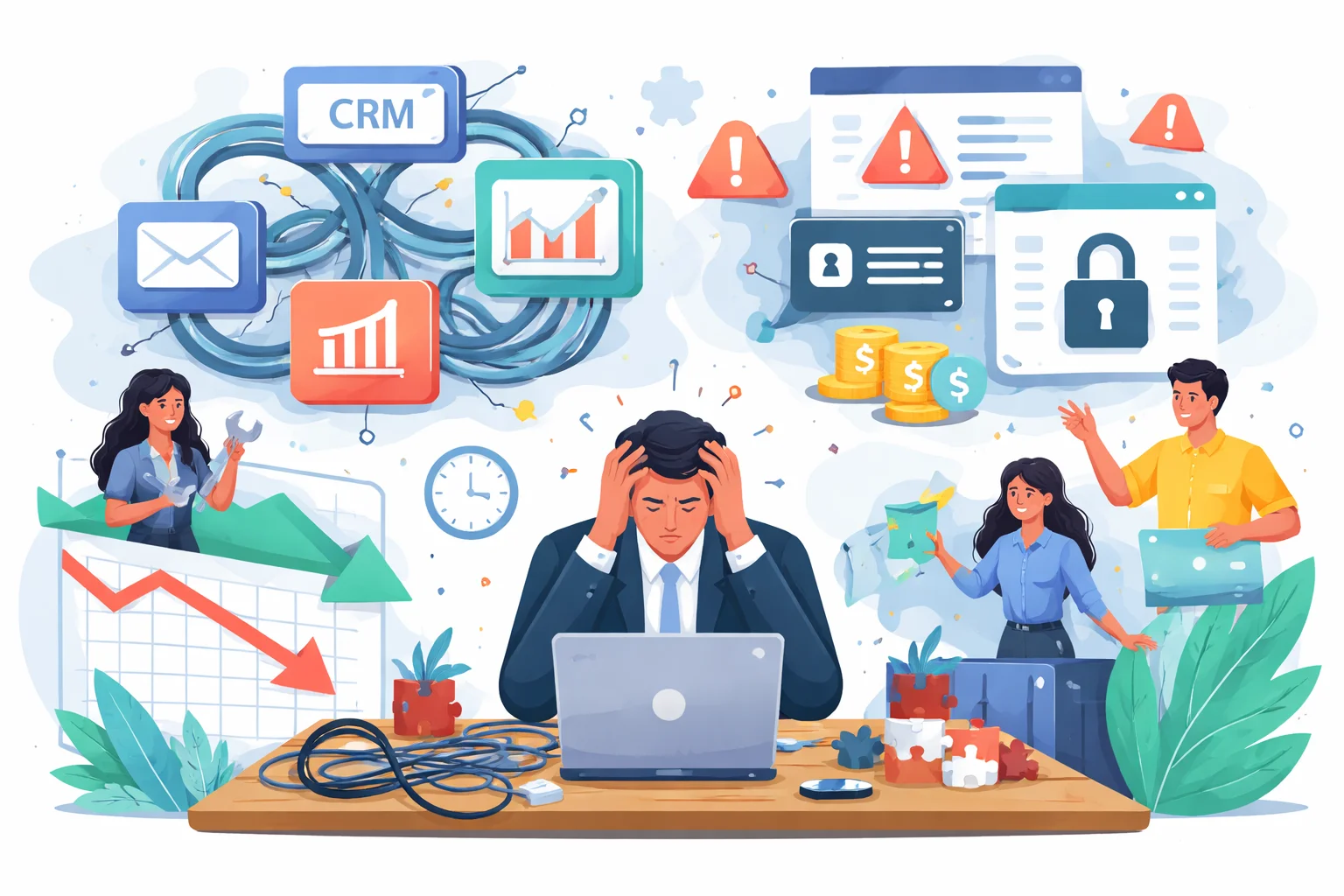
Between 20% and 70% of CRM deployments fail to meet expectations, with poor user adoption cited as the leading cause.
That number is not surprising to anyone who has managed a sales floor.
Most companies invest in All-in-One Sales Software expecting visibility, control, and predictable revenue. What they often get instead is feature overload, low adoption, unreliable forecasts, and quiet resistance from the very people the system was meant to help.
The problem is rarely the idea of consolidation. The problem is how these systems collide with real sales behavior.
Let’s examine why.
The Software Promises Simplicity but Often Creates More Complexity
On paper, everything is centralized:
- Calls
- Emails
- Leads
- Pipeline
- Reports
- Forecasts
Leadership sees consolidation. Sales teams experience a large system with multiple modules, layers, and configurations.
Instead of switching between tools, reps now navigate one heavy system.
Complexity hasn’t disappeared. It has simply been packaged differently.
Too Many Features Increase Friction Instead of Improving Productivity
Most All-in-One Sales Software platforms look impressive during demos because of the number of features they offer.
In daily use, those features often translate into:
- Excessive mandatory fields
- Multiple tabs to log simple activities
- Long update processes
If logging a call feels harder than making the call, the system becomes a burden.
Salespeople are accountable for revenue. When tools slow them down, they look for shortcuts. That is when data quality begins to suffer.
System Integration Does Not Automatically Improve Sales Results
Many businesses justify purchasing All-in-One Sales Software because everything integrates under one platform.
But integration alone does not drive outcomes.
The real impact should be visible in:
- Reduced administrative time
- Faster follow-ups
- Higher conversion rates
- Better forecasting accuracy
If those improvements do not happen, the integration has not created meaningful value.
In many cases, companies underestimate the ongoing effort required to configure, maintain, and train teams on the system.
Sales Teams Struggle When the Software Does Not Match Real Sales Conversations
Sales processes are not perfectly linear.
Prospects delay decisions. They revisit objections. They skip the expected stages.
However, many systems enforce rigid workflows that do not reflect how buying decisions actually unfold.
When the software feels unrealistic, reps stop treating it as a reflection of reality.
Even advanced sales management software fails when it forces structure instead of supporting natural selling behavior.
Poor Data Quality Gradually Reduces Trust in the System
Inconsistent updates are one of the biggest risks.
Over time:
- Pipeline numbers stop matching real deal status
- Forecasts become unreliable
- Managers start asking for manual updates outside the system
The moment leadership questions the data, the platform loses authority.
No All-in-One Sales Software can succeed without disciplined and consistent data entry practices.
Trust is the foundation of adoption.
Companies Often End Up Using Additional Tools Despite Buying an All-in-One Platform
Many organizations expect one platform to replace everything.
But after implementation, teams often discover limitations. For example:
- The built-in dialer may feel slow
- Call analytics may lack depth
- Automation rules may feel restrictive
As a result, teams sometimes continue using separate telecalling software to handle outbound activity efficiently.
Now the business is back to managing multiple systems, and data fragmentation returns.
Leadership Behavior Strongly Influences Whether the Software Is Used Properly
If managers open the system only during performance reviews, it becomes associated with pressure and monitoring.
If leaders use it daily for pipeline discussions and coaching, it becomes a working tool.
Adoption follows behavior.
No Sales Management Software can compensate for weak reinforcement or unclear expectations.
Technology reflects culture. It does not fix it.
Continuous Feature Expansion Distracts Teams from Sales Fundamentals
Most platforms regularly introduce new features, analytics layers, and AI enhancements.
While innovation is valuable, it can shift focus away from what truly improves revenue:
- Faster response time
- Clear follow-up structure
- Strong qualification criteria
- Consistent call preparation
Complex systems can create the appearance of sophistication without improving execution.
Execution remains the primary driver of results.
Artificial Intelligence Cannot Fix Broken Processes
AI is now integrated into many All-in-One Sales Software platforms.
It offers:
- Automated summaries
- Predictive scoring
- Activity recommendations
However, AI depends on clean data and consistent usage.
If foundational discipline is missing, AI adds complexity instead of clarity.
Technology cannot compensate for weak process management.
Many Businesses Do Not Define Clear Success Metrics Before Implementation
Success is often measured through:
- Login frequency
- Feature usage
- Dashboard activity
These are activity metrics, not performance metrics.
More meaningful measures include:
- Conversion rate improvements
- Pipeline velocity
- Forecast accuracy
- Reduced administrative time
Without defining these expectations upfront, organizations struggle to evaluate whether their All-in-One Sales Software is delivering value.
Conclusion
The concept behind All-in-One Sales Software is not inherently flawed.
But consolidation alone does not guarantee productivity.
Sales performance improves when:
- Workflows reflect real conversations
- Data remains accurate and trusted
- Leadership uses the system consistently
- Tools reduce friction instead of adding it
Software should support execution.
If it makes execution harder, it is not solving the problem.

.webp)