Sign up with Google
 Sign in with Zoho

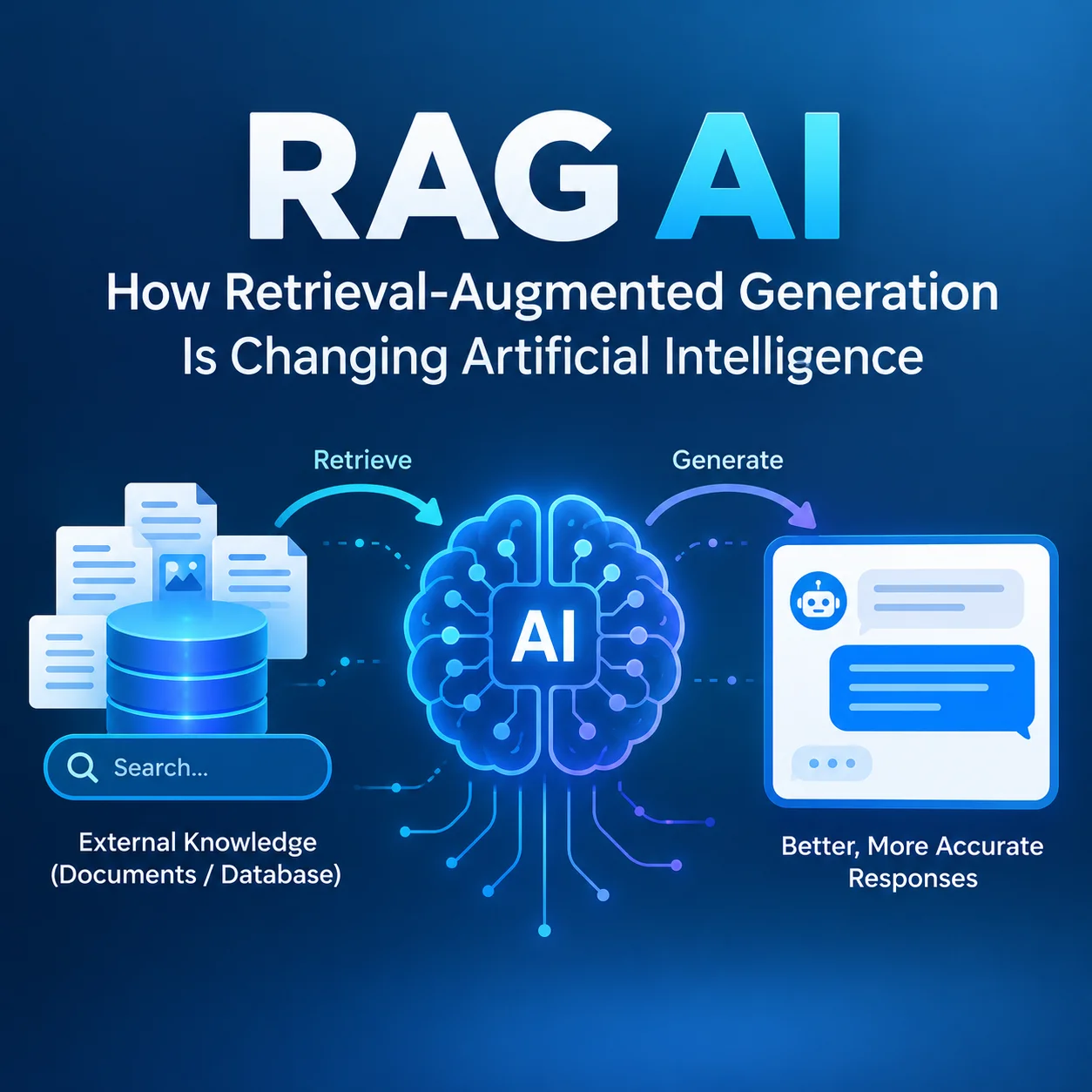
RAG AI: How Retrieval-Augmented Generation Is Changing Artificial Intelligence
Artificial intelligence is becoming an important part of modern technology. AI tools can answer questions, create content, summarize information and help people with many everyday tasks. However, traditional large language models can sometimes provide outdated or incorrect information. Retrieval-Augmented Generation, commonly known as RAG, is one approach designed to improve AI responses by connecting a language model with external information sources.
What Is RAG AI?
RAG stands for Retrieval-Augmented Generation. It combines two important processes: retrieving relevant information and generating a response. Instead of depending only on information learned during model training, a RAG system can search an external knowledge source and provide relevant information to the language model before generating an answer.
How Does RAG Work?
A typical RAG system works in several steps. First, documents or other information are prepared and stored in a searchable knowledge base. The information can come from documents, databases, company files or other sources.
When a user asks a question, the system searches the knowledge base for information that is relevant to the question. The retrieved information is then added to the prompt given to the language model. Finally, the language model uses the question and retrieved information to generate a response.
Why Is RAG Important?
One major benefit of RAG is that it can give an AI system access to information that is not part of its original training data. This is particularly useful for organizations that need answers based on their own documents, policies, product information or other specialized knowledge. RAG can also make it easier to update the information used by an AI application without retraining the entire language model.
Where Can RAG Be Used?
RAG can be useful in customer-support chatbots, company knowledge systems, research tools, document assistants and question-answering applications. For example, a company could connect an AI assistant to its internal documents so employees can ask questions and receive answers based on those documents.
Benefits of RAG
RAG can provide several benefits. It can help AI systems use current or specialized information, improve the relevance of responses and provide a way to connect answers with source information. It can also give developers more control over the information available to an AI application.
Limitations of RAG
RAG is not a guarantee that every AI answer will be correct. The quality of the final response depends partly on the quality of the information retrieved. If the knowledge base contains incorrect, outdated or incomplete information, the AI may still produce a poor answer. Good data preparation, retrieval and monitoring are therefore important when building a RAG system.
The Future of RAG AI
As AI applications become more specialized, connecting language models with reliable external information is becoming increasingly useful. RAG provides a practical way to combine the language-generation abilities of AI models with external knowledge. This makes it an important technique for building AI applications that need relevant and domain-specific information.
Conclusion
RAG AI is an important approach for improving how AI systems use information. By retrieving relevant data before generating an answer, RAG can help make AI responses more useful, contextual and grounded in external knowledge. As businesses and developers continue to build AI applications, RAG is likely to remain an important part of modern AI systems.







.webp)