Sign up with Google
 Sign in with Zoho

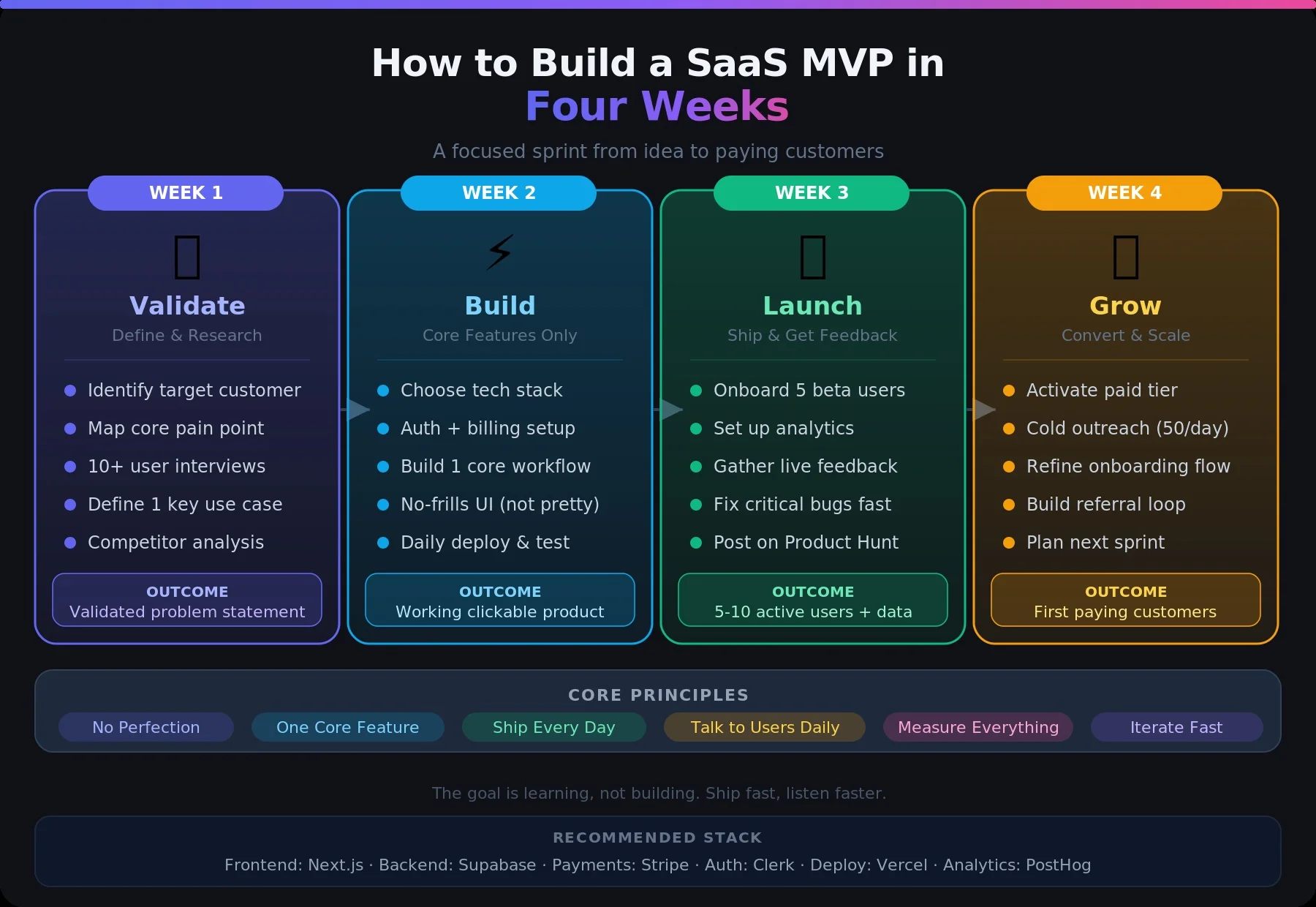
A SaaS MVP, or Minimum Viable Product, is the most stripped-down version of a software-as-a-service product that delivers enough core value to attract real users and generate actionable feedback. The concept was formalized by Eric Ries in "The Lean Startup" and is built on a single principle: ship something real, learn fast, and iterate before investing months or years into a product the market may not want.
The goal of building an MVP in 4 weeks is not arbitrary. Research consistently shows that extended development cycles increase risk, not product quality. According to the Standish Group CHAOS Report, only 31% of software projects are delivered on time and on budget. Compressing the build cycle forces ruthless prioritization and shortens the feedback loop, which is where the real learning happens.
This guide covers the exact steps, tools, and decisions required to build an MVP in 4 weeks, taking a SaaS idea from concept to a live, functioning product in 28 days. Each week has a specific mandate, a defined deliverable, and a clear boundary for what does not belong in that phase. By the end, readers will understand the practical mechanics of rapid SaaS product development and the common mistakes that derail teams before they ever reach launch.
Week 1: Problem Discovery and Core Feature Definition
The most common reason SaaS products fail is not poor execution. It is solving a problem that does not exist at sufficient scale or that users will not pay to have solved. For any team planning to build an MVP in 4 weeks, the first week should be dedicated entirely to problem discovery, not writing a single line of code.
Conduct User Interviews Before Anything Else
Start by conducting a minimum of 10 to 15 interviews with people who represent the target user. These are not sales calls. The goal is to understand how they currently handle the problem, what tools they use, how much time or money the problem costs them, and whether they would pay for a better solution. Open-ended questions like "Walk me through the last time you dealt with this problem" consistently produce more actionable insights than hypothetical preference questions.
Map the Competitive Landscape
Research what already exists. G2, Capterra, Product Hunt, and Reddit are reliable sources for understanding what competitors offer and, more importantly, what their users complain about. Negative reviews on competing products are a direct map of unmet needs and feature gaps.
Define the One Core Job-to-Be-Done
Clayton Christensen's Jobs-to-Be-Done framework is directly applicable here. Ask what specific job the user would hire your product to do. Calendly's core job is eliminating scheduling back-and-forth over email. Notion's core job is consolidating documents, databases, and wikis into one workspace. A minimum viable product should do one job exceptionally well. Every feature that does not directly serve that job belongs in a post-MVP backlog.
Week 1 Deliverable: A one-page problem statement, a list of five to seven candidate features, and a final prioritized core feature set using an impact-versus-effort matrix. The target output is two to three features maximum.
Week 2: Tech Stack Selection and Architecture Design
The second week is about making technical decisions that will determine how fast and how reliably the product can be built. Choosing the wrong stack at this stage is one of the most expensive mistakes in SaaS MVP development because it adds weeks of ramp-up time to a sprint with no room for it.
Choose Technology Your Team Already Knows
Speed beats optimization at the MVP stage. If your team works fluently in React and Node.js, build in React and Node.js. If your team has shipped Python applications, use Django or FastAPI. Adopting a new framework to gain marginal performance benefits adds unpredictable delays. That trade-off is not viable when the objective is to launch an MVP in 4 weeks.
Use Managed Infrastructure to Eliminate DevOps Work
Building custom servers and deployment pipelines is not MVP work. Managed services handle the infrastructure so the team can stay focused on product logic. The following are production-ready and widely adopted:
- Deployment: Vercel, Railway, or Render
- Database and Authentication: Supabase or Firebase
- Payments: Stripe
- Email: Resend or Postmark
These services cover the entire backend infrastructure layer without a dedicated DevOps engineer.
Design the Data Model Before Writing Code
A poorly designed data model in week two creates refactoring debt in week three that breaks timelines. Before any code is written, the team should produce an entity-relationship diagram, define the API endpoints, document the authentication model, and confirm how core data objects relate to each other. One day invested here saves three days of unplanned rework.
Explicitly List What You Will Not Build
Out-of-scope items for an MVP include: custom analytics dashboards, native mobile apps, third-party integrations beyond payment and auth, admin panels, multi-tenancy, localization, and advanced user roles. Write this list down and share it with the entire team. Scope creep is the primary cause of four-week sprints turning into four-month projects.
Week 2 Deliverable: A finalized tech stack decision document, a data model diagram, a list of third-party services to integrate, and a populated project board in Linear, Jira, or Notion.
Week 3: Building the MVP
With discovery complete and architecture locked, week three is the only week spent writing code. The goal is a functional, deployable product by Friday, not a polished one. This is the execution core of every team that successfully delivers an MVP in 4 weeks.
Build in Vertical Slices, Not Horizontal Layers
A common mistake is building the entire backend before touching the frontend. Instead, build one complete user flow end to end before starting the next. This means a user can sign up, perform the core action, and see a result by day two or three. Partial layers sitting in isolation cannot be tested, demonstrated, or shipped.
Use Component Libraries and Starter Kits
UI component libraries eliminate days of CSS and layout work. ShadCN UI, Tailwind UI, MUI, and Chakra UI are all production-quality options with strong community support. Authentication can be implemented in hours using Clerk, Auth0, or Supabase Auth. The guiding principle for week three is: do not build anything that already exists as a maintained, low-cost tool.
Ship at 80 Percent Functionality
The last 20 percent of any product takes 80 percent of the time. In a four-week MVP sprint, a product functioning at 80 percent fidelity that is in front of real users generates more learning than a product at 100 percent that has not shipped. Define "done" as the core user journey working correctly end to end, not every edge case handled.
Week 3 Deliverable: A deployed staging environment with a working end-to-end user flow, functioning authentication, and the core feature operating correctly under normal conditions.
Week 4: Testing, Launch, and Feedback Collection
The final week is about getting the product in front of real users. Development should be frozen by Monday of week four unless a critical bug blocks the core flow. Teams that consistently launch MVPs in 4 weeks treat this week as a go-to-market sprint, not an extension of the build phase.
Test the Core Journey, Not Edge Cases
Functional testing should focus exclusively on the primary user journey: can a user sign up, complete the core action, and have their data persist correctly? Automated end-to-end tests using Playwright or Cypress for the main flow take roughly one day to set up and prevent regressions during launch week. Accessibility checks and mobile responsiveness validation are also recommended before the product goes live.
Define Your MVP Launch Strategy Before Day One of Week Four
Teams that successfully launch MVPs in 4 weeks decide where their first 50 to 100 users will come from before the product is live, not after. Effective channels for early-stage SaaS MVP launches include:
- Reaching back out to the week-one interview participants directly
- Posting on Product Hunt (well-prepared launches averaged 200 to 500 upvotes in 2024 according to Product Hunt community data)
- Sharing in relevant Reddit communities where the target user is active
- LinkedIn posts from the founder's personal account
- A waitlist built during week two via a simple landing page
Instrument the Product Before Launch
Analytics must be live before the first user signs up. PostHog, Mixpanel, and Amplitude all offer free tiers adequate for MVP-stage products. Define three to five key events: account created, core action completed, return visit within seven days, and subscription started. Without tracking these events, the team has no data to inform the next iteration cycle.
Collect Structured User Feedback
Send a five-question survey to early users 48 hours after signup using Typeform or Tally. Ask: what problem they were trying to solve, whether the product solved it, what confused them, what they would pay, and who else they know with the same problem. Qualitative interviews with the first 20 users consistently produce more actionable data than quantitative survey results at this stage.
Week 4 Deliverable: A live production environment, an active analytics setup tracking core events, and a prioritized iteration backlog based on real user input.
Common Pitfalls That Derail SaaS MVP Development
Several patterns consistently prevent teams from shipping within a four-week window.
Building too many features. If the MVP has more than three core features, it is not minimal. Scope creep during week three is the single biggest cause of missed deadlines.
Skipping user interviews in week one. Assumptions about what users want are almost always wrong in at least one significant way. The interviews are not optional.
Learning a new technology during the sprint. Novelty is a post-MVP reward. Use what the team already knows.
Waiting for perfection before launch. An MVP exists to generate feedback, not to demonstrate technical excellence. Shipping at 80 percent and learning from real users is the correct outcome.
Conclusion
A four-week MVP is achievable with disciplined scope management, validated problem discovery, and a team willing to ship before the product feels ready. The timeline forces the kind of prioritization that months-long development cycles avoid. Dropbox launched a demo video before the product was built. Airbnb launched in a single city with no automated payments. Buffer launched with a landing page that had no product behind it and used sign-up conversions to validate demand.
The decision to build an MVP in 4 weeks guarantees one thing: within a month, you will know whether your idea has real market demand. That information, collected quickly and inexpensively, is the actual output of a rapid SaaS product development sprint. Everything built afterward is informed by evidence rather than assumption.
If you need an experienced team to execute this sprint alongside you, Ailoitte's AI Velocity Pods are built exactly for this kind of engagement. Ailoitte is an AI-native product engineering company that has delivered 300+ products across 21+ industries, with an average ship time of 38 days from kickoff to production. Unlike traditional time-and-material engagements where timelines expand and costs drift, AI Velocity Pods operate on a fixed-price, outcome-based model backed by a 4-Week MVP Guarantee — meaning the team is accountable to delivery milestones, not billable hours. Whether you are validating a new SaaS idea or rebuilding a legacy product with modern AI capabilities, Ailoitte brings the architecture expertise, engineering velocity, and domain experience to help you launch an MVP in 4 weeks, right the first time.