Sign up with Google
 Sign in with Zoho
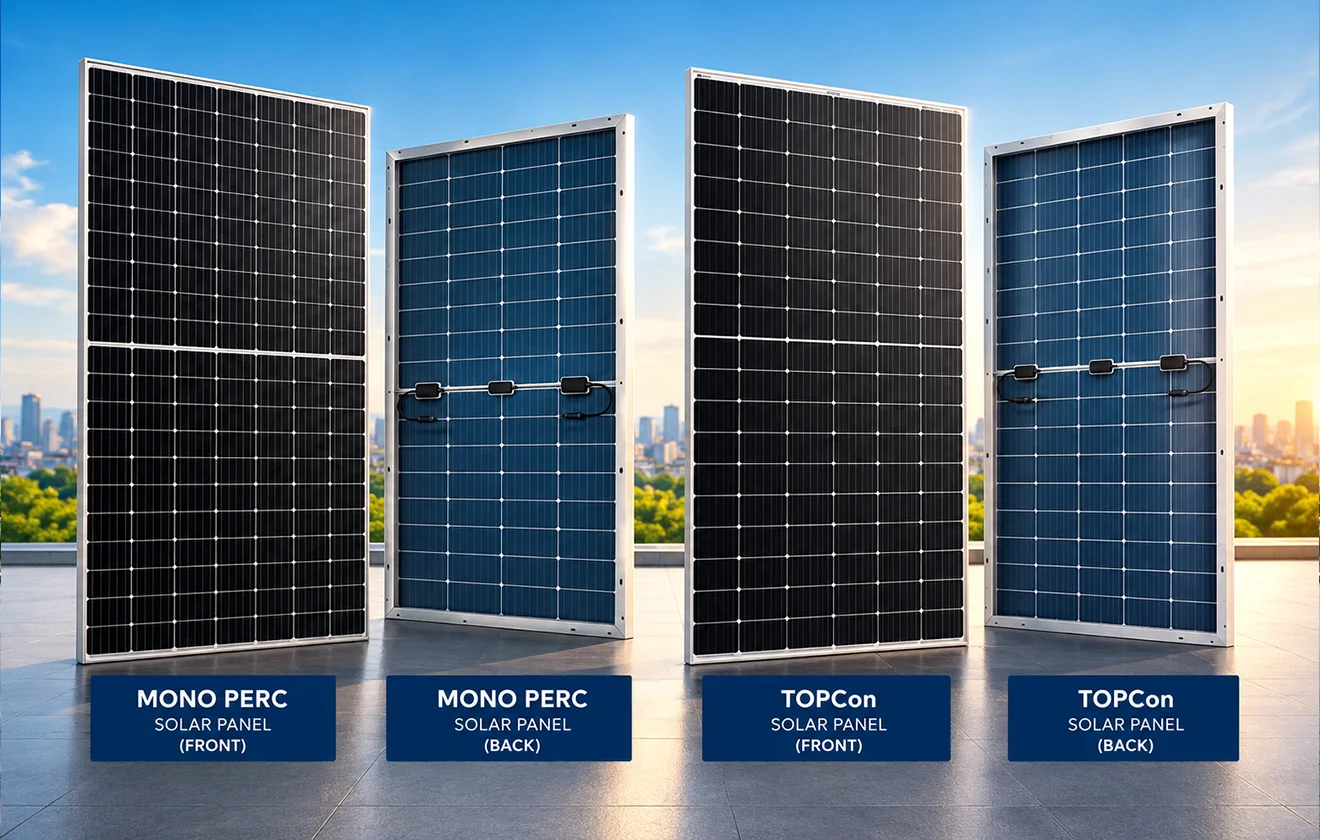
Solar panels turn sunlight into electricity for homes, farms, and businesses, and they keep cutting power bills and carbon emissions for decades. In India, most buyers now choose between Mono PERC, N-type TOPCon, and bifacial modules, and the right pick depends on roof space, budget, and climate. This guide walks through how solar panels work, how these PV module technologies differ, what affects output, and how to choose a system with confidence.
How Solar Panels Work
Solar panels work through the photovoltaic (PV) effect. When sunlight hits a silicon cell, it knocks electrons loose, and that flow of electrons is an electric current.
A typical residential panel packs 60 to 72 silicon cells under tempered glass in an aluminum frame. The cells produce direct current (DC), but your appliances and the grid run on alternating current (AC), so an inverter sits in between to convert one into the other.
A complete solar system usually includes:
- Solar panels that capture sunlight
- An inverter (string, micro, or hybrid) that converts DC to AC
- Mounting and racking that fix the panels to a roof or the ground
- A meter and monitoring system that tracks production and grid exchange
In a grid-connected system, any power you don't use straight away can flow back to the grid. Depending on your local net metering or feed-in rules, that usually earns you bill credits.
Don't treat the inverter as an afterthought. A string inverter is enough for a simple grid-tied rooftop, while a hybrid solar inverter can handle solar, grid, and backup power in a single unit, which is handy if you add storage later. When you compare hybrid solar inverters, look at conversion efficiency, warranty length, and monitoring features.
Types of Solar Panels
Three panel technologies dominate the market. For most Indian rooftops and solar projects today, the choice is between Mono PERC (including half-cut designs), N-type TOPCon, and bifacial modules. Figures below are approximate ranges and vary by manufacturer.
In practice, each one fits a different need:
- Mono PERC and half-cut modules: A mature, widely available technology. A rear passivation layer sends unused light back through the cell, and half-cut cells lose less energy to resistance. Current Mono PERC modules reach roughly 21–22% efficiency and remain a cost-effective choice for homes.
- N-type TOPCon: N-type cells generally degrade more slowly and handle heat well, so TOPCon modules suit sites where space is limited or long-term yield matters most.
- Bifacial modules: Bifacial panels collect light on both faces, and double-glass construction adds durability. They suit commercial and industrial rooftops and open ground sites.
In India, BIS certification and ALMM (Approved List of Models and Manufacturers) listing matter because many subsidy-backed and government-linked projects require ALMM-listed modules. Confirm the current rules for your scheme before you buy.
Benefits of Going Solar
Solar panels cut your electricity bill because every kilowatt-hour you generate is one you don't buy from the utility. Over a system's life of 25 years or more, that adds up, especially if grid tariffs keep climbing.
A few other benefits are worth knowing about:
- Lower carbon footprint: Solar produces electricity without burning fuel or emitting greenhouse gases during operation.
- Energy independence: You become less exposed to price swings and tariff changes.
- Higher property appeal: Homes and buildings with owned solar systems are often more attractive to buyers.
- Low running costs: Panels have no moving parts, so upkeep is minimal.
- Incentives: Many countries and regions offer tax credits, rebates, or net metering. Check what applies locally before you buy.
What Affects Solar Panel Performance
Two identical systems can produce very different amounts of power, depending on where and how they are installed. These five factors matter most:
- Sunlight availability: Regions with more peak sun hours produce more energy per panel.
- Orientation and tilt: In the northern hemisphere, south-facing roofs at a tilt close to your latitude generally perform best.
- Shading: Even partial shade from trees, chimneys, or nearby buildings can cut output sharply on string systems. Microinverters or power optimizers reduce this loss.
- Temperature: Panels lose some efficiency as they get hot. The temperature coefficient on the datasheet shows how much, and the lower it is, the better.
- Dirt and dust: Heavy dust, bird droppings, or pollution film can reduce output, particularly in dry or dusty climates.
Panels also degrade slowly over time. Quality panels typically lose around 0.5% of output per year, and many manufacturers guarantee at least 80–90% of original output after 25 years.
In much of India, summer heat and dust are the two factors you will notice most. A low temperature coefficient (a strength of N-type cells) and regular cleaning help protect output.
How to Choose Panels and an Installer
Start with your electricity bills. Your yearly consumption in kilowatt-hours tells you how big a system you need, and your roof area tells you how big a system you can fit. If space is tight, higher-efficiency panels get you to the same target with fewer modules.
When comparing panels, look at:
- Efficiency and power rating (watts): Higher values mean more output per square meter.
- Warranties: Look for a product warranty of 12 years or more and a performance warranty of 25 years.
- Temperature coefficient: Important in hot climates.
- Certifications: Check for IEC 61215 and IEC 61730 test standards, BIS certification, and ALMM listing if you plan to claim a subsidy or work on a government-linked project.
- Manufacturer track record: Prefer established brands that will still honor warranties in 20 years.
The installer matters as much as the panels. Get at least three written quotes, confirm licensing and insurance, and ask for references from past customers. Compare the cost per watt rather than the total price alone, and make sure they check your roof condition before installing.
Maintenance and Lifespan
Solar panels need very little upkeep, and most last 25 to 30 years or more. A few simple habits keep output high:
- Rinse panels with water a few times a year, or more often in dusty areas. Use a soft brush and avoid harsh chemicals.
- Clean early in the morning or in the evening, when panels are cool.
- Trim branches that start to shade the array.
- Check your monitoring app regularly. A sudden drop in production can signal a fault.
- Have a professional inspect wiring, mounting, and the inverter every few years. Inverters usually need replacing once during the system's life, typically after 10 to 15 years.
Don't walk on panels, and don't clean them yourself on a steep roof. If access is difficult, hire a professional.
Conclusion
Solar panels are still one of the most dependable ways to cut electricity costs and reduce emissions. In India, Mono PERC suits budget-focused rooftops, N-type TOPCon makes sense when space is tight or summers are hot, and bifacial modules work best on open or reflective sites. Match the technology to your site, verify BIS and ALMM status, and choose an inverter that fits. Manufacturer websites such as ADM Solar Power list datasheets and certifications you can compare before you decide.









 copy.webp)