Sign up with Google
 Sign in with Zoho
Talk to anyone sourcing components out of India right now, and you'll notice the conversation has shifted. It used to be almost entirely about price. Now it's about capacity, certification, and whether a supplier's workforce can actually run the automated equipment sitting on their shop floor. Metal manufacture in India is going through a genuine structural change, not just a cyclical upswing, and it's worth understanding why.
The Numbers Behind the Shift
India's metal fabrication sector was valued at roughly USD 3.5 billion in 2025 and is projected to grow at a steady pace through the next decade, pushed along by infrastructure spending, automotive demand, and renewable energy build-out. Crude steel capacity has already crossed 200 million tonnes, and speciality steel output is climbing as manufacturers chase higher-margin, higher-precision work rather than commodity volume.
Solar module manufacturing capacity nearly doubled between March 2024 and March 2025, and wind turbine component capacity now sits close to 18 GW domestically. None of that growth happens without a parallel expansion in precision metal stamping, forming, and fabrication the unglamorous but essential layer of manufacturing that turns raw sheet and coil into brackets, enclosures, connectors, and structural components for the industries above it.
Capacity Is Growing, But Not Evenly
Here's the part that doesn't always make it into the glossy market reports: capacity growth in Indian stamping manufacturing is concentrated. Hiring and investment are clustering around a handful of industrial corridors (Tamil Nadu, Maharashtra, Karnataka, Gujarat, and the Andhra Pradesh–Telangana belt) rather than spreading evenly across the country.
Buyers sourcing from India need to understand this geography, because supplier proximity to these corridors increasingly correlates with access to skilled labour, tooling infrastructure, and logistics reliability.
At the same time, the forging and stamping segments face a real constraint: a shortage of skilled labour for precision and automated processes, particularly among smaller MSME suppliers who haven't yet made the leap to CNC-led, sensor-monitored production. Buyers evaluating suppliers should treat that gap seriously: a shop with modern presses but inconsistent calibration and maintenance discipline can still produce unreliable parts.
The Quiet Bottleneck
Recent workforce data makes an interesting point: physical strength is now considered a low-priority hiring criterion in Indian manufacturing, cited by only around a quarter of employers. What's replaced it? Communication skills and basic computer proficiency, now valued by the large majority of manufacturing employers. That's a genuine shift in what a "skilled" shop floor worker looks like.
As Industry 4.0 technologies (IoT-connected presses, real-time process monitoring, automated material handling) spread through mid-sized manufacturers and export-oriented units, the workforce needs to interpret dashboards and coordinate across functions, not just operate a machine by feel.
Employers are increasingly hiring automation engineers, quality specialists, and robotics technicians alongside traditional press operators. For international buyers, this matters directly: a supplier's digital readiness is now as relevant to due diligence as its tonnage list.
Automation Without Losing the Basics
It's tempting to treat automation as the whole story, but the fundamentals still decide whether a supplier is worth working with. ISO 9001, ISO 14001, and ISO 45001 certifications (covering quality, environmental, and safety management) are increasingly treated as a baseline filter rather than a bonus, especially in regulated sectors like defence, railways, and oil and gas, and that expectation is now spilling into general industrial and electronics manufacturing too.
Manual cutting and forming simply can't match the repeatability of CNC-led processes, so international buyers now expect CNC capability as standard and evaluate suppliers on machine consistency rather than machine count alone. Handling multiple processes (stamping, tooling, plating, sub-assembly) under one roof is also becoming a differentiator, because every vendor handoff introduces a chance for tolerance drift or delay.
Where Established Players Fit In
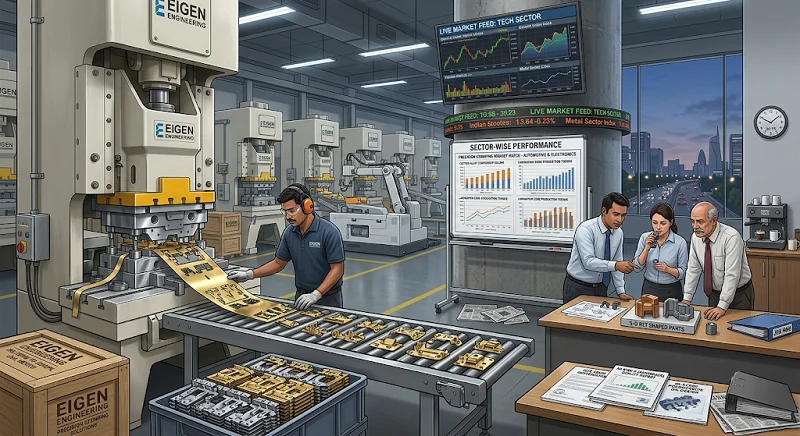
This is exactly the environment where manufacturers with decades of process discipline have an advantage over newer entrants chasing capacity alone. Eigen Engineering, based in Bangalore, is a case in point: an IATF 16949, AS9100D, ISO 9001:2015, ISO 14001:2015, and ISO 45001:2018 certified precision metal stamping company that has built its business around progressive die development, tooling, and value-added processes like plating and insert moulding, serving automotive, aerospace, electrical, and electronics clients across India, Europe, and the US.
That combination of certification depth and in-house process control is increasingly what separates suppliers who can scale reliably from those who simply have more machines on the floor.
What This Means for Buyers
India's metal manufacturing base is expanding, but expansion alone isn't the story worth paying attention to. The suppliers worth building long-term relationships with are the ones investing in both automation and the skilled people needed to run it, backed by certifications that prove process discipline rather than just claim it.
As global sourcing continues to favour China-plus-one diversification, that combination of capacity, skills, and quality systems will decide which Indian manufacturers become long-term partners and which stay stuck as low-margin subcontractors.





 (1) (1).webp)