Sign up with Google
 Sign in with Zoho

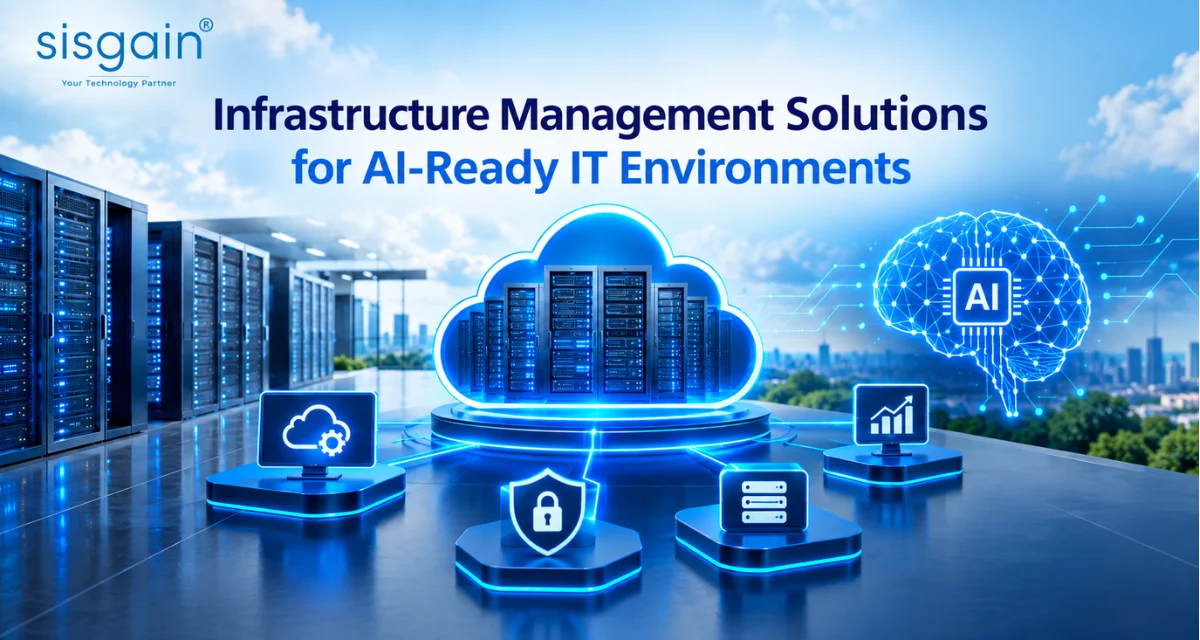
Artificial intelligence is becoming an important part of modern business operations, from intelligent automation and predictive analytics to generative AI applications and real-time decision-making. However, deploying AI successfully requires more than advanced models and quality data. Organizations also need an IT environment capable of supporting high-performance computing, scalable workloads, continuous data processing, and rapidly changing resource requirements.
This is where infrastructure management solutions play an important role. Modern infrastructure management helps businesses monitor, optimize, secure, and scale their IT environments so they can support AI workloads efficiently while maintaining reliability and cost control.
What Makes an IT Environment AI-Ready?
An AI-ready IT environment is designed to support workloads that can be significantly more demanding than traditional business applications. AI applications may require high-performance computing, GPUs, large-scale storage, fast networking, and flexible cloud resources.
A strong AI-ready infrastructure typically includes:
- Scalable compute and storage resources
- High-speed networking and data transfer
- Cloud and hybrid infrastructure capabilities
- Automated monitoring and resource management
- Strong security and access controls
- Reliable data pipelines
- Containerized and orchestration-based environments
- Cost visibility and optimization mechanisms
Building these capabilities requires organizations to take a strategic approach to infrastructure design rather than simply adding computing resources when demand increases.
Why Infrastructure Management Matters for AI Workloads
AI workloads can change rapidly. Training models may require substantial computing resources for limited periods, while inference applications may need consistent low-latency performance. Without proper infrastructure management, organizations can experience resource shortages, unnecessary cloud spending, performance bottlenecks, and operational complexity.
Effective infrastructure management enables businesses to:
- Improve resource utilization by matching infrastructure capacity with workload requirements.
- Scale applications efficiently as AI workloads increase or decrease.
- Identify performance issues before they affect critical applications.
- Improve infrastructure visibility across cloud, on-premises, and hybrid environments.
- Control operational costs through continuous monitoring and optimization.
- Strengthen security and compliance with centralized controls and monitoring.
Key Components of AI-Ready Infrastructure Management
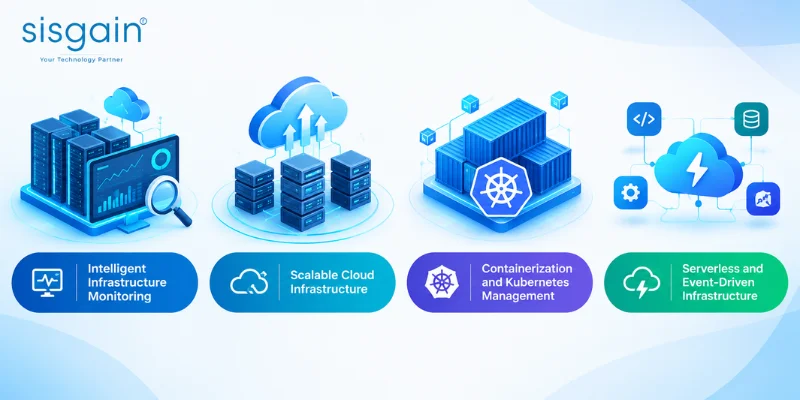
Intelligent Infrastructure Monitoring
Continuous monitoring is essential when managing AI environments. IT teams need visibility into compute utilization, memory consumption, network performance, storage activity, application health, and workload behavior.
Modern monitoring platforms can use automation and analytics to identify unusual patterns and potential infrastructure problems. This allows teams to investigate issues proactively instead of waiting for application failures.
For AI workloads, monitoring should consider both infrastructure-level metrics and application-level performance. This provides a more complete understanding of how resources affect AI applications.
Scalable Cloud Infrastructure
Cloud platforms provide the flexibility required for many AI workloads. Organizations can increase or decrease computing resources according to demand instead of maintaining excess physical capacity.
However, effective cloud deployment requires thoughtful architecture. Cloud architecture consulting can help organizations design scalable environments that consider workload requirements, security, availability, data movement, and long-term operating costs.
A well-designed architecture can also support hybrid and multi-cloud strategies when organizations need to distribute workloads across different environments.
Containerization and Kubernetes Management
AI applications increasingly use containers because they provide consistency across development, testing, and production environments. Kubernetes can further simplify the deployment and orchestration of containerized workloads.
However, managing Kubernetes at scale can become complex. Kubernetes Consulting can help organizations establish appropriate cluster architectures, workload configurations, resource allocation strategies, security controls, and monitoring practices.
For AI environments, effective Kubernetes management can help teams:
- Allocate computing resources more efficiently
- Automate workload deployment
- Scale applications based on demand
- Improve application portability
- Establish consistent operational practices
Serverless and Event-Driven Infrastructure
Not every AI workload requires dedicated infrastructure running continuously. Event-driven applications, APIs, automation workflows, and lightweight AI services can benefit from serverless technologies.
Serverless Architecture Consulting can help organizations determine where serverless approaches are appropriate and where conventional or container-based infrastructure is more suitable.
A hybrid architecture can combine virtual machines, containers, serverless functions, managed databases, and specialized computing resources according to workload requirements.
Managing AI Costs With FinOps
AI workloads can generate significant infrastructure expenses, particularly when organizations use high-performance computing resources or large-scale cloud services. Simply reducing infrastructure capacity is not always the right solution because it can negatively affect application performance.
A cloud FinOps service helps organizations connect cloud spending with business and technical requirements. FinOps practices provide greater visibility into resource consumption and help teams identify inefficient spending.
Key FinOps practices for AI environments include:
- Monitoring AI-related infrastructure spending
- Identifying unused or underutilized resources
- Establishing budgets and spending thresholds
- Allocating costs to applications or teams
- Forecasting future infrastructure requirements
- Automating resource optimization where appropriate
The objective is not simply to reduce costs. Instead, FinOps focuses on achieving better business value from technology investments.
The Role of Software Engineering in AI Infrastructure
Infrastructure and application development can no longer be treated as completely separate disciplines. AI applications often require specialized APIs, data pipelines, microservices, automation workflows, and scalable application architectures.
Software engineering services can support the development of applications that are designed to operate effectively within modern infrastructure environments. This includes building cloud-native applications, integrating AI capabilities, developing APIs, improving application performance, and implementing automation.
When application architecture and infrastructure are designed together, organizations can create systems that are easier to scale, monitor, secure, and maintain.
Modernizing Infrastructure Through Cloud Migration
Many organizations still operate applications on legacy infrastructure that was not designed for modern AI workloads. Moving suitable applications and data to cloud environments can provide greater flexibility and access to modern infrastructure capabilities.
However, migration should be approached strategically. Cloud migration consulting services can help organizations evaluate existing systems, identify suitable migration approaches, assess dependencies, and develop a practical modernization roadmap.
A migration strategy may include:
- Rehosting suitable applications
- Replatforming applications for cloud environments
- Refactoring legacy systems
- Modernizing databases and data platforms
- Moving selected workloads to managed services
- Retiring unnecessary infrastructure
The appropriate approach depends on application complexity, business priorities, compliance requirements, performance expectations, and available resources.
Integrating Cloud and Managed Services
Managing a modern AI-ready environment can involve multiple technologies and operational responsibilities. Organizations may need to manage cloud infrastructure, security, monitoring, backups, networking, containers, databases, and application platforms simultaneously.
Cloud and managed services can provide ongoing operational support across these areas. Managed approaches can help organizations maintain infrastructure availability, monitor systems continuously, apply operational controls, and respond to changing requirements.
This can be particularly valuable for businesses that want to adopt advanced technologies without significantly increasing the complexity of their internal IT operations.
Best Practices for Building an AI-Ready Infrastructure
Organizations planning to modernize their infrastructure should consider both current requirements and future growth.
1. Start With Workload Assessment
Identify which applications require AI capabilities, how they consume resources, and what performance requirements they have. This creates a foundation for infrastructure planning.
2. Design for Scalability
Infrastructure should be capable of adapting to changes in workload demand. Automated scaling, flexible cloud resources, and container orchestration can help achieve this goal.
3. Establish Strong Observability
Monitor infrastructure, applications, data pipelines, and costs through centralized observability practices. Clear visibility helps teams make informed operational decisions.
4. Build Security Into the Architecture
AI environments may process sensitive business information and large volumes of data. Identity management, encryption, network security, access controls, and continuous monitoring should be considered from the beginning.
5. Optimize Costs Continuously
Infrastructure optimization should be an ongoing process. Review resource utilization, workload performance, and cloud spending regularly instead of treating optimization as a one-time project.
The Future of AI-Ready Infrastructure Management
As AI adoption grows, infrastructure management is likely to become increasingly automated and intelligence-driven. Predictive monitoring, automated scaling, AI-assisted resource allocation, and policy-based optimization can reduce manual operational work.
Future infrastructure environments may increasingly combine:
- AI-assisted infrastructure monitoring
- Automated workload optimization
- Predictive capacity planning
- Intelligent cloud cost management
- Kubernetes-based orchestration
- Serverless and event-driven architectures
- Hybrid and multi-cloud infrastructure
These capabilities can help IT teams move from reactive infrastructure management toward proactive and automated operations.
Conclusion
AI-ready infrastructure requires a combination of scalability, performance, security, observability, and cost efficiency. Organizations that rely on traditional infrastructure management practices may struggle to support rapidly changing AI workloads effectively.
Modern infrastructure management solutions provide a foundation for managing these challenges by combining cloud technologies, automation, monitoring, container orchestration, FinOps practices, software engineering, and infrastructure modernization.
By adopting a strategic approach to infrastructure, businesses can create technology environments that are prepared not only for today's AI workloads but also for future innovation. The goal is to build an infrastructure ecosystem that can scale intelligently, operate efficiently, and support long-term digital transformation.