Sign up with Google
 Sign in with Zoho

Launching a startup in India is exciting, but building a successful business involves much more than developing a product, finding customers, and raising funds. Legal and regulatory compliance should be part of the business strategy from day one.
Many first-time founders postpone legal formalities because they believe compliance can be addressed after the business starts generating revenue. This approach can create expensive problems later, particularly during fundraising, due diligence, hiring, expansion, or a potential acquisition.
In 2026, startups also need to pay closer attention to data protection, employment regulations, intellectual property, taxation, corporate filings, and evolving government frameworks. For example, the DPIIT Startup Recognition framework was updated in 2026, including an increase in the general turnover threshold to ₹200 crore.
Understanding the most common Startup Legal Mistakes India founders make can help entrepreneurs build a stronger legal foundation and avoid preventable disputes.
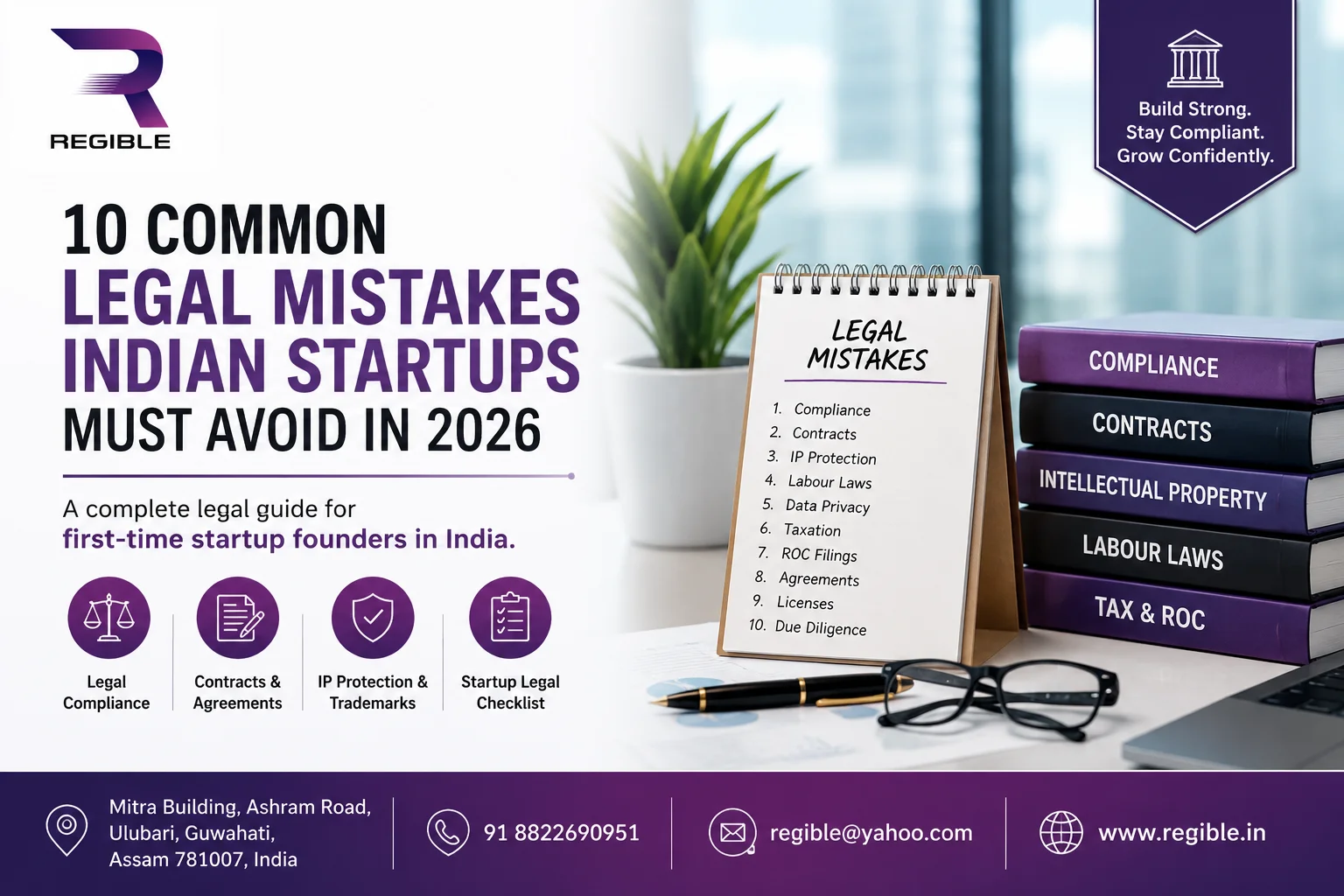
10 Common Legal Mistakes Indian Startups Should Avoid
1. Choosing the Wrong Business Structure
One of the first legal decisions a founder makes is choosing an appropriate business structure.
Many startups begin informally without evaluating whether a proprietorship, partnership, LLP, or Private Limited Company India structure is appropriate for their long-term goals.
For venture-backed or growth-oriented businesses, a private limited company can often be more suitable because it provides a structured framework for ownership, shareholding, governance, and investment.
Before completing Startup Registration India, founders should consider:
- Number of founders and investors
- Funding requirements
- Ownership and equity structure
- Liability protection
- Tax implications
- Future expansion plans
- Compliance requirements
The right structure should support the startup's future rather than simply minimize the initial paperwork.
2. Starting Without a Proper Founders Agreement
Friendship and trust are not substitutes for written agreements.
A comprehensive Founders Agreement India can establish how founders will work together and what happens if circumstances change. This becomes particularly important when there are multiple founders.
The agreement should ideally address:
- Equity ownership
- Roles and responsibilities
- Decision-making authority
- Founder compensation
- Intellectual property ownership
- Confidentiality
- Exit or resignation
- Founder disputes
- Share transfer restrictions
- Deadlock resolution
A founders agreement cannot eliminate every future disagreement, but it can significantly reduce ambiguity.
3. Ignoring Intellectual Property Protection
A startup's most valuable asset may not be its physical property. It could be its brand, software, design, technology, content, or proprietary process.
Failing to protect these assets is one of the major Legal Issues Faced By Startups In India.
Founders should consider Trademark Registration Startup requirements before investing heavily in branding. They should also review copyright, patent, design, domain-name, confidentiality, and trade-secret protection where relevant.
Another common mistake is assuming that work created by an employee or freelancer automatically belongs to the company. Appropriate intellectual property assignment clauses should be included in employment and vendor agreements.
4. Treating DPIIT Recognition as Automatic
Eligible businesses should evaluate DPIIT Startup Recognition early rather than assuming that incorporation alone makes a business a recognized startup.
As of 2026, Startup India states that eligible startups can generally be incorporated as private limited companies, registered partnership firms, LLPs, or cooperative societies. The ordinary startup recognition framework provides for a company age limit of 10 years and a turnover ceiling of ₹200 crore, subject to applicable eligibility conditions. DeepTech startups have separate thresholds.
DPIIT recognition may provide access to benefits relating to tax exemptions, intellectual property, procurement, and compliance, subject to separate eligibility requirements.
Founders should therefore verify current eligibility instead of relying on outdated articles or assumptions.
5. Neglecting ROC Compliance
Incorporation is only the beginning of corporate compliance.
A private company must continue meeting applicable requirements under corporate law. Missing statutory filings, maintaining poor records, failing to hold required meetings, or neglecting changes in directors and shareholding can create unnecessary complications.
ROC Compliance Startup obligations should therefore be tracked through a centralized compliance calendar.
Depending on the company's structure and circumstances, founders may need to monitor:
- Annual returns
- Financial statement filings
- Board and shareholder meetings
- Statutory registers
- Director-related filings
- Share allotments and transfers
- Changes to registered office
- Auditor-related requirements
Good documentation also makes future investor due diligence significantly easier.
6. Delaying GST and Tax Compliance
Another frequent mistake is assuming that GST becomes relevant only after a startup becomes large.
The applicability of GST For Startups India depends on factors such as the nature of supplies, turnover, location, registration requirements, and applicable exemptions or special provisions.
Founders should evaluate GST obligations before launching commercial operations and not simply wait until a tax notice arrives.
A startup should maintain:
- Proper invoices
- Tax records
- Input tax credit documentation
- GST returns where applicable
- Accounting records
- Tax payment schedules
Tax compliance should be integrated with bookkeeping from the beginning rather than reconstructed later.
7. Overlooking Data Protection Responsibilities
For technology companies, e-commerce businesses, SaaS platforms, fintech businesses, health-tech companies, and other digital ventures, personal data can become a major legal responsibility.
The DPDP Act India Startup landscape is particularly important in 2026. MeitY notified the Digital Personal Data Protection Rules, 2025 on November 14, 2025, along with an enforcement timeline and related measures. The government has described the framework as providing a phased implementation period.
Startups should therefore review:
- What personal data they collect
- Why they collect it
- How consent and notices are handled
- Where information is stored
- Who can access it
- How third-party vendors process it
- How data breaches are managed
- How long information is retained
A privacy policy alone should not be treated as the entire data-protection strategy.
8. Ignoring Startup Labour Laws India Requirements
Hiring the first employee can transform a founder's legal responsibilities.
Startups should not assume that a small workforce means employment laws can be ignored. Depending on the state, workforce, industry, and employment model, obligations can involve wages, social security, working conditions, leave, workplace safety, and other employment requirements.
India's labour-law framework is also evolving. The Ministry of Labour and Employment currently provides information on the four Labour Codes and related 2026 rules, including the Code on Wages, Industrial Relations Code, Code on Social Security, and Occupational Safety, Health and Working Conditions Code.
Founders should therefore review Startup Labour Laws India requirements applicable to their particular business and location.
9. Using Weak Contracts With Customers and Vendors
A startup may have an excellent product but still face serious commercial problems because its contracts are unclear.
Verbal commitments and generic internet templates can leave important issues unresolved.
Important agreements may include:
- Customer agreements
- Vendor contracts
- Employment agreements
- Consultant agreements
- Non-disclosure agreements
- Service-level agreements
- Software licensing agreements
- Intellectual property assignments
Contracts should clearly define payment terms, deliverables, ownership, confidentiality, warranties, termination, dispute resolution, and liability.
10. Failing to Maintain a Startup Legal Checklist India
The final mistake is treating compliance as a one-time task.
A practical Startup Legal Checklist India should evolve as the company grows. A business that starts with two founders and no employees will have very different legal obligations from a company with investors, employees, customers across multiple states, and significant personal-data processing.
A basic checklist can include:
- Entity incorporation and statutory records
- PAN, TAN and applicable registrations
- GST assessment
- DPIIT recognition assessment
- Trademark and IP protection
- Founder and employment agreements
- Customer and vendor contracts
- ROC filings
- Tax compliance
- Labour-law compliance
- Data-protection review
- Licences and sector-specific approvals
- Annual legal and compliance audit
The goal is not to create unnecessary paperwork. It is to ensure that important legal obligations are identified before they become problems.
How Founders Can Build Better Startup Compliance India Systems
Legal compliance becomes much easier when it is built into normal business operations.
Founders can follow a simple process:
Step 1: Identify applicable laws.Create a list based on the startup's industry, state, employees, customers, revenue model, and data processing activities.
Step 2: Assign responsibility.Someone should own the compliance calendar. Depending on the company's size, this may be a founder, finance team, company secretary, legal professional, or external advisor.
Step 3: Track deadlines.Use a centralized calendar for ROC, tax, labour, licence, contractual, and other recurring obligations.
Step 4: Maintain documentation.Keep incorporation records, agreements, invoices, board documents, IP records, employment documentation, and statutory filings organized.
Step 5: Review compliance during growth events.Fundraising, hiring, entering new states, launching new products, acquiring another business, or collecting new categories of personal data should trigger a legal review.
Conclusion: Make Legal Compliance Part of Your Startup Strategy
The biggest legal risks for startups often do not come from complicated laws alone. They come from ignoring basic requirements until the business is already growing.
From selecting the right entity and preparing a Founders Agreement India to protecting intellectual property, evaluating GST For Startups India, completing ROC Compliance Startup obligations, reviewing the DPDP Act India Startup framework, and staying updated on employment regulations, founders should treat legal compliance as an essential part of business planning.
A well-maintained Startup Legal Checklist India can help first-time entrepreneurs identify obligations early and build a business that is easier to fund, scale, operate, and protect.
If you are launching or growing a startup and need help assessing registrations, contracts, taxation, intellectual property, or ongoing compliance, contact Regible Corporate Advisor LLP for professional legal and compliance assistance. Taking the right legal steps early can help you focus on what matters most: building a sustainable and scalable business.