Sign up with Google
 Sign in with Zoho

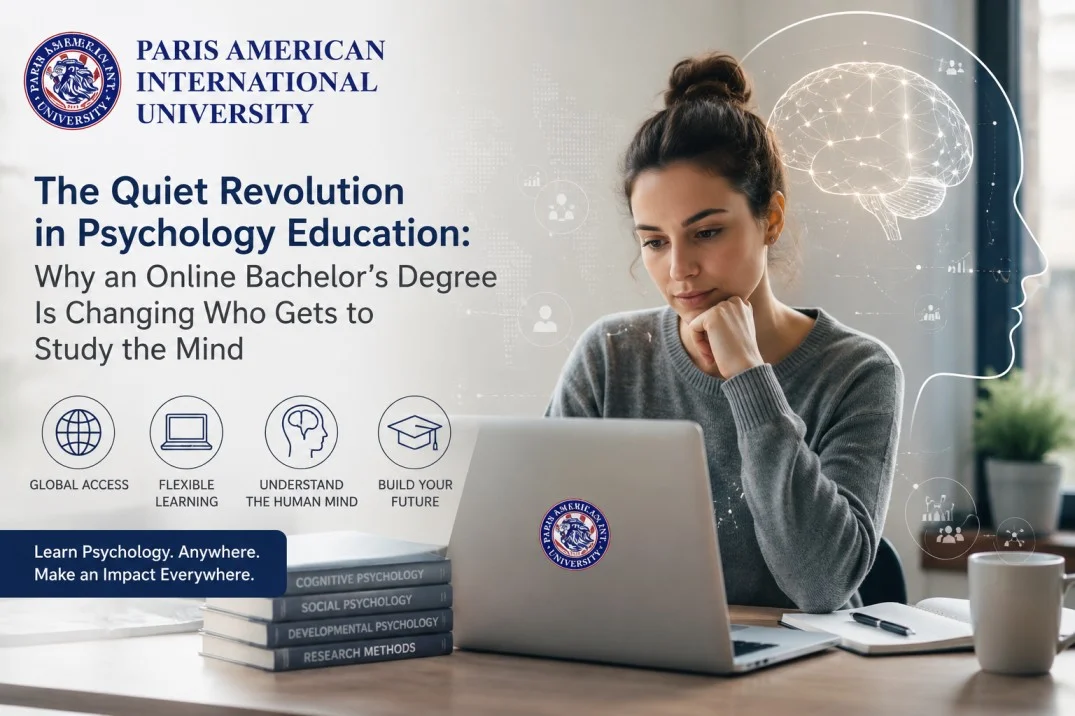
Psychology has always attracted students who ask uncomfortable questions about why people behave the way they do, how experiences shape identity, and what conditions allow human beings to thrive or to suffer. What has changed is who gets to pursue those questions at a university level. The online bachelor's degree in psychology has quietly widened the door to this field in ways that traditional campus-based programs structurally could not, and the students walking through that door are more diverse, more professionally experienced, and in many cases more motivated than previous generations of undergraduate cohorts.
That shift is worth taking seriously. Not as a trend, but as a genuine structural change in how psychological knowledge is transmitted and who gets to contribute to it.
Access Was Always the Hidden Problem
For decades, the unspoken assumption in higher education was that students began university at eighteen, lived near a campus, had family financial support, and could dedicate four years primarily to academic study. Psychology departments were built around that student. Everyone else, the working parent, the career-changer in their thirties, the student in a country without strong local psychology programs, found the door technically open but practically difficult to enter.
An online bachelor's degree in psychology dissolves most of those barriers without dissolving the academic standards behind them. A student in Nairobi, a healthcare worker in rural France, a mother of two in Melbourne can now engage with rigorous psychological theory, research methodology, and clinical foundations on a schedule their life actually permits. The knowledge being taught is identical. The flexibility of engagement is what has changed.
Here's something worth considering: widening access does not dilute a discipline. It enriches it. When psychology classrooms, even virtual ones, contain students from healthcare, education, law enforcement, social work, and business, the discussions that emerge are more textured and more practically grounded than those produced by a homogeneous cohort of recent school-leavers.
What a Psychology Degree Actually Builds
There is a persistent misunderstanding that a psychology degree is primarily useful for people who want to become therapists. The reality is considerably broader.
Students working through an online bachelor's degree in psychology develop skills that transfer into almost every professional environment where human beings interact, make decisions, or need to be understood. Research literacy is one. The ability to evaluate evidence critically, identify methodological weaknesses, and distinguish between what data shows and what people claim it shows, is a skill employers across sectors actively seek. Communication is another. Psychological training requires students to explain complex, often uncomfortable ideas clearly and precisely, which is a discipline with obvious professional value.
At the same time, the content itself prepares graduates for roles far beyond clinical practice. Human resources, user experience research, public health, education, organisational development, marketing research, and policy analysis all draw regularly from graduates with psychological training. The field is less a narrow professional pipeline than a broad analytical foundation with multiple exits.
Building Toward Advanced Study
For students who discover during their undergraduate years that psychology is not just a career path but an intellectual vocation, the question of what comes next becomes urgent.
The pathway from an online bachelor's degree in psychology to postgraduate and doctoral study is more direct than many students initially assume. A well-designed undergraduate program builds the research skills, theoretical grounding, and academic writing capabilities that postgraduate entry requires. Students who engage seriously with research methods modules, dissertation work, and theoretical seminars arrive at master's programs with genuine preparation rather than just a credential.
Paris American International University structures its psychology programs with this progression in mind. The undergraduate curriculum is designed not only to introduce students to the discipline but to develop the independent scholarly thinking that advanced study demands. For students with research ambitions, the path toward a doctorate degree in psychology online becomes a genuine possibility rather than a distant aspiration.
That said, doctoral study in psychology is a serious undertaking. A doctorate degree in psychology online suits students who have developed a specific research interest, who can sustain independent investigation over multiple years, and who want to contribute original knowledge to the field rather than simply accumulate qualifications. The undergraduate years are where those qualities either develop or don't, which is one reason the choice of undergraduate program matters more than it sometimes appears.
The International Dimension of Psychological Study
Psychology is a universal discipline in its subject matter but far from universal in its assumptions. Different cultural contexts produce different understandings of mental health, emotional expression, social obligation, and individual wellbeing. Students who engage with those differences, either through international academic environments or through globally diverse cohorts, develop a more sophisticated and more practically useful understanding of human behavior than those trained within a single cultural frame.
Paris American International University brings its bicultural French-American academic identity to bear on its psychology programs in ways that reflect this reality. Students engaging with the university's programs encounter perspectives shaped by different intellectual traditions, different clinical cultures, and different research priorities. That exposure sharpens analytical thinking and builds the kind of cultural competence that psychology, practiced seriously, requires.
Careers That a Psychology Education Opens
The careers available to psychology graduates span a range that surprises most people encountering the field for the first time. Clinical and counselling roles are the obvious ones, but they represent only a portion of where graduates actually end up.
School psychology, forensic assessment, health behavior research, corporate wellbeing programs, public policy analysis, and academic research are all fields where psychology graduates build substantial careers. Those who continue to master's and doctoral level open additional pathways in research, clinical specialisation, academic teaching, and consultancy.
Truthfully, the most valuable thing a psychology education provides is not a list of job titles. It is a way of thinking about human behavior that makes a professional more perceptive, more rigorous, and more genuinely useful in whatever environment they work in. An online bachelor's degree in psychology is where that way of thinking begins to form.