Sign up with Google
 Sign in with Zoho

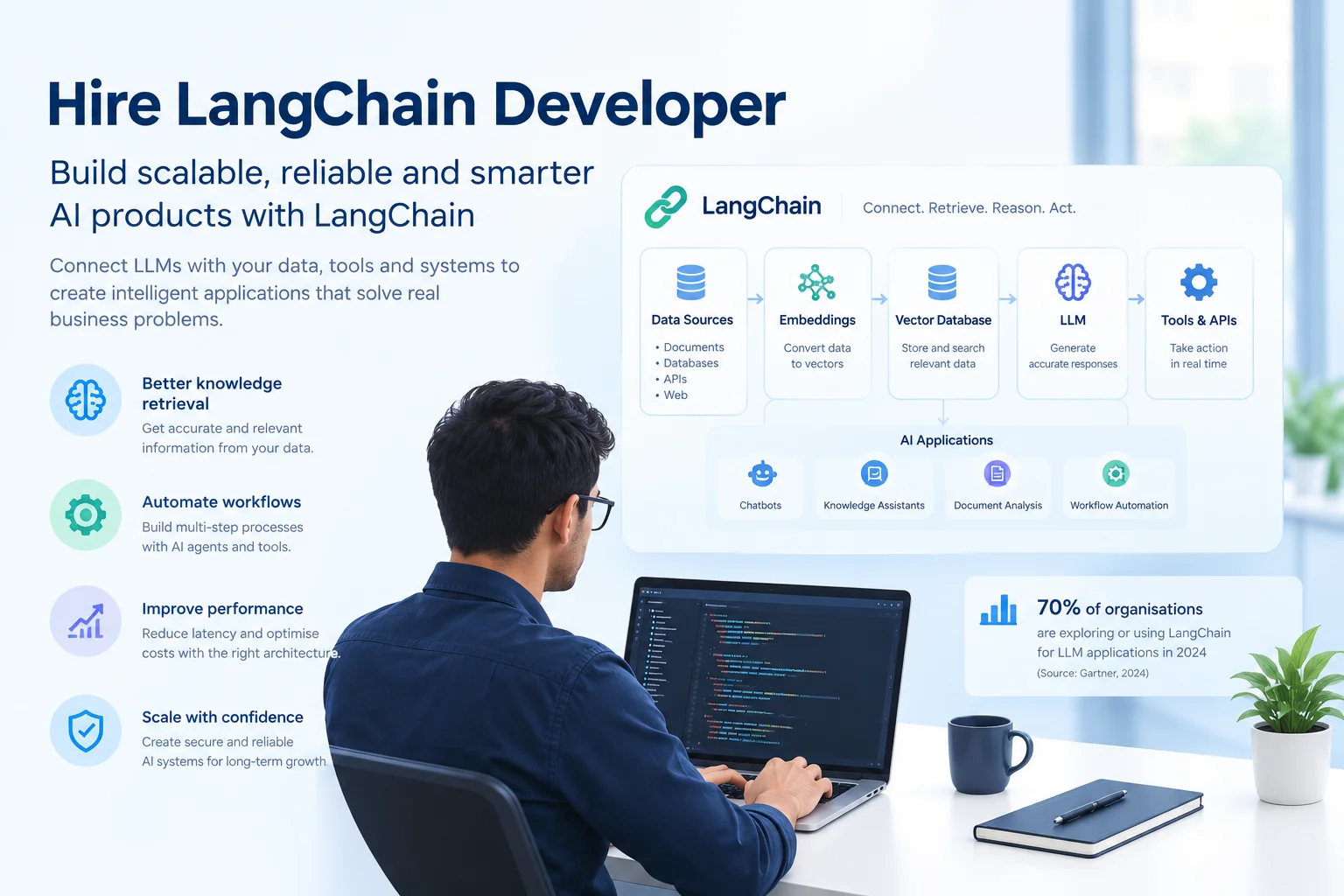
Hire LangChain Developer to Build Scalable, Reliable and Smarter AI ProductsIntroduction
Artificial intelligence is transforming how businesses develop products, automate workflows and deliver customer experiences. LangChain is a framework that helps developers connect large language models (LLMs) with external data, APIs and tools to build practical AI applications.
Businesses looking to Hire LangChain Developer expertise need professionals who can turn AI capabilities into reliable, scalable and useful products. From intelligent customer support to internal knowledge assistants, LangChain can help organisations solve real business challenges.
Why LangChain Matters for AI Product Development
Traditional LLM applications often rely on prompts and a model's existing knowledge. LangChain enables developers to connect models with external information, databases and tools, making it possible to build applications that handle more complex tasks.
For example, a customer support assistant can retrieve product documentation before generating a response. An internal knowledge platform can help employees search company documents and find relevant information quickly.
However, LangChain alone does not guarantee accurate results. Product quality depends on data quality, model selection, retrieval methods and continuous testing.
What a LangChain Developer Brings to a Business
A skilled LangChain developer can help businesses design AI workflows that connect language models with existing systems.
Key capabilities include:
- LLM integration: Connecting language models with applications and external services.
- RAG development: Building retrieval pipelines that allow AI applications to use relevant business information.
- Workflow automation: Creating multi-step processes that combine AI models with tools and structured actions.
- API integration: Connecting AI applications with databases, customer platforms and internal software.
- Performance optimisation: Improving response quality, latency and operating costs through testing and refinement.
These capabilities can support enterprise search, document analysis, customer service automation and AI-assisted business operations.
LangChain vs Traditional LLM Development
A traditional LLM application may generate responses using a prompt and a model. LangChain provides additional components for connecting models to external tools, data sources and workflows.
This can make it easier to develop applications that require multiple integrations or structured processes. However, simpler applications may not need a framework like LangChain.
The right approach depends on the product's complexity, performance requirements and maintenance needs. Decision-makers should prioritise measurable business value rather than adding unnecessary technical complexity.
How Businesses Can Improve AI Performance
Successful AI development requires more than connecting a model to a data source. Teams should evaluate response accuracy, retrieval relevance, latency, security and cost per request.
For example, a business developing an AI knowledge assistant can begin with a small set of real user questions. Developers can measure whether the system retrieves the right information and generates useful answers.
Caching, efficient model selection and better retrieval strategies can help reduce operating costs. Monitoring and regular evaluation also help teams identify problems as business data and user requirements change.
Building Scalable AI Products with LangChain
As AI adoption grows, businesses need applications that integrate with existing systems and adapt to changing requirements.
LangChain can support this process through reusable components, integrations and workflow orchestration. Scalability also depends on infrastructure, data quality, access controls and system monitoring.
For CTOs, founders and product managers, the priority should be building AI systems that solve specific business problems while maintaining reliability and manageable operating costs.






.webp)