Sign up with Google
 Sign in with Zoho
Industrial heating systems depend on more than the heating element itself. Accurate temperature control plays a direct role in product quality, process consistency, energy efficiency, equipment protection, and operational reliability. For manufacturers across India, selecting the right industrial temperature controller is therefore an important engineering decision rather than simply a component purchase.
Businesses searching for controller manufacturers in India often need solutions that can perform reliably under demanding industrial conditions while integrating with heaters, sensors, control panels, and wider automation systems. The right controller should match the process requirements, heating load, temperature range, sensor type, control logic, safety requirements, and operating environment.
As industrial processes become more automated and precision-driven, demand for dependable industrial temperature controllers and integrated heating solutions continues to grow. From plastics and packaging to food processing, pharmaceuticals, semiconductor applications, automotive manufacturing, and specialized machinery, temperature control remains a critical part of production performance.
Why Industrial Temperature Control Matters
Temperature variation can affect almost every stage of a thermal process. Excessive heating may damage materials, reduce component life, or create safety concerns. Insufficient heating can result in incomplete processing, inconsistent output, or production delays.
A properly selected industrial temperature control system helps maintain the desired process temperature by continuously receiving input from a sensor and adjusting the heating output according to the programmed settings.
Depending on the application, this may involve:
- PID temperature control
- On-off control
- Multi-zone temperature management
- Digital temperature displays
- Thermocouple or RTD sensor compatibility
- Solid-state relay integration
- Contactor-based switching
- Alarm and safety functions
- Programmable heating profiles
- Panel-mounted or machine-integrated controllers
For industrial operations, the objective is not simply to reach a temperature. It is to maintain stable, repeatable, and controlled thermal conditions throughout the production process.
What to Look for in Controller Manufacturers in India
Not every temperature controller is suitable for every industrial process. A controller used in a small laboratory setup may have very different requirements from one controlling multiple heating zones in a production machine.
When evaluating controller manufacturers in India, engineering teams should consider several practical factors.
1. Application Understanding
A capable manufacturer should understand the complete thermal application. This includes the heating method, material being processed, target temperature, process cycle, sensor requirements, electrical load, and environmental conditions.
The controller must work as part of the overall heating system rather than as an isolated device.
2. Sensor Compatibility
Industrial temperature measurement commonly relies on thermocouples and RTD sensors. The selected controller must support the appropriate sensor type and provide reliable measurement performance.
Incorrect sensor-controller matching can lead to inaccurate readings and unstable temperature control.
3. Control Accuracy and Stability
Precision is particularly important in processes where even small temperature variations can affect the final product. Advanced PID control can help reduce temperature fluctuations and improve process stability when correctly configured.
The required level of accuracy should always be determined according to the actual process rather than assuming that one specification is suitable for every application.
4. Integration with Heating Equipment
A controller performs best when it is correctly matched with the heating system. Depending on the application, this may include tubular heaters, cartridge heaters, coil heaters, ceramic heaters, flexible heating systems, or custom-designed heating assemblies.
For example, manufacturers using a tubular heater element should evaluate not only the heater wattage but also the controller capacity, switching method, sensor placement, and process response time.
5. Safety and Protection
Industrial thermal systems may require high-temperature alarms, sensor failure detection, over-temperature protection, emergency shutdown capabilities, and appropriate electrical protection.
Safety functions should be evaluated as part of the complete engineering design.
Industrial Temperature Controllers and the Complete Heating System
One of the most important considerations in industrial thermal engineering is system compatibility. The performance of a temperature controller is directly influenced by the characteristics of the heater, sensor location, process mass, insulation, airflow, and control parameters.
For this reason, working with an industrial electric heating manufacturer that understands both heating elements and control systems can simplify system design.
A complete solution may involve:
- Custom heating elements
- Temperature sensors
- Industrial controllers
- Control panels
- Power switching components
- Thermal engineering support
- System integration
- Application-specific testing
Instead of selecting individual components independently, manufacturers can evaluate how each part works within the complete thermal process.
Nexthermal provides industrial heating and temperature control solutions designed around application requirements. Businesses looking for coordinated heating and control systems can explore its industrial temperature controller solutions based on their specific operational needs.
Applications of Industrial Temperature Controllers
Industrial temperature controllers are used across a wide range of manufacturing and process applications.
Plastics and Polymer Processing
Plastic processing equipment often requires controlled heating across multiple zones. Extrusion systems, injection molding machines, dies, barrels, and other components depend on stable temperature conditions.
The controller must respond effectively to changes in process load while maintaining the programmed temperature range.
Packaging Machinery
Sealing, laminating, shrink packaging, and heat-processing equipment require repeatable thermal performance. Inconsistent temperatures can affect seal quality, material appearance, and production efficiency.
Chemical and Process Industries
Heating processes may involve tanks, vessels, pipelines, reactors, or specialized equipment. Controller selection must consider process dynamics, temperature range, sensor selection, and safety requirements.
Food Processing Equipment
Certain food processing and packaging operations depend on controlled heating for consistency and process reliability. Equipment design must also consider applicable industry and hygiene requirements.
Pharmaceutical and Specialized Manufacturing
Precision temperature management can be important where material characteristics, repeatability, and controlled operating conditions are essential.
Machinery and OEM Applications
Machine manufacturers frequently require customized control systems that integrate directly with their equipment. A well-designed system can support easier installation, operation, diagnostics, and maintenance.
The Role of Tubular Heaters in Industrial Heating
Tubular heaters remain widely used across industrial applications because they can be designed in different shapes, sizes, watt densities, and configurations.
A reliable tubular heaters manufacturer should evaluate factors such as:
- Heating medium
- Operating temperature
- Watt density
- Material selection
- Sheath compatibility
- Bending configuration
- Electrical requirements
- Mounting method
- Process environment
The heating element and temperature controller must be selected together whenever possible. A high-performance controller cannot compensate for an incorrectly designed heating element, poor sensor placement, or unsuitable watt density.
Businesses evaluating custom heating systems can learn more about tubular heater solutions and how heater configuration can be matched with process control requirements.
Custom Heating Elements for Specialized Applications
Standard heating products may not always meet the requirements of specialized machinery or production processes. Custom heating elements allow manufacturers to specify dimensions, power ratings, materials, electrical connections, mounting arrangements, and performance characteristics based on the application.
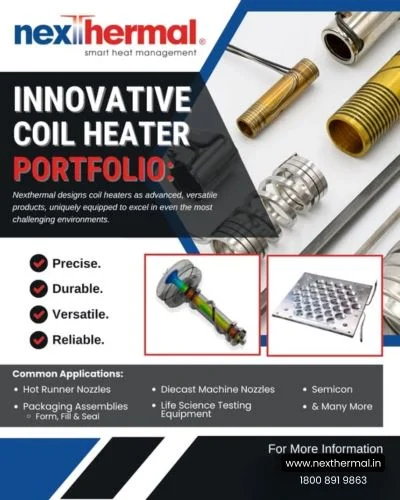
Nexthermal works with industrial heating requirements across different applications, including solutions involving cartridge heating elements, ceramic heating elements, and coil heaters.
Custom engineering can be especially valuable when equipment operates under unique conditions or requires integration into an existing production system.
Why Sensor Selection Influences Controller Performance
A temperature controller can only respond to the information it receives. This makes sensor selection and placement essential to the overall control system.
Thermocouples and RTD sensors may be selected based on factors such as temperature range, required accuracy, response time, environment, and application compatibility.
Sensor location also matters. If the sensor is positioned away from the critical process area, the controller may respond to a temperature that does not accurately represent the actual process condition.
For integrated thermal systems, manufacturers can consider compatible temperature sensing solutions alongside heating and controller selection.
Control Panels for Integrated Industrial Heating Systems
For complex equipment, a standalone controller may be only one part of the solution. A complete control panel can combine controllers, power components, relays, contactors, protection devices, indicators, and other electrical elements into an organized system.
This approach can support:
- Centralized control
- Multi-zone heating management
- Improved equipment integration
- Simplified operator access
- Better electrical organization
- Application-specific safety features
Companies requiring integrated solutions can explore temperature controller and control panel systems designed for industrial applications.
Engineering Support Creates Long-Term Value
The best industrial heating solution is not always the one with the highest specification. It is the solution that fits the process correctly.
Before selecting a controller or heating element, engineering teams should define:
- Required operating temperature
- Maximum process temperature
- Heating medium or material
- Required heating rate
- Process heat loss
- Available electrical supply
- Sensor type and location
- Number of heating zones
- Required control accuracy
- Safety and shutdown requirements
A detailed engineering review can reduce the risk of selecting incompatible components and may improve long-term system reliability.
Nexthermal also provides thermal engineering services in India for businesses that require application-focused support for heating and temperature control challenges.
How to Choose the Right Industrial Temperature Controller
When comparing industrial temperature control solutions, it is useful to follow a structured approach.
Start with the Process Requirement
Identify what is being heated, the required temperature range, and how quickly the process needs to respond.
Define the Heating Load
The controller and switching components must be appropriate for the electrical load and heating configuration.
Select the Right Sensor
Choose a compatible sensor based on the operating environment and required measurement performance.
Consider Future Expansion
Some manufacturing systems may later require additional heating zones, monitoring functions, or automation capabilities. Planning for future requirements can reduce redesign work.
Evaluate the Complete System
Controllers, heaters, sensors, and panels should be assessed as an integrated thermal system.
Work with an Application-Focused Manufacturer
Experience with industrial heating applications can help identify practical design considerations that may not be visible in a basic product specification.
Nexthermal’s Approach to Industrial Heating and Control Solutions
Nexthermal focuses on custom heating elements, controllers, and industrial heating solutions for application-specific requirements. Rather than treating temperature control as a separate component, the engineering approach can consider the relationship between heating, sensing, control, electrical integration, and operational requirements.
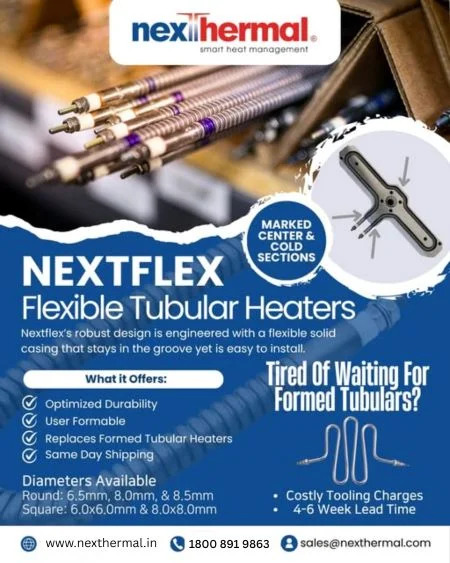
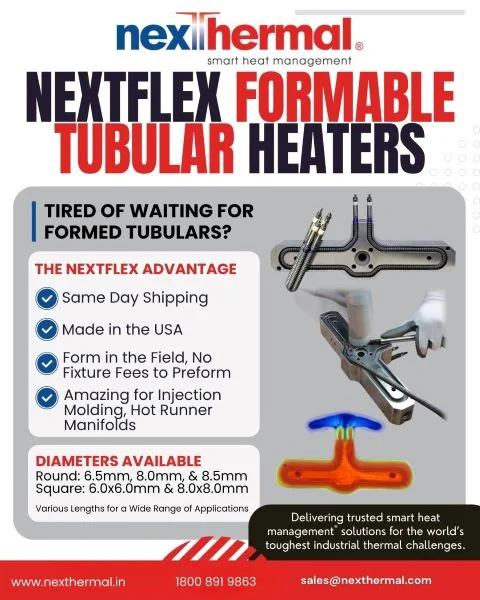
Businesses can also explore Nextflex heating solutions for specialized heating applications where flexibility and application-specific design are important.
For organizations evaluating an industrial temperature control project, reviewing the application with an experienced engineering team can help clarify heater selection, control architecture, sensor requirements, and integration needs.
Industry Perspective: Building More Reliable Thermal Processes
As Indian manufacturing continues to adopt automation, precision engineering, and energy-conscious production practices, temperature management will remain an important part of equipment design.
The future of industrial heating is increasingly focused on complete systems rather than individual components. Manufacturers are looking for solutions that combine properly engineered heating elements, responsive sensors, reliable industrial temperature controllers, suitable electrical controls, and application-specific engineering support.
For businesses comparing controller manufacturers in India, the strongest decision is usually based on process compatibility, engineering understanding, component quality, safety requirements, and the ability to support the complete thermal system.
A well-designed temperature control strategy can support more stable production, improved process consistency, better equipment protection, and a stronger foundation for long-term industrial performance.
Phone: 1800 891 9863
Book a Consultation: https://www.nexthermal.in/contact/
Visit website: https://www.nexthermal.in/
Visit Product Page: https://www.nexthermal.in/industrial-temperature-controller-manufacturers-in-india/