Sign up with Google
 Sign in with Zoho

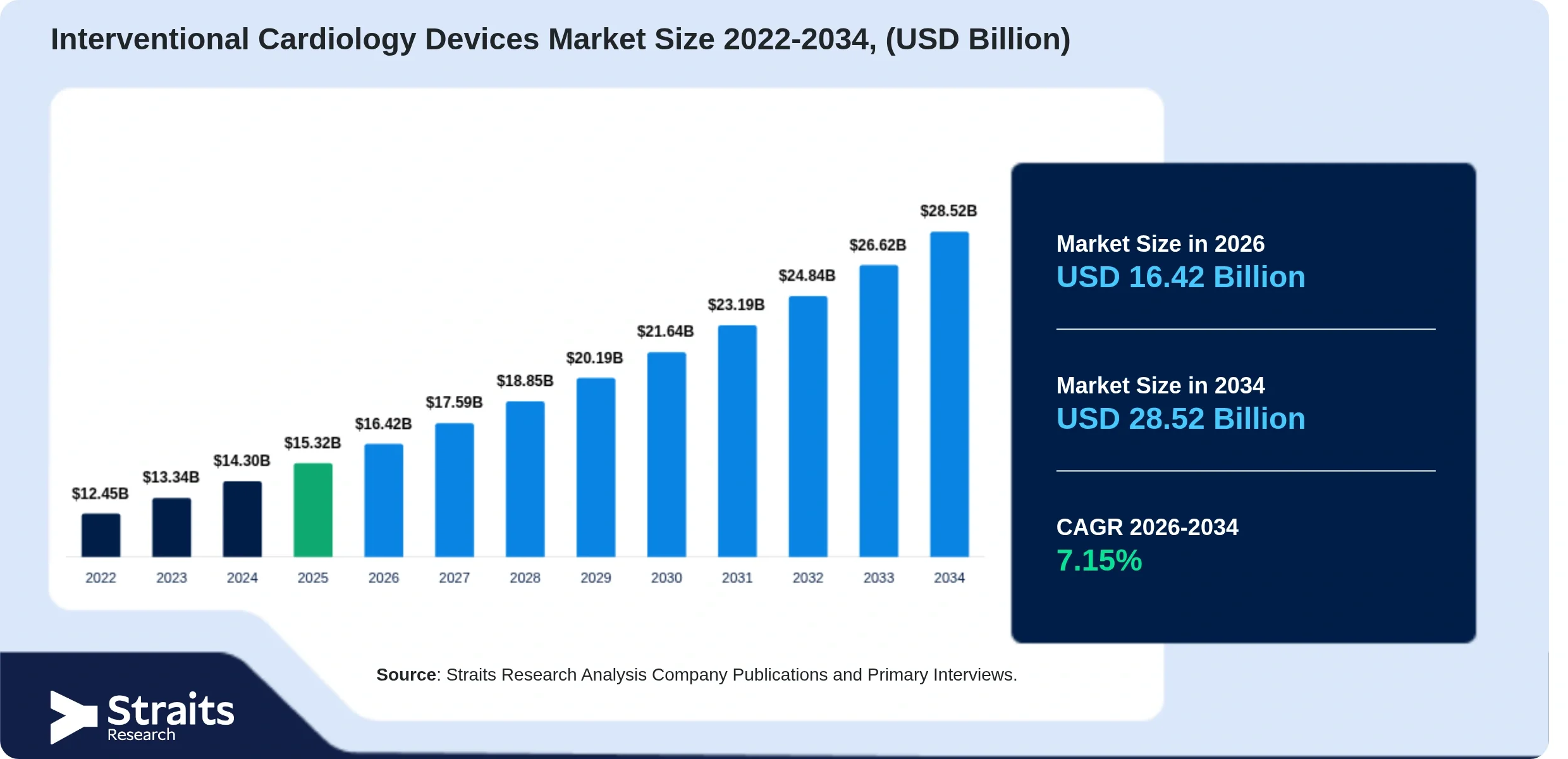
The Interventional Cardiology Devices Market is evolving through innovations in coronary stents, catheter technologies, imaging, and robotic-assisted procedures. These developments are improving procedural capabilities and supporting market growth
Interventional Cardiology Devices Market Trends
AI-Assisted Imaging Is Improving Precision in PCI Procedures
AI-assisted imaging is gaining importance in interventional cardiology as clinicians seek faster and more consistent assessment of coronary lesions. AI applications combined with intravascular ultrasound and optical coherence tomography can support calcium assessment, vessel preparation, and stent sizing. A 2025 study involving 30 interventional cardiologists found that AI-assisted OCT reduced assessment time while supporting lesion evaluation. This trend is strengthening the role of automated image interpretation in PCI planning and procedural decision-making.
Robotic-Assisted PCI Is Supporting Radiation-Sparing Procedures
Robotic-assisted PCI is gaining attention as cardiac centers seek to reduce occupational radiation exposure and improve procedural ergonomics. Robotic systems allow physicians to control interventional devices from radiation-shielded workstations while maintaining procedural capabilities. The 2026 PARTY randomized trial involving 148 patients reported substantially lower operator radiation exposure with robotic PCI than with manual PCI, supporting continued interest in robotic-assisted intervention.
Interventional Cardiology Devices Market Drivers
Higher PCI Procedure Volumes Drive Market Demand
Higher volumes of percutaneous coronary intervention procedures increase demand for coronary stents, guidewires, catheters, balloons, and other procedural devices. Hospitals and cardiac centers require recurring supplies as procedure numbers increase, creating stable procurement opportunities for manufacturers. The expansion of cardiac catheterization laboratories further increases demand because newly equipped facilities require a broad range of devices for coronary angiography and PCI.
Rising Cardiovascular Disease Burden Supports Device Adoption
The increasing prevalence of cardiovascular diseases creates a larger patient pool requiring diagnosis and minimally invasive treatment. An aging population also contributes to demand because older adults face a higher risk of cardiovascular conditions. The resulting need for coronary intervention supports the use of stents, balloons, catheters, and guidewires across hospitals and specialized cardiac centers.
Interventional Cardiology Devices Market Challenges
Device Quality and Reliability Issues
Device failures, recalls, or performance problems can interrupt procedures and reduce clinician confidence in specific products. Such incidents can also increase scrutiny of manufacturers and affect hospital procurement decisions. The FDA's September 2026 Class I recall involving Boston Scientific's Imager II angiographic catheter after two serious injuries illustrates how device-quality issues can affect product use and market confidence.
Occupational Risks in Catheterization Laboratories
Radiation exposure, musculoskeletal strain, and psychological pressure create operational challenges for interventional cardiology teams. High-volume catheterization laboratories require strong safety practices and workforce management to limit these risks. Occupational concerns can influence procedure workflows, staff retention, and the adoption of technologies designed to reduce radiation exposure.
Interventional Cardiology Devices Market Segmentation
By Product Type
The coronary stents segment dominated the Interventional Cardiology Devices Market with a 36.8% share in 2025 and is also projected to register the fastest CAGR of 7.86% during 2026–2034. Coronary stents help maintain vessel openness after coronary interventions and remain an important component of PCI procedures. Advances in stent design and drug-eluting technologies continue to support their use in cardiovascular interventions.
The market also includes catheters, PTCA balloons, PTCA guidewires, and other product types, which support vascular access, navigation, vessel dilation, and other procedural requirements.
Regional Insights
North America
North America dominated the Interventional Cardiology Devices Market with a 38.5% share in 2025. Advanced healthcare infrastructure, widespread access to specialized cardiac care, and strong adoption of minimally invasive cardiovascular procedures support regional demand. The substantial cardiovascular disease burden in the U.S. also sustains the need for advanced cardiac diagnosis and intervention technologies.
Asia Pacific
Asia Pacific is projected to be the fastest-growing region, with a CAGR of 9.18% during 2026–2034. Expanding healthcare infrastructure, a rising cardiovascular disease burden, and greater adoption of advanced cardiac intervention technologies support regional growth. China and India offer significant opportunities as healthcare capacity and access to specialized cardiovascular treatment continue to expand.
Europe
Europe accounted for a 27.4% share in 2025 and is projected to grow at a 6.92% CAGR during 2026–2034. Established healthcare systems, demand for minimally invasive procedures, and continued improvements in cardiovascular treatment technologies support the regional market.
Middle East and Africa
The Middle East and Africa market is supported by increasing investments in healthcare infrastructure and improving access to specialized cardiovascular services. The development of advanced hospitals and cardiac centers can expand the availability of catheter-based procedures and create additional demand for interventional devices.
Latin America
Latin America is supported by the rising need for cardiovascular diagnosis and treatment, improvements in healthcare infrastructure, and increasing access to minimally invasive procedures. Expanding cardiac care capacity across major markets can create additional opportunities for device manufacturers and healthcare providers.
Key Players in the Interventional Cardiology Devices Market
The Interventional Cardiology Devices Market includes global medical device manufacturers, specialized cardiovascular companies, catheter and stent manufacturers, and regional device producers. Major players include B. Braun Melsungen AG, Biotronik, Abbott Laboratories, Biosensors International Ltd., Boston Scientific, Terumo Medical Corporation, Cardinal Health, Cook Medical Inc., and Medtronic Inc.
The competitive market ecosystem focuses on product innovation, clinical evidence, regulatory approvals, manufacturing capabilities, physician relationships, hospital procurement networks, and procedural performance. Established companies compete through broad portfolios, while emerging players focus on specialized technologies, minimally invasive solutions, advanced imaging, and application-specific devices.
A reliable cumulative market-share percentage specifically for B. Braun Melsungen AG, Biotronik, Abbott Laboratories, Biosensors International Ltd., and Boston Scientific is not publicly disclosed in authoritative non-market-research sources.
Recent Industry Developments
The industry is experiencing continued product innovation across structural heart intervention, coronary devices, imaging, guidewires, and catheter technologies. According to the current market report, Abbott expanded its structural heart and interventional cardiology portfolio in June 2025, while Boston Scientific introduced advanced coronary intervention technologies in September 2025. Medtronic expanded its cardiac intervention portfolio in November 2025, and Terumo introduced next-generation guidewire and catheter technologies in February 2026.
The regulatory landscape also remains important for manufacturers. The U.S. FDA classifies coronary stents as Class III medical devices and subjects them to premarket approval requirements, reflecting the safety and clinical evidence requirements associated with implanted cardiovascular devices.
Future Outlook
The Interventional Cardiology Devices Market is expected to maintain steady expansion through 2034 as cardiovascular disease burden, PCI procedure volumes, catheterization laboratory capacity, and minimally invasive treatment adoption increase. Technology developments in AI-assisted imaging and robotic-assisted PCI are adding new capabilities to cardiovascular procedures, while coronary stents remain the leading product segment.
Asia Pacific is positioned as the fastest-growing regional market, while North America continues to hold the largest market position. Product innovation, procedural precision, device reliability, and access to specialized cardiac infrastructure will remain important factors shaping market development through 2034.
Detailed Market Insights
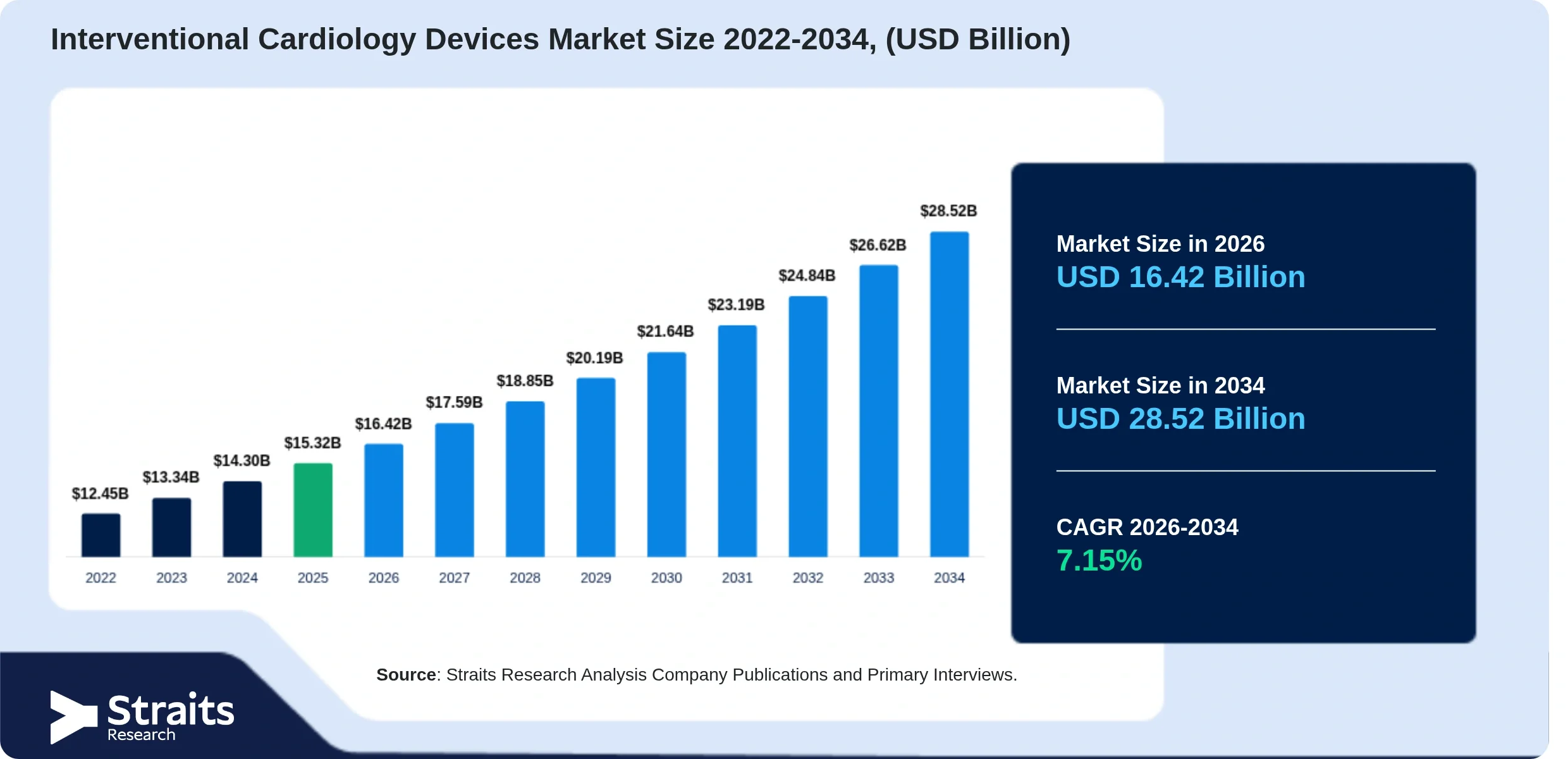
The global Interventional Cardiology Devices Market is projected to increase from USD 15.32 billion in 2025 to USD 28.52 billion by 2034, at a 7.15% CAGR during 2026–2034. North America held the largest regional share at 38.5% in 2025, while Asia Pacific is expected to record the fastest growth at 9.18%. The coronary stents segment led the market with a 36.8% share in 2025.
Market Size (2025): USD 15.32 BillionMarket Size (2026): USD 16.42 BillionProjected Market Size (2034): USD 28.52 BillionCAGR (2026–2034): 7.15%Largest Region (2025): North AmericaNorth America Share (2025): 38.5%Fastest-Growing Region: Asia PacificAsia Pacific CAGR (2026–2034): 9.18%Leading Product Segment: Coronary StentsCoronary Stents Share (2025): 36.8%
For detailed market data, segmentation, competitive analysis, and regional forecasts, visit the
https://straitsresearch.com/report/interventional-cardiology-devices-market