Sign up with Google
 Sign in with Zoho

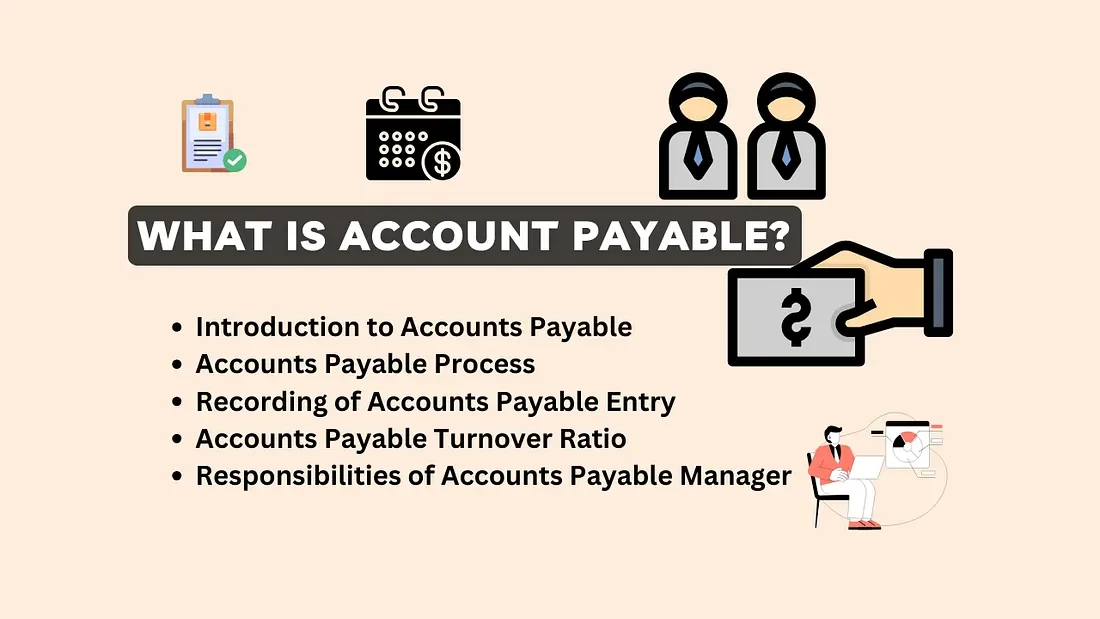
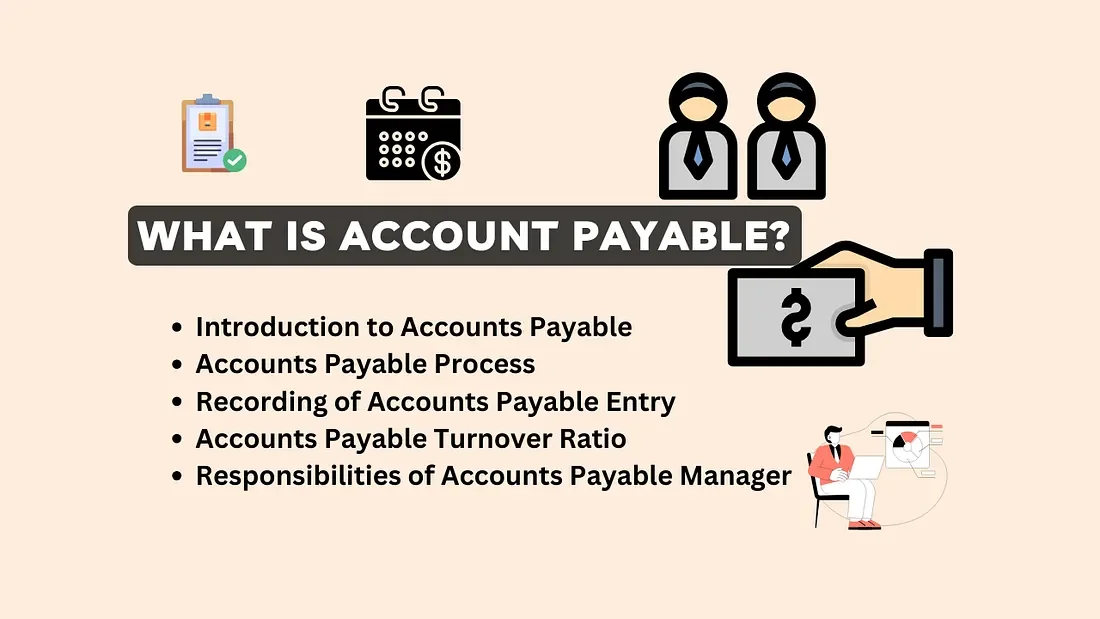
Explore the world of Accounts Payable with a comprehensive guide covering definition, process, recording, ratio analysis, and responsibilities. Learn with basic examples provided with images.
Contents
1. Introduction to Accounts Payable:
Accounts Payable contains two words i.e. ‘Accounts’ which means in business terms record of transactions, events, cash etc. and ‘Payable’ can be understood as the sum of amount which shall be paid in future to someone. Together, the term ‘Accounts Payable’ in business means an outstanding balance to be paid to the Creditor, Vendor, Supplier or Service Provider against the Goods or Services provided by them. Let’s deep dive into understanding the Accounts Payable, Process, Recording with examples. What is/are Accounts Payable? The unpaid sums that a business owes to its suppliers or vendors for goods and services that have been received but not yet paid for are referred to as accounts payable (AP). As a promise to pay off debts in the near future, it is shown as a liability on the balance sheet of the business.
What is/are Accounts Payable?
The unpaid sums that a business owes to its suppliers or vendors for goods and services that have been received but not yet paid for are referred to as accounts payable (AP). As a promise to pay off debts in the near future, it is shown as a liability on the balance sheet of the business.
Let’s continue with example in the image.
To put it simply, a Sam Super Market Sam(SM) has received goods and supplies from a manufacturer. Sam (SM) has a 45-day credit period from the manufacturer, meaning they can pay for the goods and supplies within that time frame. Since Sam (SM) has agreed to pay the Manufacturer within 45 days rather than immediately, he should enter the Manufacturer as “Account Payable” in his books on the day he receives the goods and supplies. The account payable ledger represents an outstanding obligation that Sam (SM) must pay to the Manufacturer in the near future, namely within 45 days.
The answer to one of the most frequently asked queries, “Is Accounts Payable an Asset?,” is no. We may resolve this issue by applying the accounting golden rule “Credit the Giver,” which states that accounts payable should be shown on the balance sheet as liabilities. Because we are required to pay the individual who provided the goods or services.
2. Accounts Payable Process:-
This part of the blog contains a detailed steps-by-step process of Accounts Payable which takes place within the company. The first step is to send a Purchase Order to the Vendor and end with Payment to the Vendor with proper documentation for our record. There are some more steps which are secondary in the process but play an important role they include reporting and analysis, continuous improvement and vendor relationship. The detailed process of Accounts Payable is mentioned below:
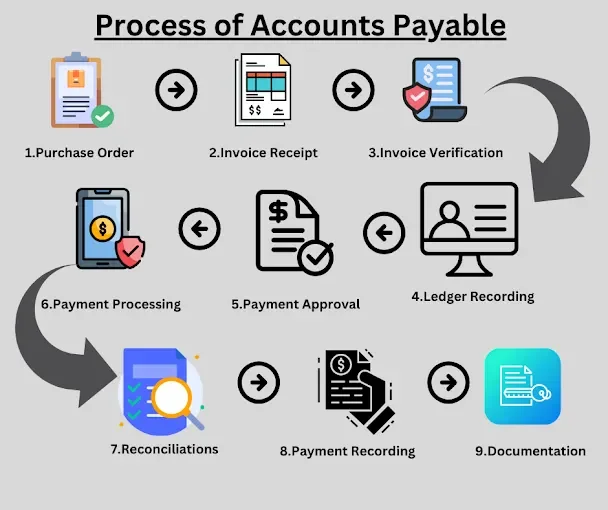
1. Sending a Purchase Order (PO):
- Initiation: When a department or project needs Goods or services, the Accounts Payable process frequently starts with the preparation of a Purchase Order (PO) to be sent to Vendor.
- Details: The PO lists the items or services’ quantity, description, agreed-upon prices, and terms of agreement for the quality, packaging and distribution channels etc..
2. Receipt for invoice:
- Initiation: The vendor sends the Invoice to Accounts Payable department of the company on the completion of services or delivery of products.
- Documentation: An itemized list of products or services, quantities, prices, terms of payment, vendor information, invoice number, date, and other details are included in the invoice details. This information shall be recorded for future PO’s.
3. Verification of Invoice:
- Accuracy Check: To verify accuracy, accounts payable personnel compare the invoice to the relevant purchase order. Any discrepancies shall be duly noted and informed to Vendor.
- Authorization: Before being processed further, the invoice could need permission from the relevant management or department. Usually, the operation team leader or department heads approval shall be taken.
4.Recording in the General Ledger:
- Entry Creation: The invoice is recorded into the business’s accounting software after it has been examined and authorized by the Accounting department head.
- Debit and Credit: A credit is applied to the Accounts Payable account and a debit is made to the relevant expense accounts in Profit and Loss Account or Trading account as applicable.
5. Payment Approval:
-Approval Workflow: Invoice payments may be subject to an internal approval workflow, based on the policies of the organization. Mostly, hierarchical approval is prescribed in SOPs i.e. director or regional head approves.
- Authorized Signatures: As per the situation, authorization for payment may need both electronic e.g. mail approval and physical signatures.
6.Payment Processing:
- Payment Methods: Businesses can accept payments by credit cards, cheques, or electronic funds transfers (EFT), RTGS etc..
- Timing: If a vendor has set terms of credit period, such as net 30 or net 60 days, payments are paid in accordance with those conditions. Here, Net 30 means payment shall be made within 30 days of receipt of goods or services.
7. Reconciliation:
- Bank Reconciliation: The business checks that the payments match the invoice transaction amount by reconciling its bank statements after making payments. Majorly, the issue may be seen in the Year end closing period.
- Vendor Reconciliation: To resolve any disparities, periodically reconcile vendor statements with your own so that books are matched.
8. Recording Payment Information in the Main Ledger:
- Entry Update: The payment is reflected by debiting the Account Payable account, which finally setoffs the outstanding balance in the books.
- Cash or Bank Account Debit: To reflect the payment, a credit is made from the cash or bank account as the golden rule says credit what goes out.
9. Document Retention:
-Record Keeping: For auditing purposes, all relevant documents, including invoices, receipts, and payment confirmations, are kept on file over a particular period.
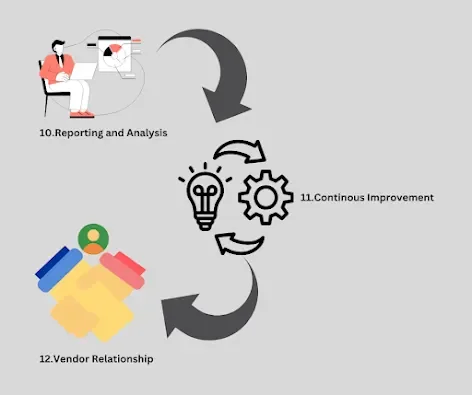
Secondary Process in Accounts Payable
10. Analysis and Reporting:
- Financial Reports: Accounts payable-related reports are regularly generated and checked by the Higher Management as it helps them to allocate funds during budget.
- Analysis: Examining reports to examine spending trends, spot areas for cost reduction, and gauge general financial well-being in budget making.
11. Continuous Improvement:
- Process Review: Consistently evaluating and streamlining the Accounts payable procedure during Internal audits and increasing effectiveness in the company.
- Automation Implementation: To improve processes, take into account and put automation tools into place for e.g. quick-books automation, net-suite ap automation etc. can be used.
12. Vendor Relationship:
- Communication: Lines of communication with suppliers shall be open for better quality of goods and services with middle as well as higher level of authority.
- Resolving concerns: To promote a good working relationship with vendors, promptly resolve any concerns or anomalies.
The accounts payable procedure prepared by the company in its SOPs shall be followed and is essential for upholding favorable vendors relations, avoiding late penalties, guaranteeing terms of payment compliance and aiding in efficient cash flow management for the company.
3.Recording of Accounts Payable Entry:
Common question among people is ‘how to make accounts payable entry?’ .In the books of accounts of company Accounts Payable Journal entry depends upon cash or accrual system followed by company.
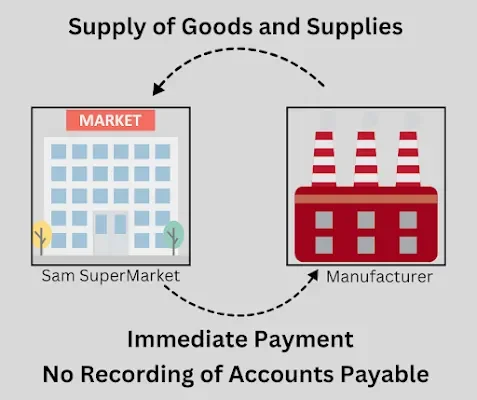
Cash System:-
The company shall pass an accounting entry at the time of payment in case of a cash system.
Cash System
In the above example, SAM(SM) shall not record account payable entry as they follow the cash system i.e. entry is booked when actual payment is made or an immediate payment can also lead to no recording of accounts payable.
Accrual System:-
In case of an accrual system, a separate ledger is created in the liability side as ‘Accounts Payable’ when goods or services are received. This method is also called the double-accounting method. The ‘Expenses’ for goods and services is debited and ‘Accounts Payable’ is credited on receipt of goods or services.
Accrual System of Accounting
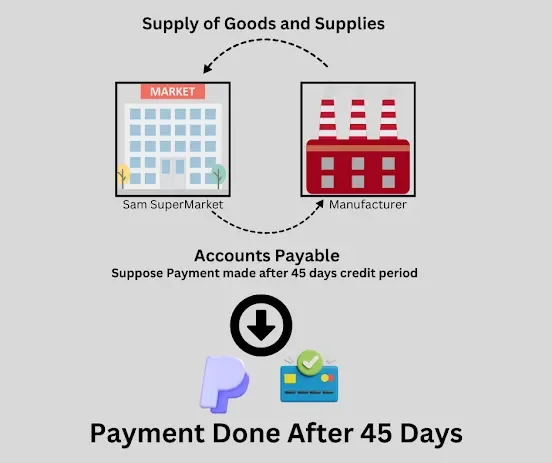
In the given image, the SAM(SM) follows an accrual system of accounting, hence they record a separate ledger and credit accounts payable in their books of accounts when goods and supplies are received. When the payment is made to the manufacturer the accounts payable entry is debited and cash/bank is credited, leading to closure of accounts.
4. Accounts Payable Turnover Ratio (AP turnover ratio):
This ratio measures how fast the company makes payment to its creditors or vendors once a transaction is placed among them. It is calculated as follows:-
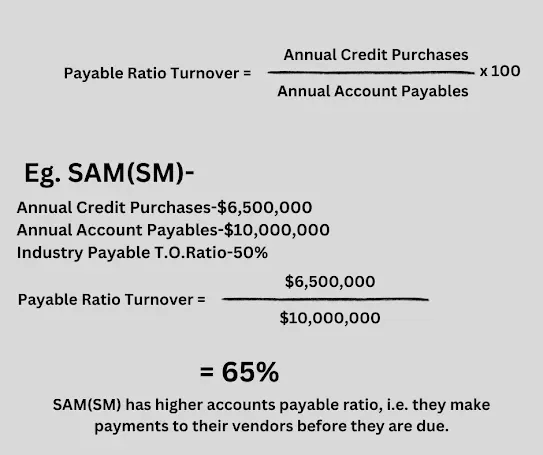
A low AP turnover ratio reflects liberal credit terms provided by the suppliers, whereas the high AP turnover ratio reflects outstanding balances payment is made before due. Payable Turnover Ratio of SAM(SM) is higher than the Industry Turnover Ratio i.e. they pay more frequently than average industry. This may suggest efficient working capital management and positive relationships with suppliers.
5. Responsibility of Accounts Payable:-
I have referred to the Glassdoor website for this part. Let’s talk about some of the key responsibilities of the role:
- Process invoices from receipt to payment, while complying with all internal procedures and standards.
- Own the purchase order and payment approval process including training and follow-up with approvers.
- Review all procure-to-pay documents and purchase orders.
- Obtain vendor setup documents, including Evolus vendor set up form.
- Vendor management and inquiries.
- Properly code invoices to correct GL accounts and work with internal departments to verify accuracy of invoices.
- Perform 3-way matching for inventory related invoices.
- Preparation of weekly AP Payment report and circulate for approval.
- Actively participate in monthly accrual meetings and accumulate accruals for month-end posting.
- Manage corporate credit card accounts and reconciliations.
- Prepare financial reports relating to accounts payable on a weekly basis.
- Perform month-end and quarter-end close responsibilities and reconciliations relating to AP and expense accruals.
- Gather and provide schedules to external auditors timely for quarterly reviews and annual audits.
- Provide top-level customer service to operation leaders.
In conclusion, Accounts Payable is an important part of Financial Management inside the company and is one of the prominent roles in day to day function of the company. As informed in the blog, the process initiates from creation of Purchase order by customer and concludes with final payment to the vendor and proper documentation. Effective management of accounts payable is necessary for keeping a positive connection with suppliers, ensuring timely payments and managing cash flow efficiently.