Sign up with Google
 Sign in with Zoho

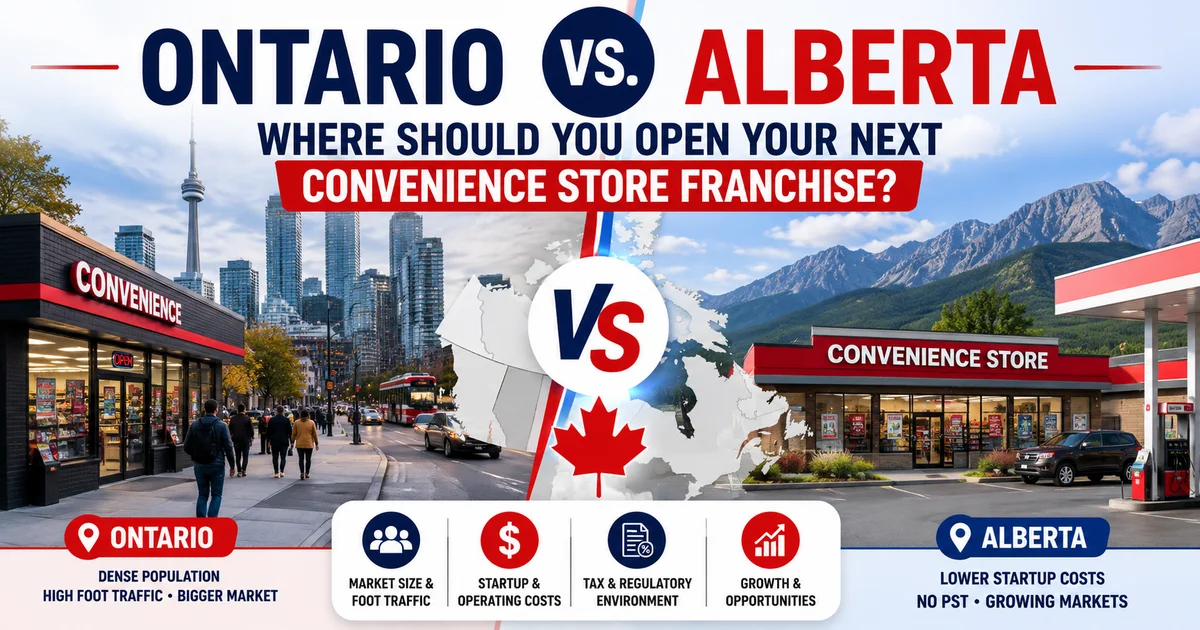
Quick Answer: For a first-time investor, Ontario generally offers denser population, higher foot traffic, and a larger resale market, while Alberta offers lower startup costs, no provincial sales tax, and less saturated territory. There is no single best province to open a convenience store in Canada. The right choice depends on your budget, your target neighborhood, and whether you want steady urban traffic or room to grow in an expanding market.
If you are weighing a convenience store franchise ontario vs alberta decision, this guide breaks down the real numbers, from licensing and labor costs to competition density and long-term growth potential, so you can make a decision based on data rather than assumptions.
Why Province Selection Matters More Than Brand Selection
New franchise buyers often spend weeks comparing brands and franchise fees, then choose a location almost as an afterthought. That order should usually be reversed. A convenience store's revenue is driven overwhelmingly by foot traffic, local demographics, and regulatory costs, all of which are set at the provincial and municipal level, not the franchise level.
Two identical stores under the same banner can post very different results simply because one sits in a high density Ontario neighborhood with transit traffic and the other sits in a growing Alberta suburb with lower rent and no PST. Before comparing franchise packages, it pays to understand the market you are buying into.
The Canadian Convenience Store Market at a Glance
Canada's convenience store sector remains one of the most stable small business categories in the country, built on high visit frequency and habitual, low ticket purchases. A few figures are useful context before comparing provinces:
- Canada has roughly 22,000 to 23,000 convenience stores nationwide, according to industry data compiled from the Canadian Convenience Stores Association and retail research firms tracking the sector.
- Ontario has historically held the largest share of that store count of any province, with figures compiled by Statista putting Ontario's convenience store count at nearly four times that of Alberta.
- Canadian convenience store owners operate under an estimated 500-plus federal and provincial regulations covering tobacco, alcohol, lottery, and food safety, according to a Canadian Convenience Stores Association state of the industry review, which adds real compliance cost regardless of province.
- Fuel and forecourt sales continue to represent the majority of revenue for combined c-store and gas station locations, which matters if you are deciding between a pure convenience format and a fuel-attached one.
These national numbers set the stage. The more useful comparison for a first-time buyer is what changes when you cross the Ontario-Alberta border.
Ontario Convenience Store Franchises: Market Snapshot
Population Density and Foot Traffic
Ontario is Canada's most populous province, and its convenience stores benefit from dense urban and suburban catchments in the Greater Toronto Area, Ottawa, and the Golden Horseshoe corridor. High density generally means more walk-in and transit driven traffic, which supports higher basket volume even in a modest sized store.
Startup and Licensing Costs in Ontario
Ontario franchise entry costs vary by brand and location, but investors should budget for higher commercial rent in urban and suburban corridors, along with Ontario's HST structure, which combines federal and provincial sales tax into a single 13 percent rate applied to most non-grocery convenience items. Municipal licensing, particularly for tobacco and lottery, adds additional paperwork and lead time in high density municipalities.
Tax and Regulatory Environment
Ontario's minimum wage is set to rise to 17.95 dollars per hour effective October 1, 2026, among the highest general minimum wage rates in the country, and it is tied to an inflation index, meaning it will continue to climb. That is a meaningful line item for any store planning to staff multiple shifts.
Competitive Saturation
Because Ontario carries the largest share of Canada's convenience stores, popular corridors in Toronto, Mississauga, and Ottawa can be more competitive, with national chains like Circle K and Couche-Tard well established. That does not rule out strong opportunities, particularly in growing suburban and exurban communities, but it does mean site selection matters more in Ontario than in a less saturated market.
Alberta Convenience Store Franchises: Market Snapshot
Population Growth and Emerging Markets
Alberta has posted some of the fastest interprovincial population growth in Canada in recent years, driven by migration to Calgary and Edmonton and their surrounding communities. Newer subdivisions and commuter corridors in these metro areas often have fewer established convenience retailers per capita than comparable Ontario suburbs, which can translate into whitespace opportunity for a new franchise.
Startup and Licensing Costs in Alberta
Alberta generally offers lower commercial rent than the Greater Toronto Area for comparable retail square footage, and provincial business registration processes are often faster with fewer municipal layers to navigate outside of Calgary and Edmonton's core zones.
The No PST Advantage
Alberta is the only province in Canada with no provincial sales tax, and no harmonized sales tax. Retailers still collect the 5 percent federal GST, but they avoid the additional provincial layer that applies in Ontario. For a convenience store owner, this simplifies point of sale tax configuration and can make certain non-grocery items more price competitive at the till compared to an Ontario location.
Competitive Saturation and Whitespace Opportunities
With a convenience store count that industry data places at roughly one quarter of Ontario's, Alberta has more headroom in specific growth corridors, particularly outside the immediate downtown cores of Calgary and Edmonton. First-time buyers who prioritize a lower cost entry point often find Alberta's newer developments attractive for that reason.
Ontario vs. Alberta: Side-by-Side Comparison
What's the Best Province to Start a Franchise Business in Canada?
There is no universal answer, but the decision usually comes down to which of these investor profiles you fit:
The budget-conscious first-timer. If minimizing upfront capital and ongoing tax complexity is the priority, Alberta's lack of PST and generally lower commercial rents make it easier to reach breakeven sooner.
The urban traffic seeker. If you want a location with a proven customer base and are comfortable paying a premium for it, Ontario's population density and established transit corridors offer more predictable daily traffic, particularly near residential towers, transit stops, and mixed-use developments.
The multi-unit operator. If your long-term goal is to own several locations, a hybrid strategy is common: enter Alberta first to build operational experience and cash flow at a lower cost, then expand into Ontario once you have systems and staffing figured out, or vice versa depending on where you already have local market knowledge.
C-Store vs. Gas Station: Does Fuel Change the Calculus?
Whether you choose Ontario or Alberta, one of the biggest decisions is format: a standalone convenience store or a combined convenience store and gas station. Fuel-attached locations typically see higher daily traffic and larger basket sizes from fuel customers who step inside, but they also carry higher upfront costs, stricter environmental and safety regulation, and thinner margins on the fuel itself compared to in-store merchandise. We cover this comparison in detail in our C-Store vs Gas Station franchise breakdown, which is worth reading before you commit to a format in either province, since the regulatory approval timeline for a fuel-attached site can differ meaningfully between Ontario and Alberta municipalities.
How to Own Multiple Convenience Store Franchises in Canada
Many successful convenience store owners in Canada do not stop at one location. If multi-unit ownership is part of your long-term plan, a few things matter more than they did for your first store:
- Prove out one location first. Lenders and franchisors both want to see operational consistency before backing a second or third unit.
- Build a management layer early. Owner-operators who try to run multiple stores without a trained shift manager at each location tend to burn out or lose consistency in customer service.
- Understand area development agreements. Some franchise systems offer multi-unit or territory development deals that lock in expansion rights within a defined area, which can be valuable in a fast-growing Alberta corridor or a stable Ontario neighborhood.
- Centralize back-office systems. Payroll, inventory, and supplier ordering across provinces (if you expand beyond one) need to account for different tax rates and labor rules, particularly the HST versus GST-only distinction between Ontario and Alberta.
If multi-location ownership is a goal, it is worth discussing available territories directly with a franchise team early, since some regions fill faster than others.
Affordable Ways to Enter the Canadian Convenience Store Market
For buyers focused on keeping initial investment manageable, a few paths are worth exploring regardless of province:
- Resale locations. Buying an existing store with an established customer base and sales history can reduce the ramp-up period compared to a brand new build.
- Smaller footprint formats. Some franchise systems offer compact store formats with lower buildout costs, suited to suburban strip malls or transit-adjacent units.
- Provinces with lower tax friction. As outlined above, Alberta's lack of PST reduces one layer of ongoing compliance cost that Ontario operators must manage.
Infinity Mart works with first-time and multi-unit investors across Canada to identify franchise opportunities that match a buyer's budget and growth goals, whether that means an established Ontario neighborhood or an emerging Alberta corridor. You can review currently available convenience store locations to see what fits your target investment range, or start a conversation through the franchise application page if you are ready to take the next step.
Frequently Asked Questions
Is Ontario or Alberta better for a first-time franchise investor? It depends on your priorities. Ontario offers denser population and more established traffic patterns, which can mean steadier early revenue. Alberta offers lower startup costs and no provincial sales tax, which can mean a faster path to profitability on a smaller budget.
How much does it cost to open a convenience store franchise in Canada? Costs vary widely by brand, location, and whether the store is a new build or an existing resale, with commercial rent and licensing fees being the largest variables between provinces. Ontario's urban corridors typically carry higher rent than comparable Alberta suburbs.
Which province has lower taxes for small business owners? Alberta has no provincial sales tax, so retailers only collect the 5 percent federal GST. Ontario applies a combined 13 percent HST to most non-grocery items, which adds administrative and point-of-sale complexity.
Can I own more than one convenience store franchise in Canada? Yes. Many franchise systems support multi-unit ownership once an operator has proven success with a first location, often through area development agreements that reserve territory for expansion.
What's the difference between a convenience store and a gas station franchise? A standalone convenience store focuses purely on in-store merchandise, while a gas station franchise combines fuel sales with a convenience retail component, typically requiring higher upfront investment and stricter environmental permitting, but often higher overall traffic.
How long does it take to open a franchise location in Ontario vs. Alberta? Timelines depend on municipality and whether the location requires new construction, but Alberta's registration and permitting processes outside of Calgary and Edmonton's core zones are often faster due to fewer municipal review layers compared to dense Ontario municipalities.
Is the Canadian convenience store industry growing? Store counts nationally have been relatively flat to slightly declining in recent years as the sector consolidates, but revenue per location has remained resilient, and specific growth corridors, particularly in Alberta's expanding metro suburbs, continue to see new store openings.
Conclusion
Choosing between Ontario and Alberta for your next convenience store franchise is not about which province is objectively better. It is about matching the market's characteristics to your budget, your risk tolerance, and your long-term goals. Ontario rewards buyers who can afford a premium for proven traffic. Alberta rewards buyers looking for a lower cost entry point with room to grow. Either way, the decision deserves the same level of research you would put into comparing franchise brands.
If you want to talk through which province and location fit your investment goals, Infinity Mart's franchise team is available to walk through current opportunities with you.