Sign up with Google
 Sign in with Zoho

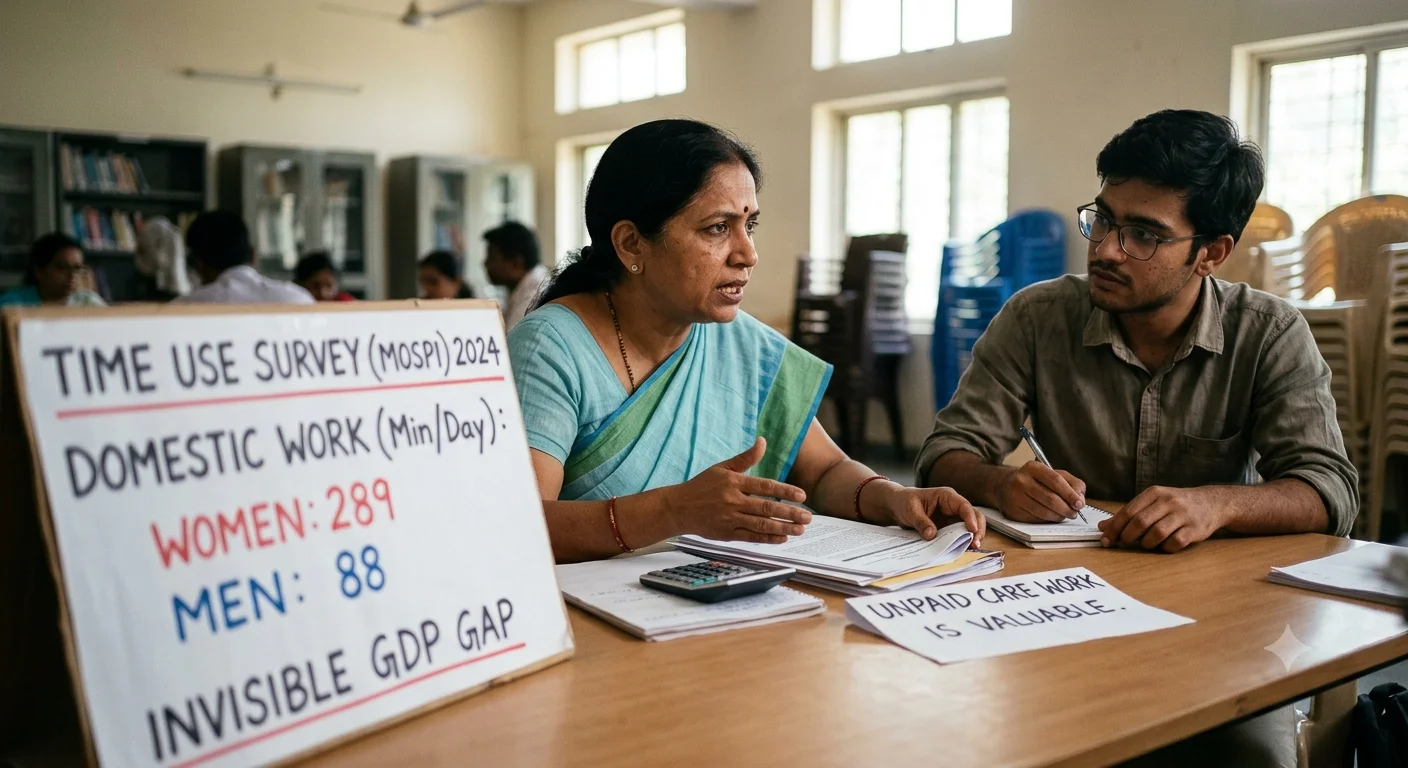
I remember, at a moment while the family WhatsApp debate about "who does more" in the house was in progress that it was impossible to measure how much my mother does each day. Cooking, laundry picking children from school the endless list of items to be bought – none of these are paid work and therefore they did not enter the debate. It turns out that this is not a problem only, to our family but a national problem.The Time Use Survey 2024 released by the Ministry of Statistics and Programme Implementation (MoSPI) supplies the numbers that illustrate the problem described above. Indian women spend 289 minutes each day on domestic chores while men spend only 88 minutes. Indian women also spend 137 minutes each day on caregiving while men spend 75 minutes. This means that an Indian woman spends four extra hours of the day on work that the law has historically chosen not to count as work. This article discusses when the law began to address this decision.
The Economy That Doesn’t Count ItselfGDP as we learn to calculate it in first-year economics only looks at what's bought and sold. A woman making a meal for her family creates nothing that a statistician can put a price on. It is as if nothing is created at all. The same meal, made by a paid helper is counted. Nothing about the work changes; only whether it is in the market changes. This is not a mistake in numbers. When work is not seen by GDP it is not seen by policy because policy usually follows the money it can see. It is also not seen by how pensionsre designed because in India retirement security is still based on a working life that is measured by salary slips. It is not seen by the law either especially when it comes to how compensation and family law have treated the contribution of a homemaker as either nothing or very small. Lower numbers of women, in the workforce is not a puzzle when you understand this clearly. It is very hard to join the paid work world when the unpaid work already takes up your day.
The Turning PointFor a time Indian courts followed this same logic almost by default. If a homemaker died in a motor accident and left no payslip behind tribunals would often value her life and labour as though she had contributed nothing to her household’s economy. The first real crack in that approach came in Arun Kumar Agrawal v. National Insurance Co. Ltd. (2010) 9 SCC 218 where the Supreme Court refused to treat a housewife as a "non-earning member" and instead computed a notional income for her reasoning that her domestic contribution had genuine economic substance even without a market transaction attached to it. It was a step but it broke a habit of thought that had gone unquestioned for decades.
The next major development came in Kirti & Anr. V. Oriental Insurance Co. Ltd., (2021) 2 SCC 166 where a three-judge bench went further and held that a homemaker’s notional income must actually reflect her work, labour and sacrifice than the arbitrarily low figures tribunals had been, in the habit of assigning. Reading that judgment as a student what struck me most was not the outcome but the reasoning. The Court was explicit that because housework is heavily gendered, undervaluing it in law was not a neutral technical choice but a way of quietly reproducing inequality through the compensation tables themselves.
Then on 11 June 2026 came the ruling that this piece is really built around. In Shishu Pal @ Shish Ram & Ors. V. Surjeet & Ors. 2026 INSC 634 a bench of Justices Sanjay Karol and N. Kotiswar Singh did something no earlier judgment had done: they created "loss of care" as a distinct independent head of compensation in motor accident claims building on the multiplier method laid down in National Insurance Co. Ltd. V. Pranay Sethi, (2017) 16 SCC 680. The Court fixed a notional income of ₹30,000 a month for a homemaker’s unpaid work described explicitly as a floor and not a ceiling to be revised upward by ten per cent every three years to keep pace with inflation. Perhaps the striking part of the ruling is that even a homemaker who is also formally employed can claim this amount as a separate additional head because paid work, outside the home does not erase the unpaid work that continues inside it.“The loss of a homemaker however is not limited to husband and children.”
Calling homemakers "nation builders" in the judgment could be dismissed as flourish a line that gets quoted in headlines and then forgotten. I do not think that reading holds up. Once a court declares that a homemaker’s work is worth a indexed recurring monetary amount, that work moves from a sentimental afterthought in compensation law to a recognised measurable economic contribution – the same status that paid work has always had without having to argue for it. It is important to be honest about the limits because a law student’s job is to see where a good judgment ends than pretend that it goes further. This recognition lives entirely within the Motor Vehicles Act framework for accident compensation. It has not yet been extended to how matrimonial property's divided on divorce to how maintenance is calculated or to how India measures its own national income. The floor Shishu Pal built is real. It is only a floor, under one room of a much larger house.
A Problem the Law Can Actually SolveRaising awareness is not enough as if the problem were that people do not know that homemakers work hard. Everyone already knows that. The real problem is in institutions and institutional problems need solutions. UN Women’s toolkit on paid and unpaid care work offers a framework, built around three verbs: Recognise, Reduce and Redistribute unpaid care work. India has also formally committed to this agenda through SDG Target 5.4 which calls on states to recognise and value unpaid care work through services, infrastructure and shared responsibility within households.
Three concrete steps follow from this framework. None of them require reinventing the wheel that Shishu Pal already built. First the ₹30,000 principle needs extension beyond accident compensation into matrimonial and succession law so that the economic value of unpaid care work is recognised whenever property or maintenance is being divided, not only when someone has died in an accident. Second India needs non‑transferable paternity leave to actually redistribute care work at home rather than simply compensating it after the fact. Most private employers in India offer no paternity leave all unlike countries that mandate weeks of non‑transferable leave so fathers cannot simply hand their share back to their partners. Third the time‑use data itself needs to feed into policymaking particularly for building pension and social security credits for unpaid caregivers so that a lifetime of unpaid care work does not translate into a retirement, with no safety net.
Closing the LoopFour extra hours a day multiplied over a lifetime is not a rounding error. It is a figure that the Supreme Court has told us costs money. The time a compensation amount is set or the next time a household budget is quietly split at the kitchen table extra hours deserve asking what those 289 minutes are truly worth because the Supreme Court has already answered:, at least ₹30,000 a month and rising. What Shishu Pal has not yet done is anyone ’s job to finish and I would argue it is specifically the job of law students to push that principle into every other corner of the law it has not yet reached. Matrimonial property, maintenance, succession and eventually the national accounts themselves.
Nation Builders, Not Non-Earning Members: What ₹30,000 a Month Tells Us About India’s Invisible GDP Gap