Sign up with Google
 Sign in with Zoho

If you've been shopping for colored contacts and keep seeing "prescription" and "non-prescription" listed as separate options, you're not the only one who's paused and wondered what that actually means for you. It's one of the most common points of confusion for first-time buyers, and honestly, the terminology doesn't help — both types are still contact lenses, and both still need a bit more care than most people expect.
Here's the actual difference, and how to figure out which one you need.
The Short Answer
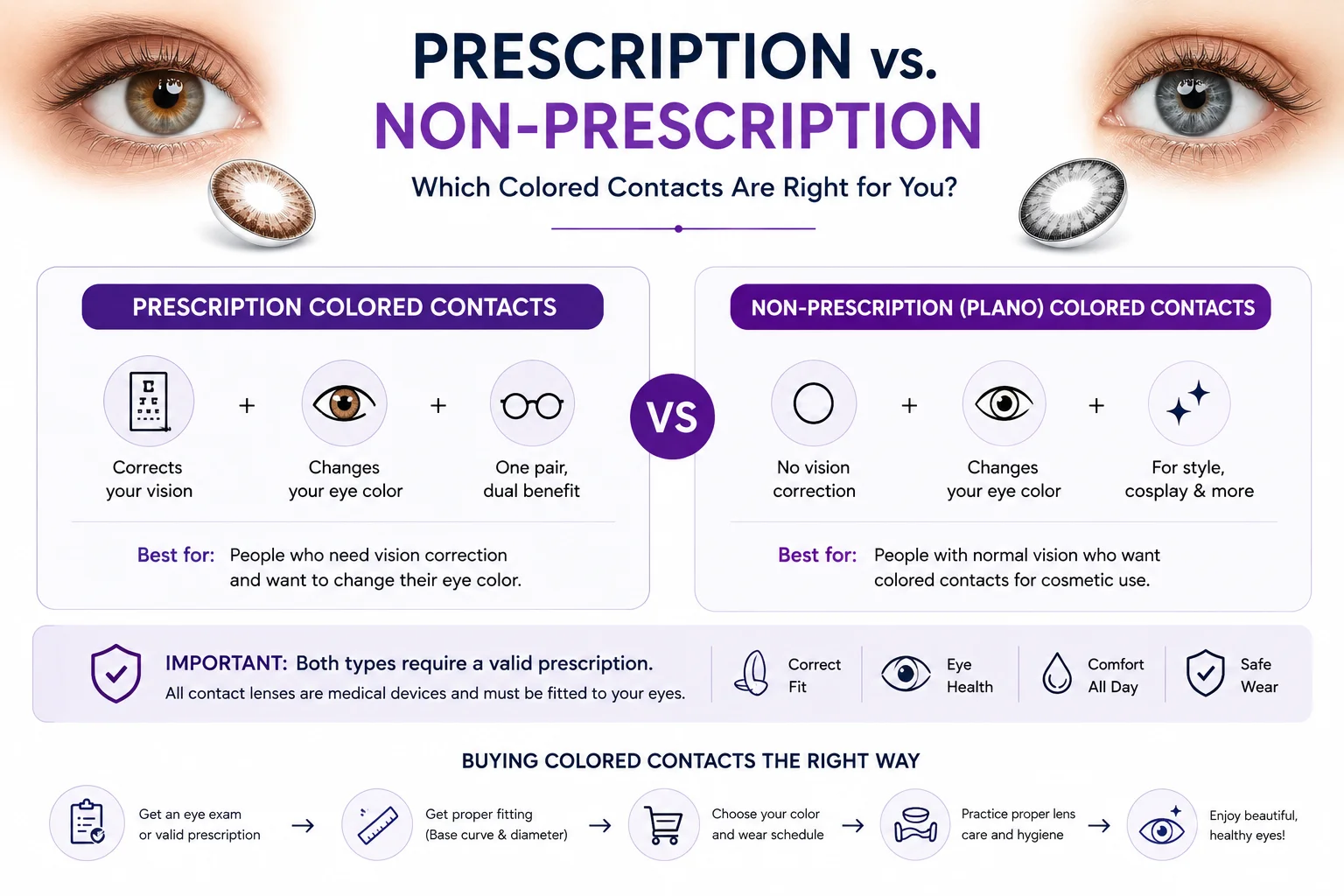
Prescription colored contacts correct your vision and change your eye color at the same time. Non-prescription colored contacts (sometimes called "plano" lenses) do nothing for your vision — they're purely cosmetic, made only to change how your eyes look.
That's really the whole distinction. But there's a catch that surprises a lot of people: both types legally require a valid prescription to buy, even the purely cosmetic ones.
Wait — Non-Prescription Lenses Still Need a Prescription?
Yes, and this trips up more people than anything else in this whole topic. "Non-prescription" refers to whether the lens corrects your vision — not whether you need a doctor's approval to wear it.
Any contact lens, colored or clear, corrective or purely cosmetic, sits directly on your eye. That means it needs to be fitted to your eye's actual curvature and size, not just picked based on a color you like. A lens that's the wrong base curve or diameter for your eye can cause discomfort, scratches, or worse — even if your vision doesn't need correcting at all.
This is why legitimate retailers ask for a prescription (or at least basic fitting information) before shipping any colored lenses, cosmetic or not. If a site sells colored contacts with zero prescription requirement, zero fitting questions, and no verification at all, that's a real red flag — not a convenience.
Who Actually Needs Prescription Colored Contacts
If you already wear glasses or contacts to correct your vision, prescription colored lenses let you handle both things in one pair. You get:
- Vision correction tailored to your actual eye
- The eye color change you're after
- One product instead of juggling glasses plus separate cosmetic lenses
The prescription itself comes from an actual eye exam, and it includes more than just a "-2.00" style number — it specifies base curve and diameter too, which matters more for comfort than most people realize.
Who Should Go With Non-Prescription (Plano) Lenses
If your vision doesn't need correcting, plano lenses are built for exactly that — same base curve and diameter fitting process, just without any corrective power ground into the lens. These are the lenses most people reach for when they want a color change for a cosplay look, a photo shoot, or just switching things up for a night out, with zero interest in vision correction.
Even though there's no vision component, you'll still want a proper eye measurement (many opticians will do this even if you're not getting a full prescription) so the lens actually fits.
What About Astigmatism or Other Vision Needs?
If you have astigmatism, presbyopia, or another vision condition beyond basic nearsightedness or farsightedness, you'll want toric or multifocal colored lenses specifically — a standard prescription colored lens won't correct astigmatism the way a toric lens will. Not every retailer carries these in every color, so it's worth checking availability before falling in love with a specific shade.
The Part People Skip: Getting Properly Fitted
Whichever type you land on, the fitting step isn't optional, and it's genuinely the part that determines whether your lenses feel great or feel like a mistake. An eye care professional will check:
- Base curve — how steeply the lens curves to match your eye's shape
- Diameter — the lens size, which affects coverage and comfort
- Overall eye health — to rule out anything that would make contact lens wear uncomfortable or risky
Skipping this step to save time (or because you found a "no prescription needed" listing online) is exactly how people end up with lenses that never quite feel right, or worse, an eye irritation that could've been avoided entirely.
Buying Colored Contacts the Right Way
Once you know your prescription (or your plano fitting details), shopping gets a lot simpler — you're really just choosing a color and a wear schedule at that point. GleGlow's collection covers both prescription and non-prescription options across natural and bold shades, so whether you're correcting your vision or just switching up your look for a weekend, you're choosing from lenses built with the same fitting standards either way.
Bottom Line
"Prescription" and "non-prescription" describe whether a lens corrects your vision — not whether you're allowed to skip getting properly fitted. Both types are still medical devices sitting on your eye, and both deserve the same level of care in how you buy and wear them.
Browse GleGlow's prescription and non-prescription colored contacts →