Sign up with Google
 Sign in with Zoho

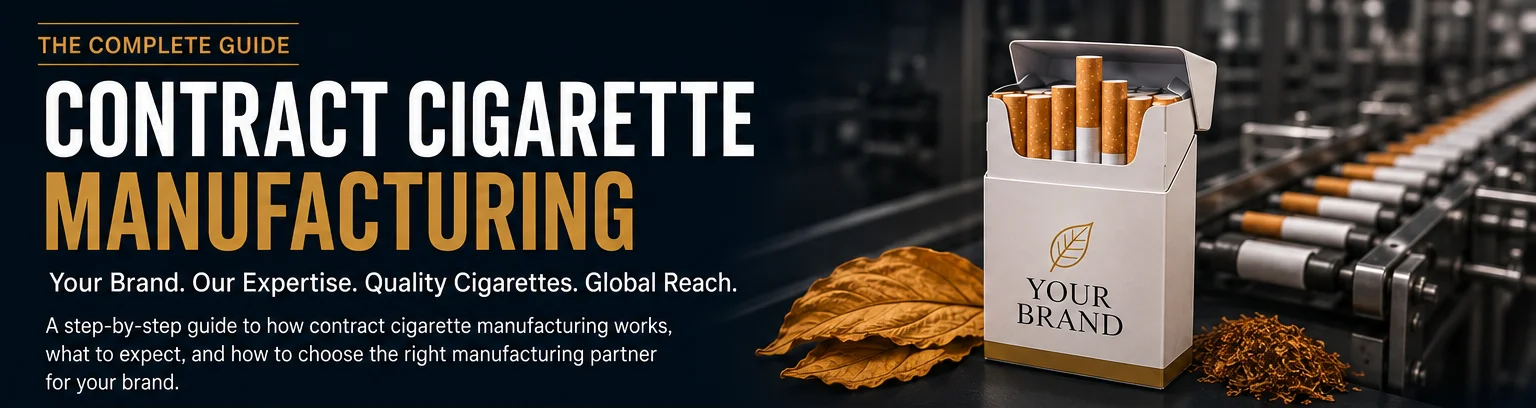
Complete Guide to Contract Cigarette Manufacturing
Contract cigarette manufacturing has become the standard route for brand owners and distributors who want to launch or scale a cigarette brand without owning a factory. Rather than building production infrastructure from scratch, a brand owner partners with an established manufacturer who handles production while the brand owner controls identity, positioning, and market strategy. This guide covers how contract manufacturing actually works, what to expect at each stage, and how to evaluate whether it fits your brand.
What Contract Cigarette Manufacturing Actually Means
In a contract manufacturing arrangement, the manufacturer produces your brand according to agreed specifications, blend, format, and packaging, using their own production facility, equipment, and workforce. You are not buying machinery or hiring production staff. You are contracting an experienced manufacturer to produce your product to your specification, at the volume and schedule your business needs.
This differs from simply buying an existing generic product and slapping a label on it. A genuine contract manufacturing relationship involves real input from the brand owner into blend character, format, and packaging, while the manufacturer contributes the production expertise, compliance knowledge, and physical infrastructure required to actually build the product.
Contract Manufacturing vs OEM Production
These terms overlap in practice, but there is a useful distinction. Contract manufacturing typically describes a manufacturer producing your brand to agreed specifications within their existing production capability. OEM production usually implies a closer, more fully customized relationship, where the manufacturer builds to your exact specification across every detail, functioning almost as an extension of your own operation.
In practice, many manufacturers offer both models and the line between them depends on how much customization your brand actually needs. A brand launching with a fairly standard blend and pack format may fit comfortably within standard contract manufacturing services. A brand with very specific requirements across blend, format, and packaging may need a more OEM style arrangement to get exactly what it wants.
Why Brand Owners Choose Contract Manufacturing
Lower capital requirement. Building a cigarette production facility requires significant capital investment and years of setup time. Contract manufacturing lets a brand owner launch a commercial production run without any of that upfront infrastructure cost.
Access to established expertise. Blend development, production quality control, and regulatory compliance all draw on expertise that takes years to build independently. An established manufacturer already has this knowledge in place.
Faster time to market. A brand working with an experienced contract manufacturer can typically move from concept to finished product significantly faster than a brand attempting to build its own production capability first.
Scalability. As demand grows, an established manufacturer can typically scale production volume more easily than a brand owner managing their own smaller facility, since the manufacturer's production line is already built for commercial scale output.
How the Contract Manufacturing Process Works
Initial Consultation and Specification
The process begins with a conversation about your target market, brand positioning, and product goals. This shapes decisions on tobacco blend character, cigarette format and size, and pack style, hard pack or soft pack, that will define your finished product.
Blend Development
Working with the manufacturer's blending expertise, you develop a tobacco blend suited to your target market and positioning. This may involve reviewing sample blends and refining the specification until it matches what you are aiming for.
Minimum Order Quantity and Costing
Manufacturing services operate around a minimum order quantity tied to production line efficiency. This figure, along with per unit costing, gets confirmed early so you can plan capital requirements accurately before committing further.
Packaging and Artwork
Your brand's packaging gets developed to match your chosen pack format, with artwork templates specific to that format and all required regulatory markings, including health warnings mandated in your target market.
Sample Production
Before committing to a full commercial production run, a reputable manufacturer produces samples matching your final specification. This gives you the opportunity to confirm blend, format, and packaging match your expectations before full production begins.
Full Production Run
Once samples are approved, production moves into the manufacturer's commercial production line, running your brand at the agreed volume and specification through rod making, quality control, and packing.
Compliance and Export Preparation
For brands shipping to international markets, the manufacturer prepares documentation and confirms regulatory compliance specific to the destination market before shipment.
Delivery
Finished product ships to your target market, whether through domestic distribution or international freight, completing the commercial production cycle for that order.
What to Look for in a Contract Manufacturing Partner
Genuine production experience. Ask how long the manufacturer has operated and request examples of other brands they have produced for. Established manufacturing services built on years of production history carry far less risk than a newer, unproven operation.
Compliance and export knowledge. Confirm the manufacturer has real experience exporting to your specific target market, since regulatory requirements vary significantly between markets.
Transparency on minimum order quantities and costing. A manufacturer who shares these figures clearly and early is generally easier to build a long term relationship with than one who withholds details until late in negotiations.
Willingness to provide samples. Any manufacturer confident in their production quality should be willing to prove it with samples before asking for a full commercial order.
Format and blend flexibility. Confirm the manufacturer can actually produce the specific blend character, cigarette size, and pack format your target market expects, rather than pushing you toward whatever is easiest for their existing setup.
Is Contract Manufacturing Right for Your Brand
Contract manufacturing suits the overwhelming majority of brand owners entering the cigarette category, since it removes the capital and expertise barriers that would otherwise make brand ownership impractical for anyone without an existing factory. It is worth considering an alternative only in unusual cases where a brand owner already has direct manufacturing infrastructure or extremely specific production requirements that no existing manufacturer can accommodate, which is rare in practice.
For nearly everyone else, the question is not whether to use contract manufacturing, but which manufacturing partner to use.
Getting Started
At General Tobacco, contract cigarette manufacturing and OEM production services are built on decades of production expertise, covering blend development, packaging, compliance, and export to markets worldwide. Whether you are launching a new brand or looking for a more reliable manufacturing partner for an existing one, understanding how the contract manufacturing process actually works puts you in a much stronger position to choose the right partner and get your product to market the way you intended.