Sign up with Google
 Sign in with Zoho
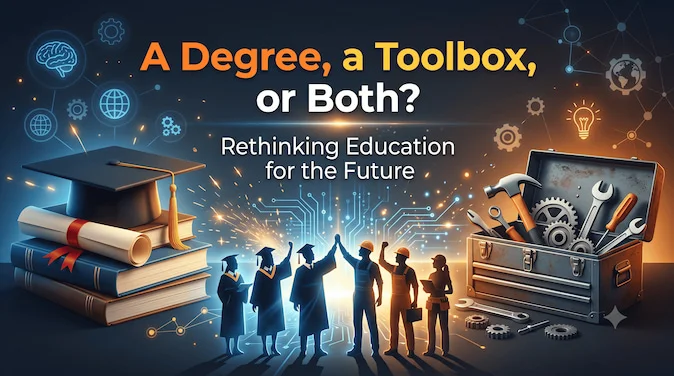
Students have been told for years that getting a degree is one of the most important steps to building a successful career. Parents want their children to take up professional courses, colleges want academic qualifications and students spend years preparing for examinations and earning degrees.But there is another side of the employment picture that is harder to ignore.It can be incredibly hard to find a good plumber, electrician, carpenter, painter, mechanic or technician. These professionals do the essential work that people and business rely on every day. At the same time, many degree holders find it hard to get jobs matching their qualifications.This brings up an important question: Is education preparing students for the real world, or are we still valuing degrees too much?Having a degree does not mean you will get a jobCollege degrees can provide you with valuable knowledge, develop critical thinking and open a lot of doors to your career. But a degree doesn't guarantee a job.Increasingly, employers want workers who can apply what they have learned. Communication, problem-solving, digital skills, teamwork, technical skills and practical experience all impact employability.The question, therefore, should not be whether degrees are useful or not. Instead, we should ask if students are given enough opportunities to turn their education into practical skills.The Skills We Forget AboutConsider the people who work with their hands every day.An electrician should be familiar with electrical systems, safety codes, wiring, and troubleshooting. A plumber should know about water systems, pipes, fittings and repair. Carpentering is about precision, measuring, knowing the material, designing. A painter needs to know about surfaces, materials, techniques and finishing.These aren’t just “physical jobs.”They need training, experience, technical knowledge and problem solving skills.And yet many of these careers are often seen as less prestigious than traditional office careers. This can lead young people to think that skilled trades are not serious career options.What Happens When Everybody Walks Down the Same Road?While many students are encouraged to pursue similar academic and career paths, some other important areas may be overlooked.Society needs engineers, doctors, teachers, accountants and managers. But it also needs electricians to keep buildings running, technicians to fix equipment, mechanics to keep vehicles going, plumbers to maintain water systems, and skilled tradespeople to construct and maintain the spaces we live in.A robust economy requires a wide range of skills.So the question should not be “Degree or skilled work?”It has to be:“How can education equip students with the right skills for the career they want?”Education needs to include skilled trades.This is where vocational and skills-based education can play an important role.Students need the chance to learn practical skills as well as traditional academic subjects. Depending on their interests, it can be technical training, workshops, apprenticeships, internships, industry projects, certifications and hands-on learning.This exposure can help students learn that there are multiple ways to build a successful career.For some students, the traditional degree route may be the way to go. Some may find a technical or vocational qualification more appropriate. Some may equate it to a blend of academic education, professional certifications, and practical skills.Education should assist students in discovering these options rather than forcing everyone into the same definition of success.Future May Require a Degree and a ToolboxThe "toolbox" is more than just tools.It is the collection of skills that a person has for their career.What's in the modern student's toolbox?Knowledge of the academicTechnical skillCommunication skillsDigital literaciesProblem solving skillsCreative ThoughtCooperationIndustry experienceEntrepreneurial thinkingFlexibilityWith a degree you get a good academic background. The practical experience shows students how to apply that knowledge.They can be used together to provide a more complete approach to career preparation.Changing Our Definition of SuccessOne of the biggest changes may need to take place not in the classroom but in the way society views careers.You don’t have to sit behind a desk to have a successful career.A person who builds a business as an electrician, becomes a highly skilled carpenter, runs a plumbing service, works as an advanced technician, or starts a specialised trade company can also build a sustainable and rewarding career.A graduate also can use his or her academic knowledge to be an entrepreneur, researcher, professional or industry specialist.There is no one definition of career success.What matters is whether somebody has the knowledge, skills and confidence to generate value through their work.What Should Educational Institutions Do?Educational institutions have an important role to play in preparing students for a dynamic employment landscape.Apart from classroom learning, institutions can give opportunities to students for practical exposure through internships, industry interactions, projects, workshops, entrepreneurship programs and skill-development initiatives.The challenge is to help students answer an important question before they leave school:What can I actually do with what I have learned?”When education links knowledge to application, students can be better prepared for real-world opportunities.So, Toolbox, Degree or Both?Maybe the answer is a combination of both.Education in the future should allow students to build their own combination of knowledge, skills and experience.A degree can open a door.Work can be done with the help of a useful skill.Experience teaches how to manage real world challenges.And ongoing education can help you keep up as industries evolve.There will always be a need for people who can think, design, analyse, manage, build, repair, create and solve problems.So maybe education should help students build a degree and a toolbox, instead of asking them to choose between the two.Because the future might not belong to the most qualified people. It might be the work of people who can turn to good account what they have learnt.Get the Education You Need to Build Your Future At Rathinam Group of Institutions, education is more than simply getting a degree. Students can work toward becoming confident and career-ready professionals with opportunities to learn, develop skills and get exposed to real-world applications.Whether your aspirations are to further your education, develop industry skills, become an entrepreneur or carve out a specialised career, choosing the right educational environment can be an important first step.Discover the academic excellence of Rathinam Group of Institutions and step ahead in building your future with knowledge, skills and experience.
A Degree, a Toolbox, or Both? Rethinking Education for the Future