Sign up with Google
 Sign in with Zoho
How Polysorbate 20 Helps Stabilize Essential Oils in Water-Based Products
Quick Answer: Why Is Polysorbate 20 Used with Essential Oils?
Polysorbate 20 is commonly used to help disperse small amounts of essential oils and fragrance oils in water-based formulations. It acts as a non-ionic solubilizer, improving the distribution of oil-soluble materials and helping reduce floating droplets, haze and visible separation.
This makes it useful in room sprays, facial mists, body sprays, cleansing waters and other aqueous formulations where clarity and uniformity are important.
Why Essential Oils Are Difficult to Add to Water
Essential oils do not naturally dissolve in water. When they are added directly, they may float on the surface, form droplets or create an unstable cloudy mixture.
This can cause:
- Uneven fragrance distribution
- Oil rings around the container
- Surface separation
- Cloudiness
- Inconsistent appearance
- Poor batch uniformity
For manufacturers, this becomes especially important when the product must remain visually stable during storage and transport.
A solubilizer helps bridge the difference between the oil phase and the water phase so the essential oil can remain more evenly dispersed.
How Polysorbate 20 Works
Polysorbate 20 has both hydrophilic and lipophilic characteristics. This allows it to interact with water while also associating with oil-soluble materials.
In suitable formulations, it can help:
- Improve essential-oil dispersion
- Reduce visible separation
- Support clearer formulations
- Maintain more consistent fragrance distribution
- Improve batch-to-batch appearance
- Simplify processing
It is commonly used where the oil load is relatively low and the goal is solubilization rather than formation of a full cream or lotion emulsion.
Applications in Facial and Body Mists
Facial mists and body sprays often contain a high percentage of water with small amounts of fragrance or essential oil.
Without a suitable solubilizer, these oils may separate during storage. Polysorbate 20 can help maintain a more uniform system and support a cleaner visual appearance.
Formulators should evaluate:
- Fragrance concentration
- Essential-oil type
- Water content
- Alcohol level
- pH
- Preservative system
- Storage temperature
A formulation that looks clear immediately after mixing may become hazy later, so stability testing remains important.
Use in Room and Linen Sprays
Room sprays and linen sprays also benefit from effective oil dispersion.
These products may contain fragrance oils, essential oils and water, sometimes with alcohol or other solvents. Polysorbate 20 can help reduce separation and improve scent distribution.
Manufacturers should check:
- Spray pattern
- Nozzle compatibility
- Clarity
- Surface residue
- Fragrance uniformity
- Bottle appearance over time
The amount of solubilizer required depends on the fragrance system and the target level of clarity.
Application in Cleansing Waters
Water-based cleansing products such as micellar waters may also contain small amounts of fragrance or oil-soluble ingredients.
Polysorbate 20 can help distribute these components without creating a heavy emulsion. This is useful when formulators want a light, fluid product with minimal visible oil.
It may also work alongside other surfactants, but compatibility should be checked carefully because the overall surfactant system can affect foam, skin feel and clarity.
Factors That Affect Solubilization
Polysorbate 20 does not perform the same way in every formulation.
Because of these variables, formulators should test several oil-to-solubilizer ratios instead of relying on one fixed number.
Why Premixing Matters
A useful manufacturing approach is to first blend the essential oil with Polysorbate 20 before adding the mixture to water.
This can improve dispersion and reduce the chance of floating oil droplets.
The exact process should still be tested because mixing speed, temperature and order of addition can change the result.
Production teams should document:
- Premix ratio
- Mixing time
- Addition sequence
- Processing temperature
- Final appearance
This helps improve consistency during scale-up.
How Manufacturers Select Polysorbate 20
When choosing material for regular production, buyers should consider more than price.
Important checks include:
- Product grade
- Appearance
- Odour
- Solubilizing performance
- Batch consistency
- Packing size
- COA availability
- TDS and SDS support
- Delivery reliability
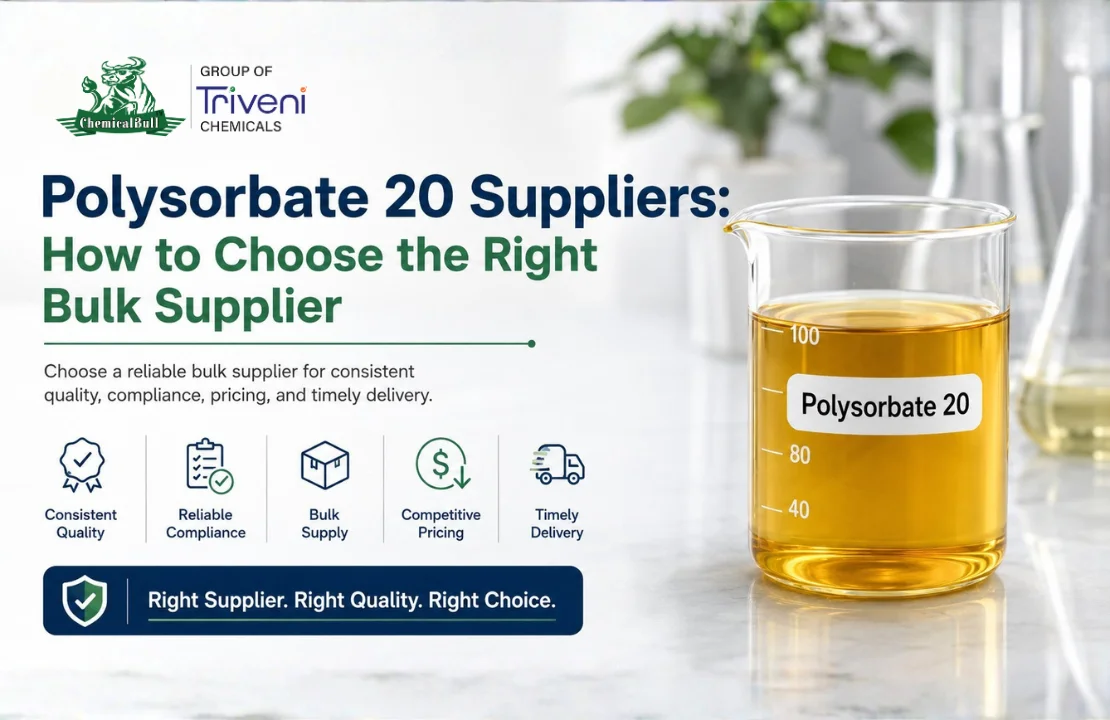
Procurement teams can also review this guide on Polysorbate 20 quality and bulk sourcing for formulation use before moving from trial quantities to larger production volumes.
Stability Testing Before Scale-Up
Before commercial production, manufacturers should test the formulation under different storage conditions.
Useful checks include:
- Room-temperature storage
- High-temperature storage
- Low-temperature storage
- Freeze-thaw testing where relevant
- Centrifuge testing
- Packaging compatibility
During testing, monitor:
- Clarity
- Odour
- Colour
- Surface oiling
- Sediment
- Separation
- Packaging changes
This helps identify problems before the product reaches the market.
Conclusion
Polysorbate 20 is a practical solubilizer for essential oils, fragrance oils and other lipophilic materials in water-based formulations.
Its main value lies in helping manufacturers improve dispersion, reduce visible separation and maintain more consistent product appearance. The correct use level depends on the oil type, concentration, water content and complete formulation.
Laboratory trials, premixing and stability testing are important before full-scale production.
Chemical Bull supplies Polysorbate 20 in bulk quantities and exports globally.