Sign up with Google
 Sign in with Zoho

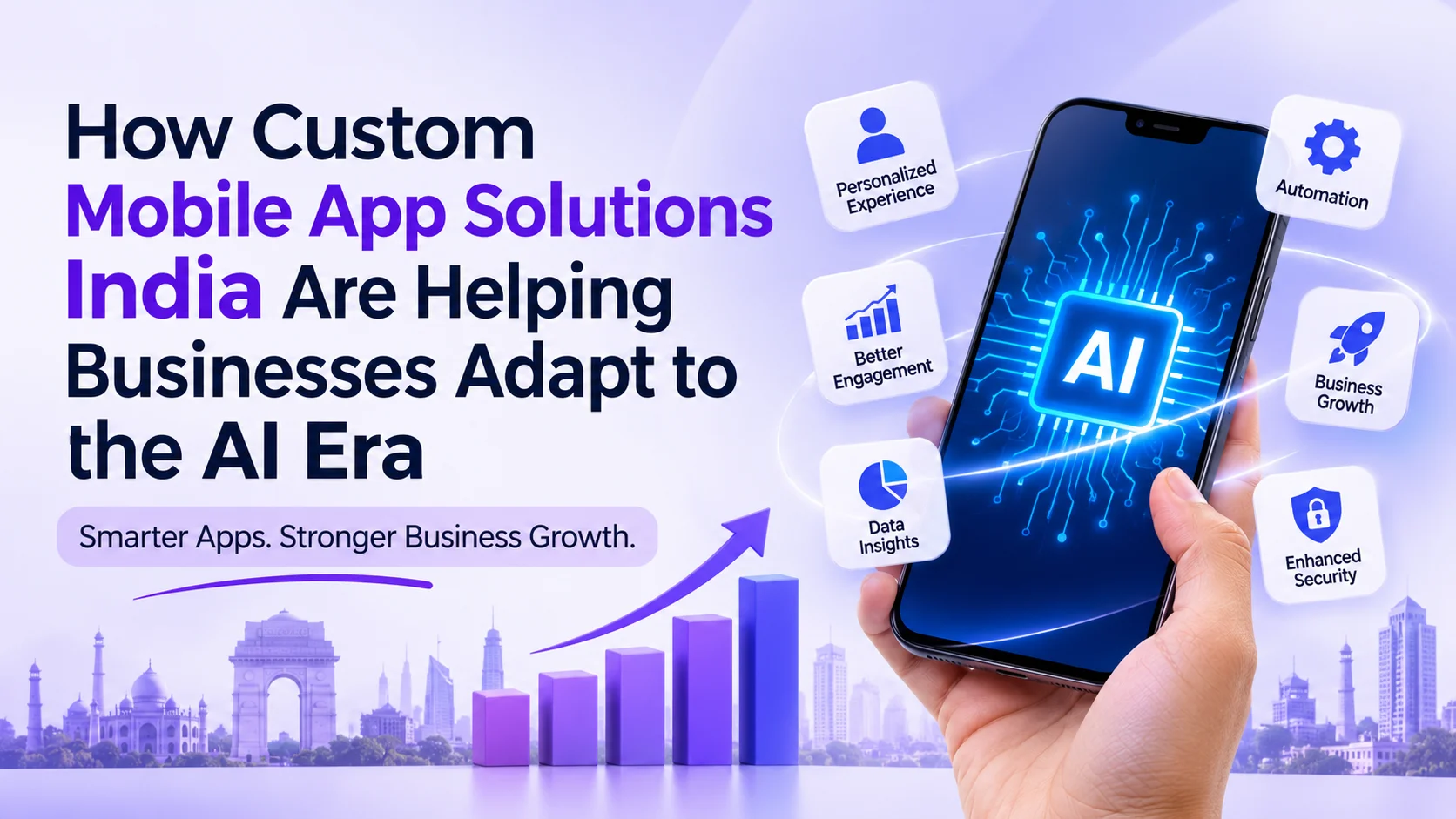
Think about a business that receives hundreds of customer messages every day. Its team spends hours answering the same questions, checking order details, and forwarding requests to different departments. A basic mobile app can bring these activities into one place, but a thoughtfully designed AI feature can take things further by sorting requests, suggesting responses, and helping customers find information faster.
This is the practical shift businesses are exploring: not adding AI for appearance, but using it to remove everyday friction. The momentum is visible in India. A February 2026 Press Information Bureau release, citing the NASSCOM AI Adoption Index, reports that 87% of Indian enterprises are actively using AI solutions. That figure covers enterprise AI adoption broadly, not mobile apps alone. The government's overview of AI adoption in India provides useful context.
For companies planning their next digital product, custom mobile app solutions India can offer a way to connect AI capabilities with specific workflows, customer expectations, and business goals. The real value comes from choosing the right features, designing them around users, and making sure they work reliably after launch.
1. Why Are Businesses Moving Towards Custom AI-Powered Apps?
Off-the-shelf applications are useful for standard tasks, but they may not fit every business process. A growing retailer, healthcare provider, logistics company, or education platform can have very different requirements.
A custom application is designed around those requirements. AI can then be added where it makes a measurable difference.
For example:
- A retail app can recommend products based on browsing patterns and stated preferences.
- A logistics app can help identify delivery delays using available shipment data.
- An education app can suggest practice material based on a learner's progress.
- A service business can use an AI assistant to classify customer queries and direct them to the right team.
The advantage of custom mobile app solutions India is that the features can be planned around the actual way a business operates, rather than forcing employees and customers to adjust to a generic system.
2. Personalised Experiences That Feel More Relevant
Customers do not always want more notifications or a longer list of features. They want an app that understands what they are trying to do.
AI-powered recommendation systems can analyse permitted user activity, preferences, and past interactions to make relevant suggestions. An online fashion store, for instance, could organise products around a customer's selected style, size, or browsing interests.
Personalisation can also improve search. Instead of requiring users to enter an exact product name, an app could understand a phrase such as "comfortable shoes for daily walking" and return relevant options.
However, personalisation needs sensible limits. Businesses should explain how user data is used and provide appropriate controls. Recommendations should help people discover useful options, not make the app feel intrusive.
A capable development partner will treat personalisation as a user-experience decision, not just a model integration task. This is one area where custom mobile app solutions India can be shaped to match a brand's audience and customer journey.
3. Automating Repetitive Work Across Business Operations
Many business processes involve repeated actions: entering information, checking records, assigning requests, and preparing routine updates. These tasks can consume time that employees could spend on more valuable work.
AI can support automation when it is connected to reliable business data and clearly defined actions.
Consider a field service company. When a customer submits a maintenance request, an AI-assisted workflow could identify the type of issue, collect missing details, and suggest the appropriate service category. An employee can review the information before a technician is assigned.
For a business with several departments, custom mobile app solutions India can bring these workflows into a single interface. Staff can view tasks, receive updates, and access relevant information without switching between disconnected tools.
Automation should still include human approval for important actions. AI can make suggestions, but businesses need clear rules for decisions involving payments, sensitive records, or customer commitments.
4. Smarter Customer Support Through AI Assistants
Customer support is another area where AI can make mobile applications more useful.
An in-app assistant can answer common questions about order status, account settings, appointment details, or service availability. It can also collect information before passing a complicated request to a human support representative.
For example, a travel application could help a customer find a booking reference, explain cancellation steps, and direct them to an agent when the request requires individual attention.
A useful assistant should be connected to approved information sources. If it cannot verify an answer, it should say so rather than inventing details.
Businesses should also measure whether the assistant actually helps. Useful indicators include successful self-service sessions, escalation rates, response times, and customer feedback. These measures show whether custom mobile app solutions India are improving support or simply adding another interface.
5. Making Better Use of Business Data
Most businesses already collect information through sales, customer service, inventory, subscriptions, or employee activity. The difficulty is often turning that information into decisions.
AI can help identify patterns, classify information, and generate summaries that make large datasets easier to understand.
A restaurant chain, for instance, might use historical orders and seasonal patterns to support demand planning. A retail business could identify products that are frequently viewed together. A service company might review support requests to find recurring customer problems.
These features depend on data quality. Incomplete records, inconsistent labels, outdated information, and duplicated entries can lead to unreliable results.
Before adding predictive features, businesses should review the information they have, decide who can access it, and establish how it will be maintained. Strong data foundations make custom mobile app solutions India more useful over time.
6. Choosing the Right Mobile Technology for AI Features
AI is only one part of a successful application. The underlying mobile architecture still needs to support performance, usability, security, and maintenance.
The choice between native app development and hybrid app development depends on the product.
Native development can be appropriate when an app needs platform-specific capabilities, intensive device processing, or detailed control over Android and iOS experiences.
Hybrid development can be suitable when a business wants to share more code across platforms and maintain a consistent experience with a defined development budget.
A project may also need:
- Android app development for the features and devices in its target market.
- iOS app development to support Apple's platform and its development requirements.
- Enterprise app development for internal workflows, employee access, and business-system integrations.
- Secure APIs and cloud services to connect the app with external data and AI models.
An experienced mobile application development company should explain these trade-offs before development begins. The best architecture is the one that supports the product's real requirements, not simply the one with the most fashionable technology.
7. On-Device AI and Cloud AI: Which Approach Makes Sense?
AI processing does not always need to happen on a remote server.
On-device AI runs supported models directly on compatible phones. It can be useful for certain tasks where privacy, responsiveness, or limited connectivity matters. Cloud AI can handle more demanding workloads and provide access to models that may be too large to run locally.
Google's Android documentation describes Gemini Nano and ML Kit capabilities for on-device generative AI. Its Gemini Nano developer guide also explains that device capabilities and model limitations matter when selecting this approach.
A practical example is a notes app that summarises short text locally, while sending a more complex request to a cloud model when needed. A hybrid design can use both approaches, provided the app handles data and network transitions carefully.
When planning custom mobile app solutions India, businesses should consider device compatibility, model performance, connectivity, data sensitivity, and usage costs before choosing where AI should run.
8. Security, Privacy, and Responsible AI Cannot Be Afterthoughts
AI-powered features may process personal details, business documents, location information, or customer conversations. This creates responsibilities that need to be addressed during planning and development.
A reliable development process should include:
- Collecting only the data needed for a defined purpose.
- Protecting information during transmission and storage.
- Reviewing third-party AI providers and their data-handling terms.
- Applying role-based access controls.
- Explaining data use and consent clearly.
- Testing AI outputs for unsafe or misleading responses.
- Providing a way to report problems or reach human support.
Businesses should be especially careful with healthcare, finance, and other sensitive applications. AI-generated suggestions should not replace qualified human decisions where professional judgement is required.
Responsible custom mobile app solutions India should make these safeguards part of the product architecture, not features added after a problem appears.
9. How to Choose the Right Development Partner
Selecting a development partner requires more than comparing project estimates. Businesses need a team that understands both mobile engineering and the practical limits of AI.
When evaluating mobile app developers India, ask questions such as:
- Have they built applications with AI integrations or data-driven features?
- Can they explain why a particular model or service suits the use case?
- How will they protect user information?
- What testing will be performed before release?
- How will AI usage costs be monitored?
- What support is available after launch?
Review the team's approach to discovery, design, development, testing, deployment, and maintenance. Ask for examples of technical decisions they have made, not just screenshots of completed apps.
A dependable app development company India should be willing to explain limitations and suggest a simpler solution when AI is not necessary. That kind of advice can prevent unnecessary complexity and expense.
10. What Should Businesses Plan Before Starting an AI App Project?
Before requesting proposals from mobile app development services India, define the problem the app should solve.
A short planning exercise can make the project more focused:
- Identify the user: Who will use the app—customers, employees, partners, or a combination?
- Choose one priority problem: Start with a workflow or customer issue that can be clearly described.
- Review available data: Check whether the business has enough accurate information for the proposed AI feature.
- Define success: Decide which measurable outcome matters, such as reduced manual processing time or improved support resolution.
- Plan for exceptions: Decide what the app should do when the AI is uncertain, unavailable, or incorrect.
- Estimate ongoing costs: Include hosting, model usage, maintenance, security, and future improvements.
Starting with a focused feature is often more practical than trying to make every part of an application AI-powered from day one.
Conclusion
AI is changing what businesses can expect from mobile applications, but successful adoption starts with understanding people and processes. A recommendation engine, automated workflow, or intelligent assistant is valuable only when it makes an actual task easier, faster, or more useful.
Well-planned custom mobile app solutions India help businesses connect AI with their existing operations while keeping usability, security, and scalability in focus. The right development partner will help identify where AI makes sense, select suitable technologies, and build an application that can improve as business needs evolve.
Rather than adding every new AI feature at once, businesses should begin with one clear problem, test the solution with real users, and expand based on measurable results.
FAQs
Q1. What are custom mobile app solutions?
Ans. Custom mobile app solutions are applications designed around a business's specific requirements, customers, and workflows. They can include features such as AI recommendations, automated processes, payment integrations, analytics, and customer support tools.
Q2. How can AI improve a business mobile app?
Ans. AI can help personalise recommendations, understand natural-language searches, classify customer requests, summarise information, and identify patterns in business data. The right feature depends on the problem the business wants to solve.
Q3. Are AI-powered mobile apps expensive to develop?
Ans. Costs depend on the app's complexity, platform requirements, AI model, data infrastructure, integrations, and maintenance needs. A focused first release with one useful AI feature may be more cost-effective than building a large system immediately.
Q4. Can small businesses benefit from custom mobile app solutions India?
Ans. Yes. Small businesses can start with practical features such as an AI-assisted FAQ tool, product recommendations, appointment management, or automated request classification. The feature should address a real business need and fit the available budget.
Q5. Should businesses use on-device AI or cloud-based AI?
Ans. On-device AI can suit supported tasks that benefit from local processing, while cloud AI is useful for more demanding models and workloads. Some applications combine both, depending on device compatibility, privacy requirements, connectivity, and cost.
Q6. How do businesses choose a mobile app development company for AI projects?
Ans. Look for experience in mobile development, AI integration, data security, API development, testing, and post-launch support. Ask the team to explain its proposed architecture, expected costs, limitations, and how it will measure the feature's success.