Sign up with Google
 Sign in with Zoho

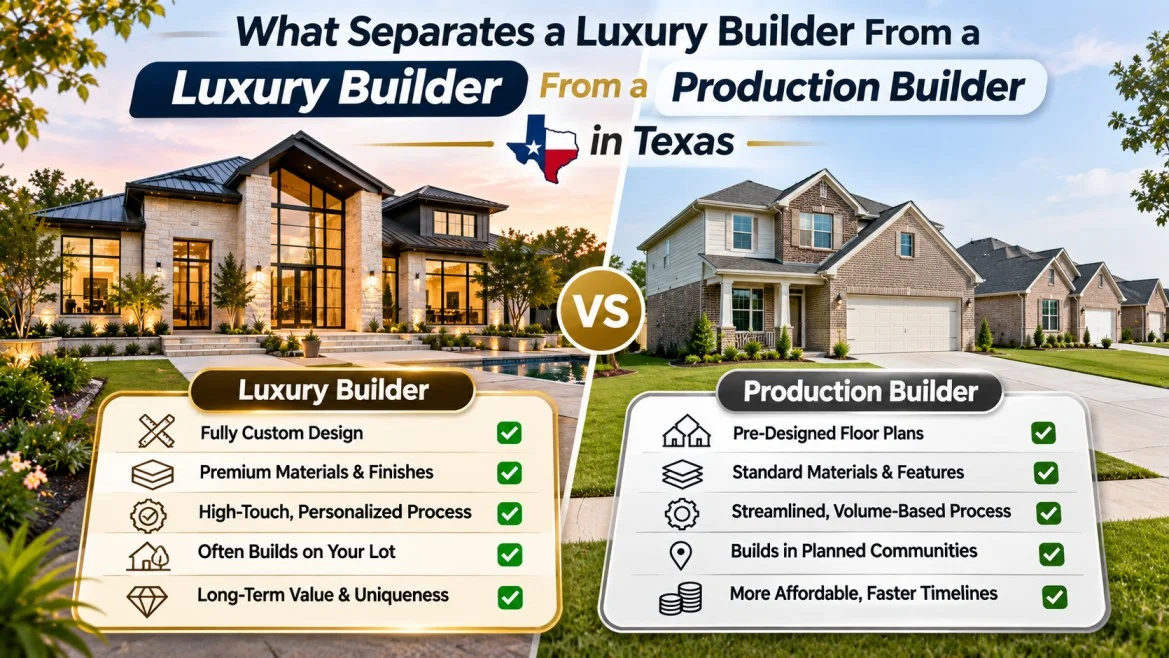
A production builder and a luxury builder can both deliver a 4,000-square-foot home in Texas. They can even use some of the same materials. But the way each company gets to the finished house is so different that the experience, the risks and the result are not comparable.
If you are deciding between them, the label on the sign matters less than how the company works. This guide explains the real differences, where each one makes sense, and how to tell which type of builder you are actually talking to.
The Business Model Is the Biggest Difference
Production builders run on repetition. They design a library of floor plans, buy materials in volume, use the same crews in the same communities, and build many homes at once. That system is why they can offer a predictable price and schedule.
Luxury builders run on one-of-a-kind projects. Each home is designed around a specific client and lot, so every project needs its own plans, engineering, material sourcing and trade coordination. They build far fewer homes per year, and the people who sold you the project are usually the same people managing it.
Neither model is better in every case. They solve different problems. The mistake is expecting one to behave like the other.
1. Design: Choosing a Plan vs. Creating One
In production building, you typically choose from existing plans and select options such as elevations, finishes and upgrades. Changes to the structure are limited, because every change disrupts a repeatable system.
A luxury builder usually starts with you, your lot and how you live. An architect or designer develops a plan that fits the site, orientation, views and lifestyle, then the builder helps refine it for cost and buildability.
The practical difference: with a production home, the plan fits many buyers. With a luxury home, the plan fits you.
2. Engineering and Structure
This is where the gap is least visible and most important.
Production homes are usually built from standard structural details, with foundations and framing that follow proven templates. That works well for typical floor plans on typical lots.
Luxury homes tend to push beyond the template: long open spans, tall ceilings, large glass walls, heavy stone, cantilevers and complex rooflines. These features need project-specific structural engineering. In Texas, they also need a foundation designed for the actual soil, not an assumed one.
Expansive clay, rock, slope and drainage can all change what the foundation should be. A builder who treats engineering as a design input, not an afterthought, is a sign you are dealing with a true luxury operation.
3. Materials and Finishes
Production builders offer curated packages. Selections are usually made from a design center, with set options for cabinets, flooring, countertops and fixtures. This keeps pricing predictable and installation efficient.
Luxury builders work with a much wider palette: natural stone, custom millwork and cabinetry, specialty metals, high-end appliances, bespoke lighting and imported or made-to-order materials. Many of these have long lead times and require careful coordination.
The point isn't that expensive is always better. It is that luxury building requires the ability to source, schedule and install materials that fall outside a standard catalog.
4. Trades and Craftsmanship
Production builders rely on repeatable subcontractor teams trained to build a limited set of plans. That efficiency can produce consistent quality when the work is standard.
Luxury homes demand skilled specialists: finish carpenters, masons, stone fabricators, high-end tile setters, and trades who are comfortable solving unusual details on site. The builder's relationships with those trades, and how closely they supervise the work, strongly affect the final quality.
Ask how a builder selects trades, how long they have worked together, and who inspects the work at each stage.
5. Process and Pricing
How the contract works also differs.
- Production builders generally offer a fixed price for a defined plan with listed options. The buyer knows the price early, but has less control over details.
- Luxury builders often work on a more collaborative basis. Pricing may be fixed or cost-plus, and it develops as the design is finalized. This gives more flexibility, but requires more attention to allowances, selections and change orders.
In luxury building, the budget is shaped throughout the design phase. That means early decisions, careful documentation and clear communication matter more.
6. Timeline and Pace
Production homes tend to move faster because the plans, materials and crews are standardized. Schedules are often more predictable.
Luxury homes usually take longer. Design, engineering, permitting, material lead times and detailed finishing all add time. The upside is that the schedule is built around quality, not volume.
A useful rule: be wary of a luxury builder promising a production-builder timeline, and of a production builder promising luxury-level customization.
7. Accountability and Service
On a production job, you may deal with a sales representative, a design center, a construction manager and a warranty department, each handling one phase. This works, though it can feel impersonal.
A luxury builder typically offers more direct access to the people running your project, such as the owner, project manager or superintendent. Because they are building fewer homes, their reputation depends on each one.
Whichever you choose, read the warranty. Ask what is covered, for how long, and whether a third-party company backs it so coverage does not depend on the builder staying in business.
8. The Lot and Site Work
Production builders typically build on lots they have prepared in their own communities, which keeps site conditions predictable.
Luxury builders frequently work on a client's land, which can mean sloped terrain, trees, rock, water, limited access or views to preserve. Site work such as grading, retaining walls, drainage and utilities can become a major part of the project.
This is also why land evaluation belongs ahead of design when you are building a luxury home. The lot decides what is possible.
So Which One Do You Need?
Choose a production builder if you want:
- A faster, more predictable schedule and price
- A home in an established community
- A proven plan with a limited set of choices
- A lower level of personal involvement
Choose a luxury builder if you want:
- A home designed around you and your land
- Complex architecture or high-end materials
- Project-specific engineering
- Direct access to the people building your home
- The flexibility to shape the home as it develops
Some buyers fall in between, and semi-custom builders can fit that need. The key is to be honest about what you need and choose a company that works that way every day.
How to Tell What Type of Builder You're Talking To
A few simple questions reveal how a builder actually operates:
- How many homes do you build in a year? Large numbers usually mean a production model.
- Do you build from your own plans or from mine?
- Who is the structural engineer, and how involved are they?
- How do you handle selections that aren't in your standard catalog?
- Who will manage my project day to day?
- Can I see a project that is finished and one that is under construction?
- How do you handle change orders?
Specific, confident answers show real experience. Vague answers about "quality" and "attention to detail" do not.
Where to Look Next
If you are exploring the market, a list of luxury home builders in Texas can help you see who works at this level in your region. Use it as a starting point, then apply the questions above and speak to past clients before you decide.
Final Thoughts
Production and luxury builders are built to solve different problems. One delivers a proven home efficiently. The other creates a home designed around you, with the engineering, materials and craftsmanship to match.
The right choice is not the more expensive one. It is the one whose process matches what you actually want to build. Ask how the company works, not just what it builds, and you will know which one you are dealing with.